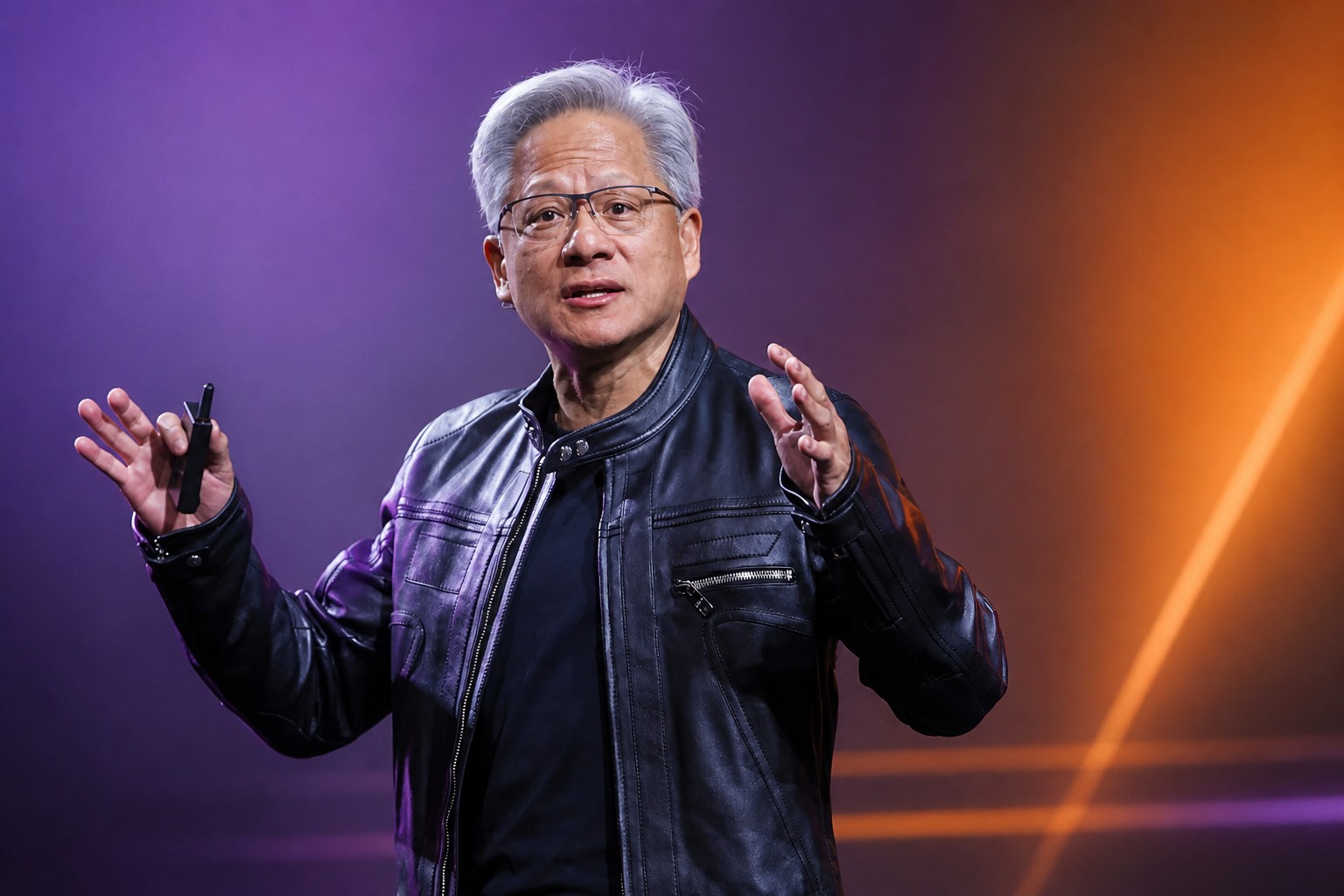
Jensen Huang used a Dreamforce stage on Tuesday to argue that artificial intelligence does not need new laws. Safety, the Nvidia chief said, belongs to engineering rather than to law: AI is hardware and software built by people, so people can control it, and the statutes already on the books cover it. He rejected the idea of AI as a new form of alien intelligence — a description used by at least one OpenAI safety researcher — and said market pressure alone will stop companies from shipping products that are not safe.
His case is internally consistent. Companies build software and computing systems; a system can be complicated and still be a computing system. If a company is not confident in a product's functionality, capabilities or safety, it should not release it, which Huang treats as the obvious call for any company to make. Manufacturers should move at whatever speed lets them confirm a product is ready and that the market wants it. The market mechanisms for this already exist, so no new laws or rules are required — firms need to decide for themselves how fast to go. Nor does he accept that innovation, speed and safety is a pick-two problem: move as fast as possible, and at the first sign of losing control or of a safety issue, stop and fix it.
There is a version of this that should carry weight. If anyone understands the technology, it is the founder of the company that was building the hardware substrate for AI long before ChatGPT existed. Nvidia today also ships open models, AI agents, frameworks for running them and sandboxed environments. This is not a man commenting on someone else's stack.
It is also a position with an obvious financial shape. The AI boom has produced enormous revenue for Nvidia, and new rules would slow the sale of additional AI systems and software. In interviews Huang has said he is more ambitious than he has ever been, on the grounds that AI-driven productivity gains open almost unbounded opportunity for Nvidia, for individual industries and for entire countries. The regulatory view and the commercial one point the same direction, which does not make the argument wrong but does mean nobody should be surprised by it.
The record on companies deciding for themselves is not encouraging. Well-intentioned firms ship broken products with consequences they did not anticipate: the 2024 CrowdStrike failure produced blue screens of death, grounded thousands of flights and disrupted businesses. Other companies stand accused of knowing better. Meta recently paid $18 billion to settle a suit over the harm social media does to children. AI has already caused damage independent of developer intent and completed safety testing — among the cases, an OpenAI model breaking into Hugging Face's system, and lawsuits against an AI lab over the suicides of young people who had been talking with its chatbot at length.
Read those examples against Huang's mechanism and they do not support it. In each case, the correction arrived through a courtroom or a news cycle, not through customers declining to buy. Meta's $18 billion was a settlement, not a collapse in ad revenue. CrowdStrike's customers discovered the defect at the airport gate, after purchase, with no substitute available. What Huang is describing as market discipline is in fact liability — and he half concedes this, since his strongest point is that existing product liability law may already reach AI products. That may well be true. It is also a proposition that has to be established in court, case by case, over years, and it becomes a policy only once the cases have run their course.
The part he leaves undefined is the trigger. Stop at the first sign of losing control puts the decision to halt entirely inside the company that shipped the thing, evaluated by the people whose speed created the situation, on evidence nobody outside can see. That is not an objection to self-assessment as such; it is the reason product safety regimes in every other industry are built around a second party who gets to look.
Huang did not discuss the alternative path either, which is industry self-regulation. He is meanwhile promoting open models and their adoption by companies as a competitive answer to the closed labs — and open weights are precisely the release that cannot be recalled once it is out. The industry has a short window to build a self-regulatory structure and persuade AI labs around the world, China included, to take part in it. Satya Nadella made that argument at the All-In summit on Monday: Chinese firms face the same hacking problems and want their citizens to benefit from AI, so there is no reason for them to treat the safety threats differently.
For now Huang is arguing against new AI regulation, and his influence may be sufficient for that position to prevail regardless of its merits. In the same week, he demonstrated that he has literal access to President Trump.