One model, several predictions
JEPA models predict an abstract representation of a missing or future state rather than reconstructing raw data such as pixels. JEPA-Anything divides that prediction among separate modules, with a constraint intended to make each capture a different aspect of the data. The model combines their outputs into a whole.
The researchers do not assign meanings to the parts in advance; those roles emerge during training. For each field, they change only how the data is prepared.
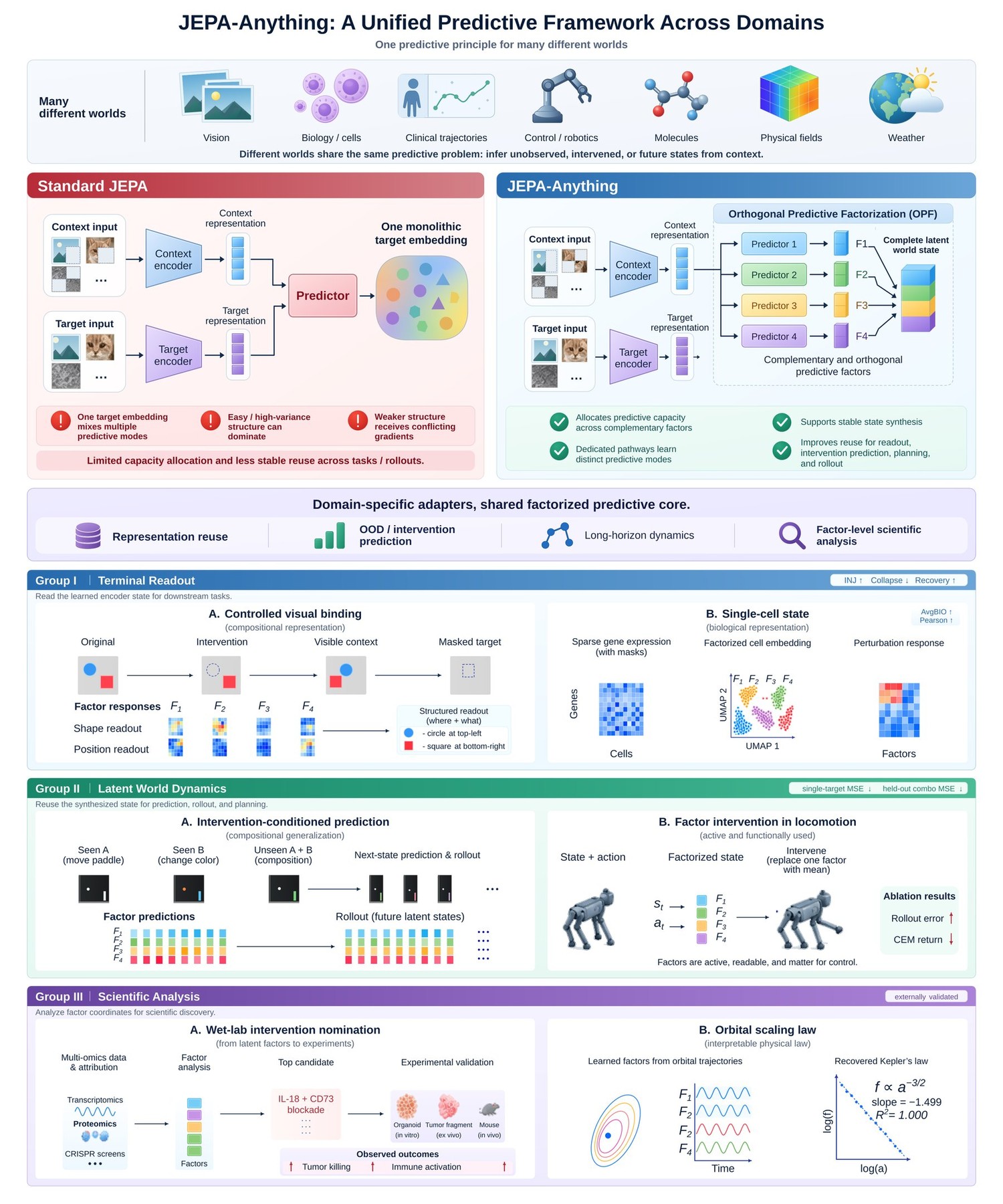
Unlike standard JEPA, JEPA-Anything splits the predicted state into four orthogonal factors, each with its own predictor, then reassembles them into a complete world state. | Image: Meta
Source: the-decoder.com
Where the gains appeared
The team compared JEPA-Anything with a standard JEPA of the same architecture, trained on the same data and under the same conditions. The clearest gains were in dynamic systems. In a simplified Pong environment with target interventions, prediction error fell by 35%. For combinations of interventions absent from training, it fell by 13%.
Across ten test tasks in physics, robotics and weather forecasting, the authors report that JEPA-Anything consistently outperformed the baseline. On the Burgers’ equation benchmark in fluid dynamics, its error was nearly halved. At a 50-step horizon, the advantage narrowed to about 3%. The model also did better in simulations of water, quartz, acetaminophen and benzene, even after 100 steps.
Results were more mixed elsewhere:
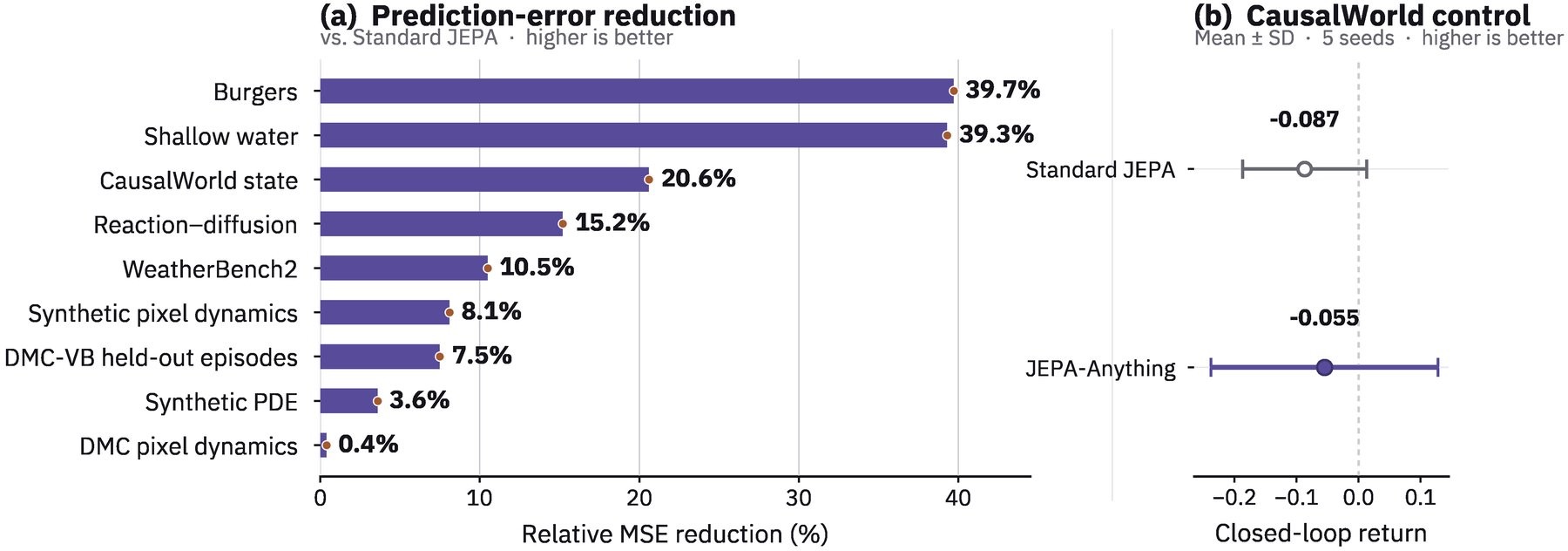
JEPA-Anything's biggest gains come on physical flow equations, while its edge over standard JEPA is barely measurable for pixel dynamics. | Image: Met
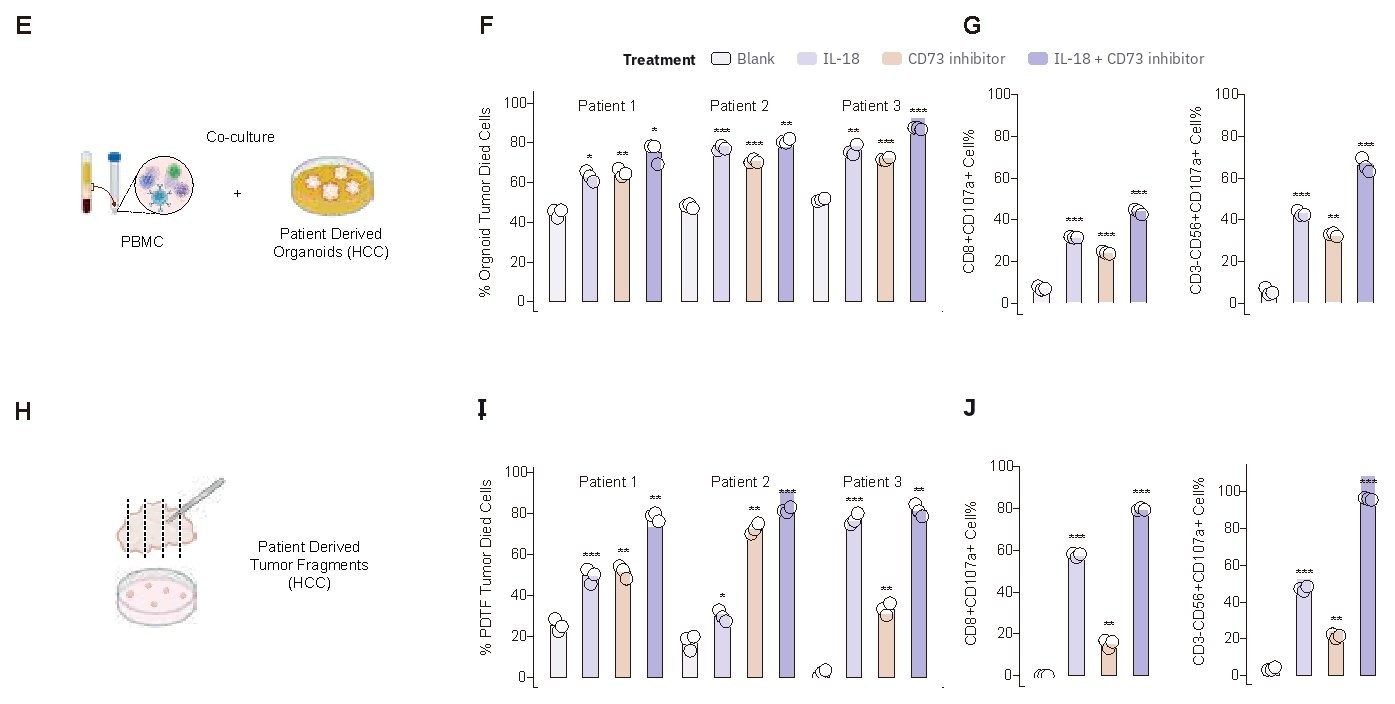
The model-proposed combination of IL-18 and CD73 blockade killed the most cancer cells and activated the most immune cells in organoids and tumor fragments. | Image: Meta
Source: the-decoder.com
Source: the-decoder.com
A biological lead, not a treatment
The paper’s most striking claim is that the model’s learned predictions pointed to a possible liver-cancer strategy: combine IL-18, a signaling molecule that activates immune cells, with inhibition of CD73, an enzyme tumors use to suppress immune responses in surrounding tissue.
Researchers tested the combination in liver-cancer cells grown with immune cells, organoids, tumor tissue from three patients and mice. In organoids and tissue samples, the combination killed more tumor cells than either IL-18 alone or CD73 inhibition alone. T cells and natural killer cells also showed stronger activation. The study does not establish that the combination will become a real treatment.
The team also trained the model on simulated orbits without providing physical quantities. One training run produced a pattern close to Kepler’s third law: the model’s exponent was −1.4991, compared with the law’s −1.5. But the researchers ran training only once and selected the run with the lowest error. That makes the result intriguing, not a demonstration that the model reliably discovers physical laws.
What the model still cannot tell us
I think the key caveat is not whether the model can split predictions into distinct parts, but whether those parts correspond to real causes. The authors explicitly warn that clear separation does not establish causal relationships. They also say it remains unclear when the model will be reliable enough to help plan experiments.
That gap matters because the longer-term ambition is an AI agent that proposes and ranks experiments, then feeds the results back into the model. The code and models are publicly available, but the paper does not show that this loop works in practice.
The approach sits within a growing effort to make world models useful beyond a single domain. LeCun proposed JEPA in 2022 as an alternative to generative models. Meta released the 1.2-billion-parameter video model V-JEPA 2 in June 2025; it controlled robotic arms in unfamiliar conditions without additional training. In November 2025, LeCun and Randall Balestriero introduced LeJEPA, a theoretical framework intended to make training stable without familiar workarounds. LeCun is now developing the approach at AMI Labs, which raised more than a billion dollars in March 2026 to build world models.
Google DeepMind offers a useful comparison on the scientific side. In October 2025, its C2S-Scale 27B model, based on Gemma, proposed silmitasertib as a way to make tumor cells more visible to the immune system; experiments on human-cell models confirmed the prediction. Its Co-Scientist system can plan experiments and operate lab equipment, covering part of the research loop JEPA-Anything’s team wants to build. People still have to load the samples.
The tension is clear: JEPA-Anything’s results reach across fields, but breadth is not the same as dependable scientific judgment. Its next test is whether the learned parts can guide repeatable experiments, rather than merely produce promising patterns after the fact.
Daily AI news
Every day we pick what actually matters in AI and explain it plainly — no hype, no filler. Subscribe if you want to follow where the industry is going.
Only what matters — every day
Follow on X