
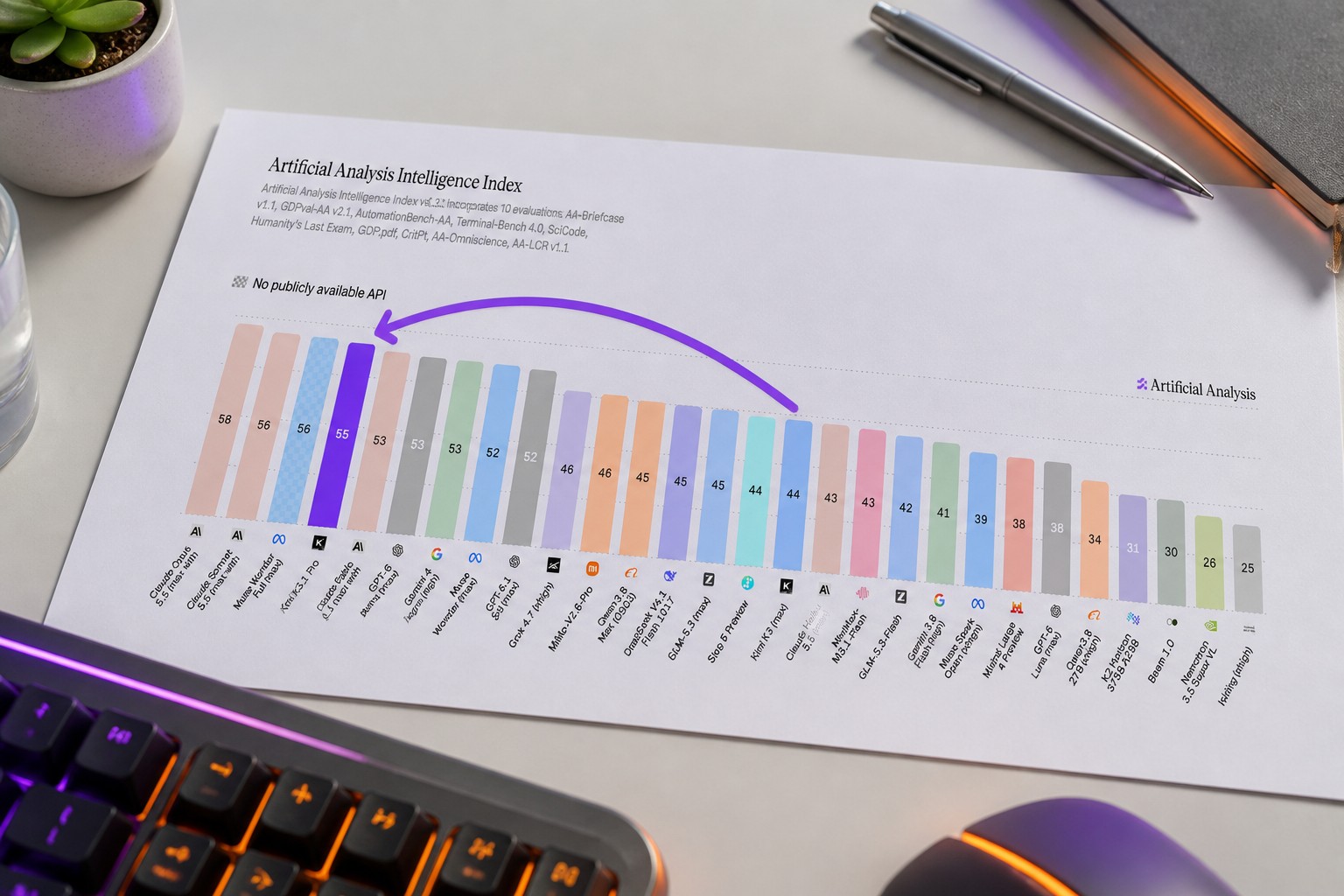
The benchmark gains are uneven
K3.1 Pro’s strongest reported results are on agent benchmarks. It scored 1,846 Elo on GDPval-AA, behind only Claude Opus 5.5 and Muse Wonder Full. On Terminal-Bench 4.0, Moonshot reports 65.7%, just below Opus 5.5’s 66.4% and above GPT-6 Astra’s 58.2%. K3 scored 13% on that test.
Moonshot also reports a drop in claim-level hallucinations on its Kimi Hallu Bench Hard, from 23.4% for K3 to 8.3% for K3.1 Pro. The company cautions that the test does not measure overall error rates. GPT-6 Astra scored 5.5%, better than K3.1 Pro on this measure.
Other reported gains include 7.2 points on Financial Modeling and 11.6 on Financial Research. Moonshot says K3.1 Pro outperformed all tested models on OfficeQA Pro v2.
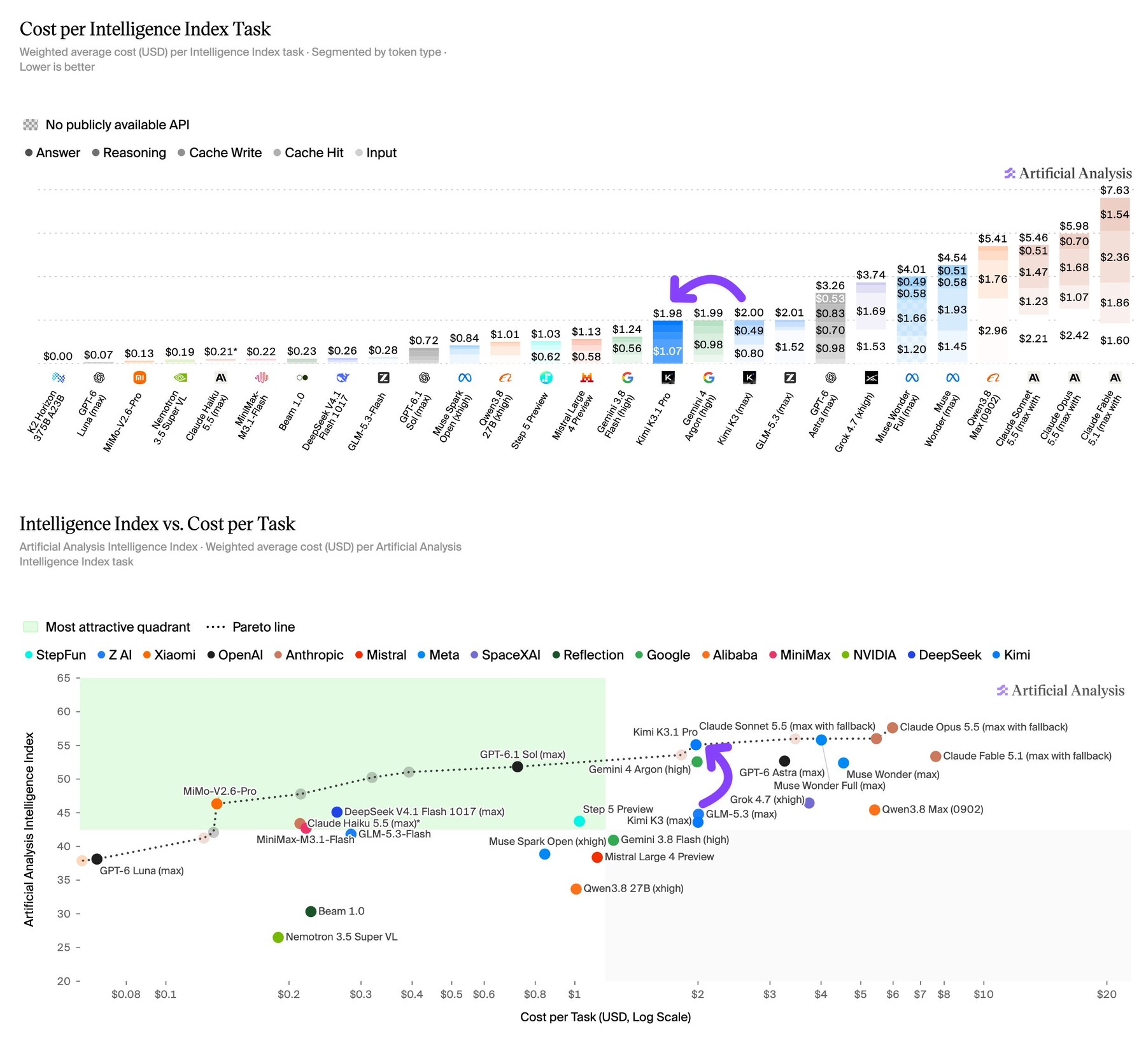
Kimi K3.1 Pro delivers much higher performance than Kimi K3 at slightly lower cost per task ($1.98 vs. $2.00), placing it on the Artificial Analysis Pareto line. | Image: AA
Source: the-decoder.com
A model built to use tools
Moonshot says K3.1 Pro can work directly with Unity, Unreal Engine and Godot, making quick fixes and building complete projects. On BenchCAD, it scored 92.7% with tools, close to Claude Opus 5.5 at 96.2% and GPT-6 Astra at 95.9%. Without tools, it scored 72.8%, just below Opus 5.5’s 73.0%.
The company says the model is strongest at parametric modeling for mechanical parts, architecture and customizable products. It can write and run scripts for Blender and computer-aided design software without MCP connections. Moonshot has also launched 3D Make on Kimi.com, where users can view, edit and export 3D models.
The model’s scale is unchanged from K3: 2.8 trillion parameters, with 104 billion active, and a context window of one million tokens. It handles both text and images. Artificial Analysis places it near the upper edge of the Pareto frontier, saying no model with a comparable parameter count scores higher on its Intelligence Index.
Lower prices, with a cost caveat
Token prices are down 33%. A million input tokens now costs $2, down from $3; a million output tokens costs $10, down from $15; and cached input costs $0.20, down from $0.30.
Yet an Intelligence Index task costs $1.98, almost unchanged from K3’s $2. Moonshot attributes that to K3.1 Pro generating 14% more output tokens. The faster K3.1 Pro Highspeed version, released alongside it, is reported to run two to three times faster. Both models are available through Kimi.ai, Kimi Work, Kimi Code and Kimi API.
I think the most consequential part of this launch is not the three-point gap to Opus 5.5, but the combination of a planned open-weight release and lower prices. The qualification is that the benchmark lead is conditional: the ranking could change before the planned release, and Moonshot’s own results account for much of the detailed performance picture.
The open-weight safety trade-off
Moonshot says it removed cybersecurity data from both intermediate training and reinforcement-learning environments before releasing the model. The company says greater training compute had increased the model’s ability to find vulnerabilities. Its xdev-bench-hard test covers recently disclosed flaws in software including the Linux kernel, Node.js and JavaScriptCore.
The version trained without that data solved 90.5% of the test’s tasks; K3.1 Pro after data removal solved 81.0%. DeepSeek-V4.1-Flash scored 85.7%, while Kimi K3 scored 33.3%.
Moonshot argues that open-weight models should not reach the absolute limit of cyberattack capability, while still gaining capabilities useful for defense, such as auditing legacy systems. Anthropic has previously shown that GLM-5.3, despite scoring 45 on the Artificial Analysis Intelligence Index, could write exploits at a level close to Claude Mythos. That tension will follow K3.1 Pro into any open release: reducing offensive capability is a stated goal, but the benchmark results show how much capability remains.
Source: the-decoder.com
Daily AI news
Every day we pick what actually matters in AI and explain it plainly — no hype, no filler. Subscribe if you want to follow where the industry is going.
Only what matters — every day
Follow on X