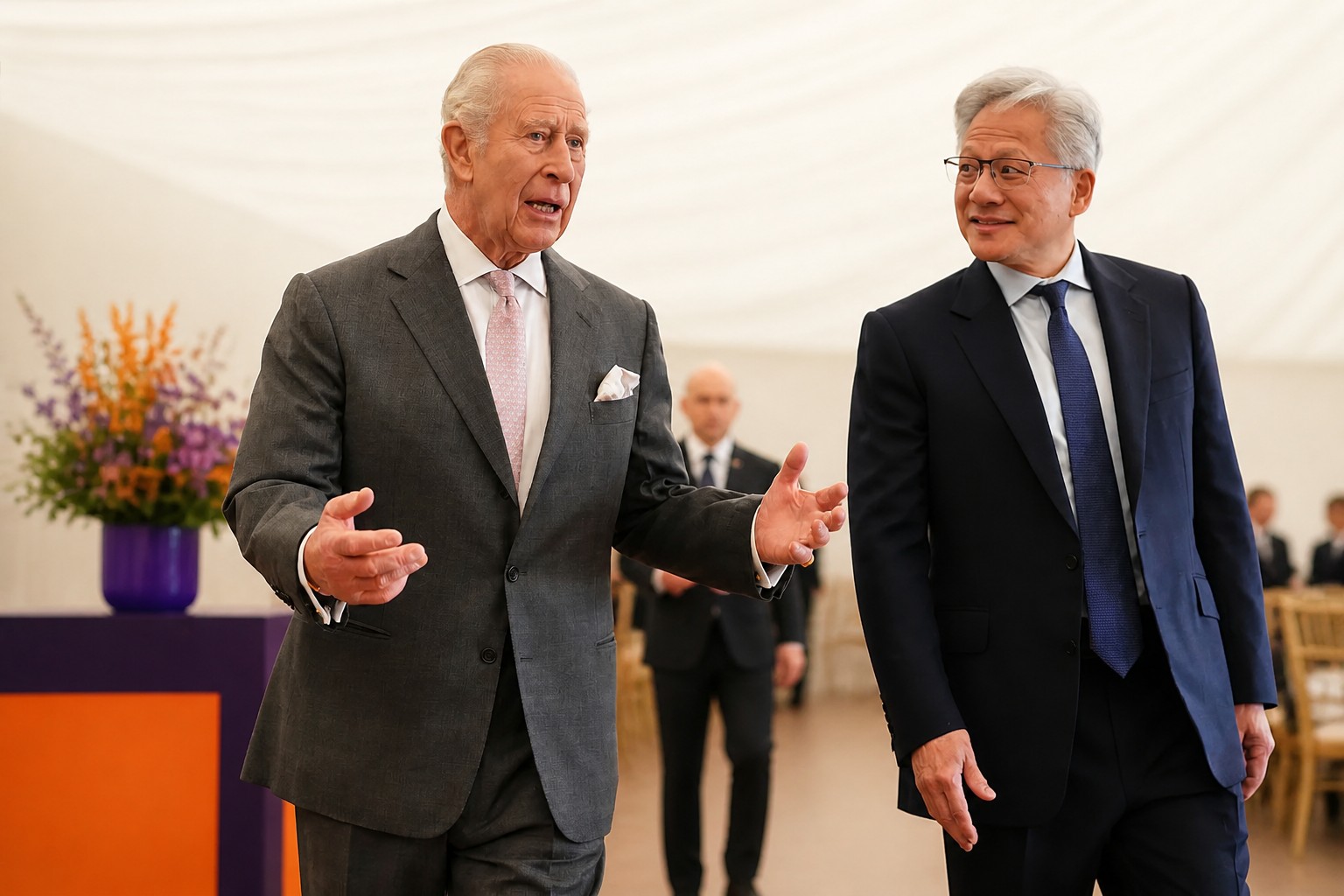
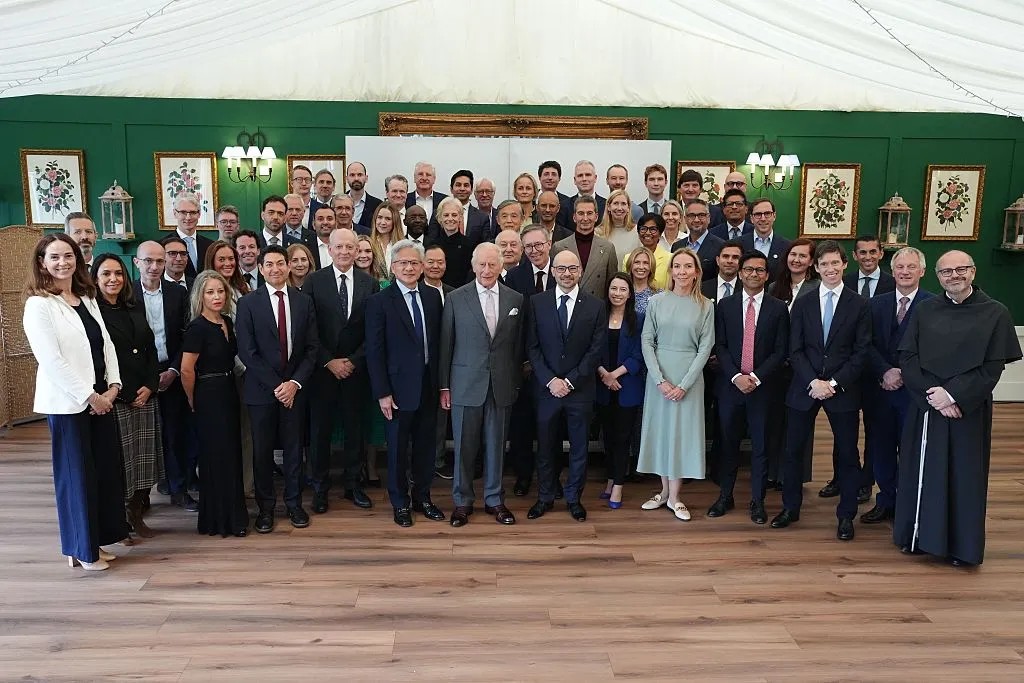
King Charles III spent about 20 minutes on Thursday telling a room that included Jensen Huang of Nvidia, the head of Britain's foreign intelligence service and the Pope's AI adviser that the industry needs to find a way to control AI before it is too late. The meeting was closed, held at Dumfries House, an 18th-century estate in Ayrshire owned by the King's charitable foundation. By constitutional convention, British royals keep clear of political subjects, and AI is currently one of the sharpest there is. That he spoke on it at all is part of the story. What he said was that the people building the technology now warn it may acquire the ability to take human lives.
The King's framing was double-edged. He noted that AI can already improve and save lives in medicine and science. He then set that against the warnings coming from the technology's own creators about darker capabilities, and described the pace of the technology, and what it contains, as both intriguing and deeply alarming.
The timing was not accidental. The summit came days after an Anthropic researcher resigned and wrote online that AI companies are racing to build machines far smarter than any human, and that humanity may not survive it.
Charles urged the room to think urgently about the "existential threats" that follow if the technology reaches the wrong hands and is used in ways with catastrophic consequences.
Source: techcrunch.com
He asked whether humanity has sufficient means of control, and whether it will be too late by the time they are applied. He closed by calling on the executives present to turn the useful side of AI toward the good of society, and to build international cooperation and a shared approach. Their task, he said, is not only to develop the technology but to keep it in the service of humanity, society and nature, and in adopting the new not to lose what holds its meaning over time.
The guest list was unusual enough to read as its own statement: Huang, the leadership of OpenAI and Anthropic, Kanishka Narayan, Britain's new AI minister, the head of British foreign intelligence, and Paolo Benanti, the Pope's adviser on AI. Charles left after roughly 20 minutes and the others carried on without him.
OpenAI sent its chief financial officer, Sarah Friar. Anthropic sent Tino Cuéllar, who handles the company's international relations. Asked for comment, Cuéllar said Anthropic was glad to take part and grateful to the King for convening industry leaders alongside representatives of different parts of society, and that the discussion covered AI's role in serving the public good.
The delegations say more than the speech does. OpenAI's attendance at a summit about controlling AI was handled by the executive whose brief is the initial public offering the company has just paused for this year, citing continuing safety concerns. Anthropic's was handled by its head of international relations, at a meeting where the King asked for international cooperation, shortly after the company restricted its Fable and Mythos models to users in the United States, a decision that surprised the European technology industry and pushed AI sovereignty up the agenda there. Both choices are legible. Neither is a chief executive.
Huang's presence has a sharper edge. Earlier this month Sam Altman of OpenAI, Elon Musk and Dario Amodei of Anthropic called for slowing AI development, and Huang and US President Donald Trump rejected the idea quickly. Trump's position is that the United States is ahead of China and is the most technologically advanced country in the world, that he intends to keep it there, and that whoever wins the AI race gains an advantage across the board. Huang then sat and listened to a head of state make the opposite case.
Charles has spoken about the promise and the problems of AI in 2023 and in 2024. What has changed since is not the monarch's view but the industry's: the argument for brakes now comes from the principals as well as from outside critics, which is why the same sentiment from Dumfries House registers differently than it did two years ago.
What the summit did not produce is a mechanism. The King asked whether the means of control exist; the room contained the people who would have to build them, including a sitting AI minister and an intelligence chief, and the only public account of the part of the meeting he did not attend is Cuéllar's description of a conversation about the public good. A closed meeting is a reasonable format for a hard subject. It is a poor format for an answer.
Charles asked whether it will be too late by the time anyone applies controls. He left after 20 minutes. The people who could answer stayed in the room.