

Christine Lagarde used a speech in Vienna to tell Europe it needs AI models of its own and data centers of its own, because the ones it depends on today sit outside its borders. The European Central Bank president put numbers behind the warning: last year the United States released 59 notable AI models and China 35, while France and the United Kingdom produced one each. The US holds 75% of the world's AI computing capacity. Europe holds 5%. Her argument is not that Europe should win the model race. It is that Europe should not be in a position where someone else can switch the technology off.

Source: theguardian.com
The models Lagarde described are deliberately modest in ambition. They should be efficient enough to handle most tasks, and they should run on European infrastructure. Investment in home-grown AI, she said, would strip the threat of a cutoff of its former force.
The scenario she sketched is not about chatbots. Within a few years, she said, AI may be checking goods at the border, selecting tax returns for audit, running train traffic, monitoring patients in hospital wards, and clearing payments in banks. Once that is true, losing access to AI systems — or simply seeing the terms of access rewritten — hits every sector at the same moment rather than one industry at a time.
That leads to the choice Lagarde framed as genuinely difficult. Hold back adoption to keep European data inside Europe, and the continent gives up the growth the technology carries with it. Adopt quickly, and it becomes heavily dependent on outside suppliers and risks losing the freedom to organize its economy according to its own values. Dependence of that kind, she argued, creates a trade lever of a sort none of Europe's partners has held before — one that could be pulled in any negotiation, over tariffs or digital taxes.
Lagarde was explicit about why this is a live question now rather than a hypothetical. The EU and the US remain key allies, but the Trump administration has already shaken that trust: she named the tariffs, the demands that Greenland — a largely autonomous territory within the Danish Realm — be handed to the US, and the withdrawal of American troops from Europe over political disagreements.
Against that, she offered the upside. Rapid AI adoption could raise productivity, the measure of how efficiently an economy converts inputs into output, by at most 4% over ten years — enough, in her estimate, to change the state of public finances noticeably.
Lagarde also called on Europe to build compute. The continent's data centers already fall short of domestic demand, and on current trends the shortfall grows more than sixfold over the next decade.
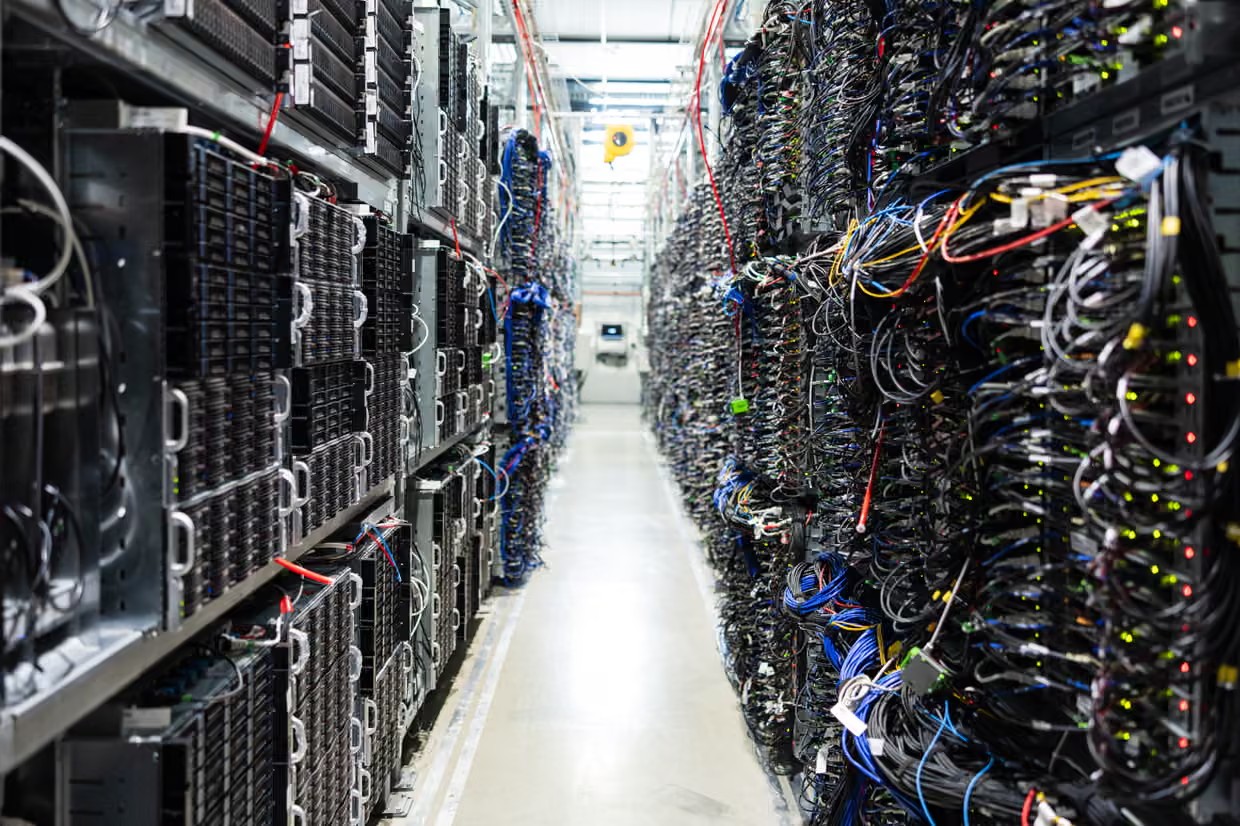
A data center operated by the French company OVHcloud in Roubaix — Lagarde wants Europe to have far more capacity of its own
Source: theguardian.com
Two details in the speech deserve more attention than the headline warning. The first is that 4% figure. It is a ceiling, not a forecast, and it covers ten years. A central bank president is proposing a continental infrastructure program on the strength of a maximum four-percent productivity gain over a decade — which tells you the case for building is defensive, not economic. The second is the standard she set for the models themselves: efficient enough to handle most tasks. That is a sufficiency test, and it concedes the frontier. Europe is not being asked to answer 59 American models with more than the one apiece that France and the UK managed; it is being asked to keep a working fallback so that losing access to the American and Chinese ones is survivable rather than catastrophic. That is a reasonable goal, but it is a different goal from the one the word "sovereignty" usually implies, and the speech does not draw the distinction.
What the speech does not contain is a number for what any of this costs, or a mechanism for paying it. Lagarde identified the gap, the risk and the timeline, and named no source of capital. That is a conspicuous omission from a speech that otherwise quantifies everything, and it is the part that decides whether the rest happens.
The closing section of her remarks is where the problem becomes uncomfortable. American technology companies' investment needs are now so large that some of them borrow in Europe, pushing up borrowing costs for everyone else by crowding them out of the debt market. European pension funds, meanwhile, hold substantial positions in American tech equities, so a correction in that market would reach European savings directly.
Read together, those two facts say something the rest of the speech does not. European capital is already financing the American compute buildout — through the bond market on one side and through pension portfolios on the other — while European borrowers pay more for credit as a result. The money to close the 75-to-5 gap is not missing. It is already deployed, on the other side of the Atlantic, in the infrastructure Lagarde says Europe cannot afford to depend on.