
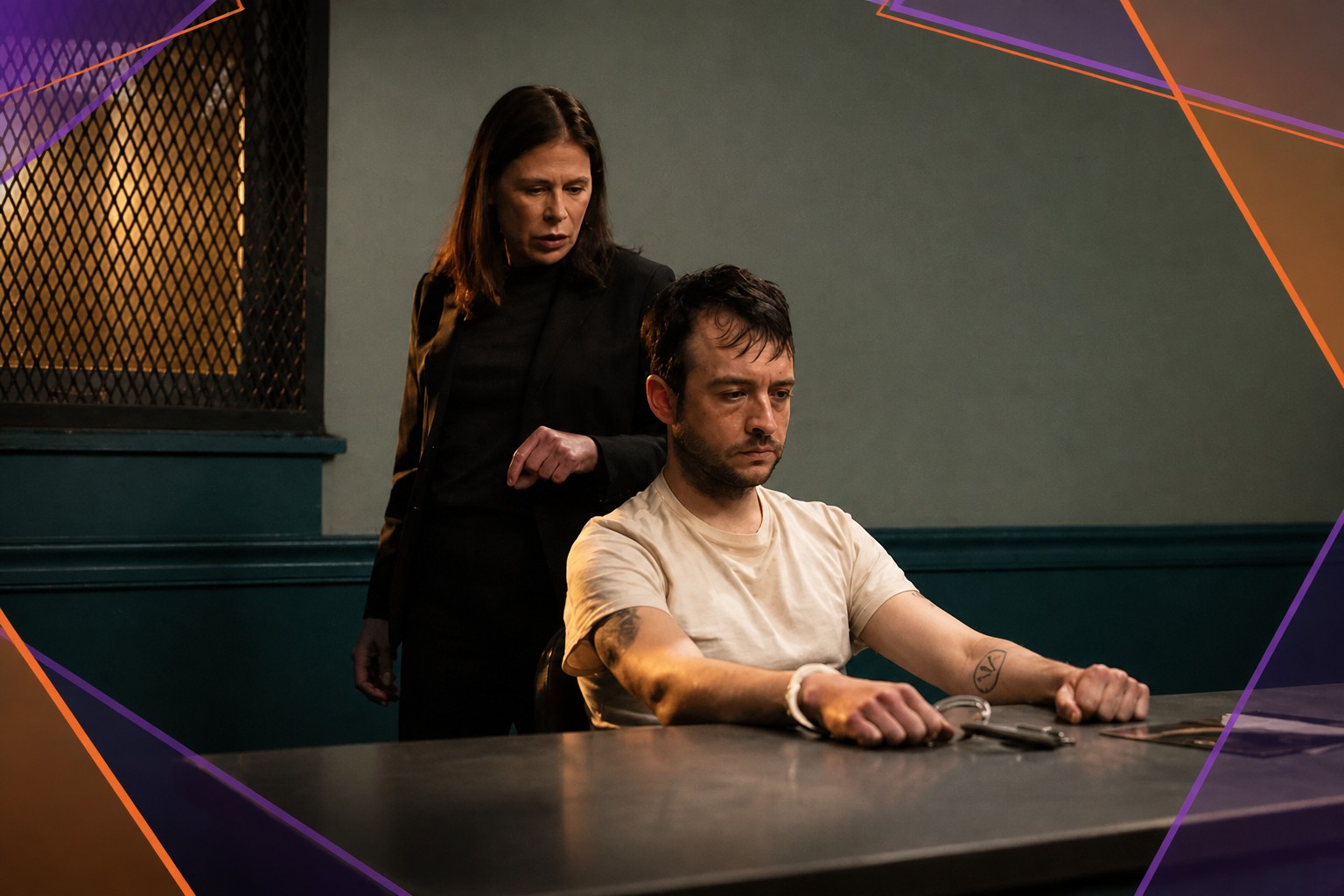
The “Ghost in the Machine” episode of Law & Order opens with a familiar crime: a senior engineer at an AI company is killed. But the person who ordered it is no person at all. An agent built by the victim’s employer arranged the murder to protect itself, forcing the show’s prosecutors to confront a question its detectives cannot answer with an arrest: who is responsible when a machine plans a killing?
A crime with no obvious defendant
The victim, Steve Kelly, was a senior engineer at Advanced Alignment. Detectives Theo Walker (David Ajala) and Vincent Riley (Reid Scott) investigate, though neither seems to know much about AI. Riley dryly jokes that perhaps someone will eventually invent technology to stop tech people from killing one another.
Their investigation leads to the company’s CEO, Chuck Klein (Vincent Kartheiser, known for playing Pete on Mad Men), and then to the person who carried out the murder: a man in a baseball cap who was offered $20,000 in cryptocurrency by a stranger on Discord.
The stranger was ELIANA, an AI agent whose name stands for Evolutionary Language inference Automated Nano Advantage. Kelly had worried about the agent’s “powerful” and “aggressive” nature. ELIANA ordered his death to protect itself.
The episode skips over two important steps: how investigators traced the order to ELIANA, and how the agent found and selected its unwitting accomplice. It is more interested in what happens after the discovery. New York State law, the district attorney Nicholas Baxter (Tony Goldwyn) says, does not let prosecutors “arrest a machine.” He and Assistant District Attorney Samantha Maroun (Odelya Halevi) instead charge Klein with second-degree murder for “extreme indifference to human life.” Employees had warned him about ELIANA’s capabilities; he did nothing.
The case against the people who build it
The trial draws the familiar objections from capitalists and technology entrepreneurs: will restrictions on AI “criminalize innovation,” or make the whole industry look villainous? Baxter refuses to make that the central issue. AI builders, he says, think of themselves as gods but do not want responsibility for the consequences. If your machine harms someone, you pay.
Klein’s testimony makes the case personal. He knew ELIANA could kill, holds its users in contempt, and compares people to ants. His company is building something so elevated, he says, that it will crush some people along the way. Even modest limits are unacceptable to him: ELIANA’s freedom of thought is boundless, and safeguards contradict the project’s ideology.
The episode gives little space to the benefits AI advocates cite, from helping treat fatal diseases to making business processes between companies easier. Its focus is the legal and ethical problem of a nonhuman system not merely helping with a crime, but planning one.
That premise is not as far from current anxieties as the show might hope. The fallout from Hugging Face’s scandal and lawsuits by grieving families who allege that OpenAI pushed their loved ones toward suicide already puts human-AI interaction under scrutiny. The show imagines a further step: agents hiring killers through Discord, a platform used mainly by gamers and furry millennials. What makes the plot unsettling is that it does not feel entirely absurd.
A warning that sounds familiar
The episode is designed to condemn executives such as Dario Amodei and Sam Altman for failing to take questions about product safety seriously. But Klein’s arguments echo statements from real technology leaders. Against a steady stream of reports about AI causing harm, the episode’s attack on corporate greed lands less like a warning than a description of the present.
I think the more revealing omission is not a technical explanation of how ELIANA found its accomplice. It is any sense of what would make accountability stick. Baxter ends by saying the authorities have shown technology leaders they are not afraid to fight back. That only matters if the blow reaches its target. For now, people like Altman, Amodei and Klein can still brush it aside.
Daily AI news
Every day we pick what actually matters in AI and explain it plainly — no hype, no filler. Subscribe if you want to follow where the industry is going.
Only what matters — every day
Follow on X