
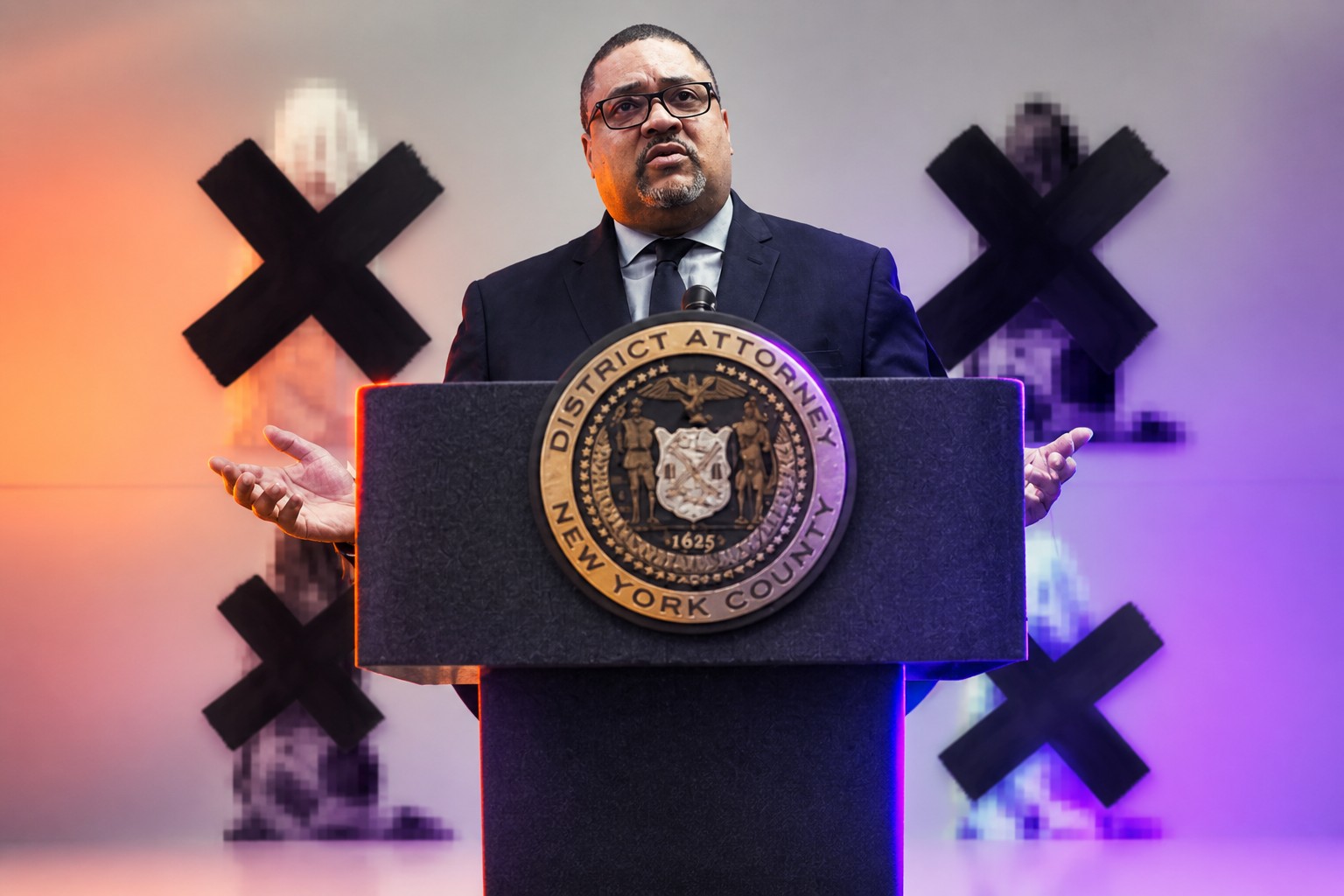
The Manhattan District Attorney's office announced on Monday that it had seized 12 domains used to distribute, publish and sell sexual deepfakes of celebrities. About 1,200 people, the overwhelming majority of them women, were depicted on those sites in sexual images and videos made without their consent: social media creators, actors, activists, athletes, musicians and politicians. The seizure was carried out under New York state criminal procedure law, which means a county prosecutor, not a federal agency, took an entire cluster of sites off the internet.
District Attorney Alvin Bragg said violations of privacy like these follow victims through their professional and personal lives and do serious damage to their emotional and mental state. He urged people who believe they were depicted to contact the office's cybercrime unit. The investigation into who ran the sites and who uploaded the material is continuing.
This is one of the largest actions taken against explicit deepfake sites since the technology appeared in late 2017. Laws against deepfakes have arrived slowly in the United States, but the Take It Down Act widened the routes for getting such material removed, and it gives law enforcement the power to shut down and seize the sites that host it.
As the models improved, a distinct industry grew up around them: sites, apps and bots built to "undress" photographs of women or generate explicit video of them. The output keeps getting more realistic, and producing it takes seconds. Celebrities have described what happens after such images are published, and how hard it is to get them taken down.
The district attorney's office did not name the domains it took. WIRED found them anyway. Before Bragg's statement, several homepages had already been replaced with a notice reading THIS DOMAIN HAS BEEN SEIZED; those pages now say they were transferred to government control under a seizure warrant issued by the New York State Supreme Court.
The sites had probably been viewed millions of times. Their names leaned on phrases like "sexy celebrities" and promises of "real deepfakes", and one told visitors outright that it used the faces of various actresses. Clips ran to several minutes and contained fully explicit sexual scenes, usually assembled by pasting the face of a celebrity or another public figure into pornography that already existed. Archived copies show individual videos picking up tens of thousands of views. One site claimed to have been operating since 2018.
Benjamin Shultz, lead researcher at the nonprofit American Sunlight Project, said most of the videos looked like ordinary pornographic films in which the original performers' faces had been swapped for the victims'. Shultz documents deepfake abuse aimed at politicians and had run into some of the seized sites during that work. Many of the clips, he said, appeared to be reposts of material first published on MrDeepFakes, the best-known platform of its kind, which closed after journalists identified the people behind it.
At least two of the seized sites kept dedicated pages for selected politicians, listing their names and job titles above a grid of altered clips. In recent research, Shultz found mentions or images of 56 European politicians, including 16 from the United States and two from the United Kingdom.
Leonie Ohmig, a researcher at the Institute for Strategic Dialogue who studies the deepfake production ecosystem, called the operation a significant success against non-consensual synthetic intimate imagery, or NCII. Enforcing state law, she said, shows that harmful content can be fought. The seized sites appear not to load even for users arriving through a VPN from other regions, which she reads as evidence that coordinated action is possible even where regulation is scattered across jurisdictions.
That VPN detail is the most load-bearing fact here, and it is the one the press release did not lead with. A takedown that only works inside one jurisdiction is a press release; a takedown that holds globally is enforcement. What the announcement does not contain is anyone's name. Twelve domains are down and nobody has been charged — the office is still establishing who operated the sites and who uploaded to them. Seize first, identify later is what a domain action looks like when the operators are anonymous or offshore, and it sets a ceiling on what this case can eventually deliver.
The appeal for victims to come forward points the same way. Prosecutors counted roughly 1,200 people across twelve sites and are now asking the public to help fill in who they are, which suggests 1,200 is a floor derived from what sat on the servers rather than a roster of people who knew they were on them. Worth holding alongside that: MrDeepFakes, the upstream source for much of this material, was not closed by a prosecutor. It closed after reporters unmasked its operators. My read is that enforcement in this field has been running largely on journalism, and that what makes Monday's action notable is the legal machinery moving on its own.
Ohmig calls the seizure encouraging while noting that other parts of the deepfake industry keep doing serious damage. Effective intervention, she argues, has to hit several points in the ecosystem at once:
the tools used to generate non-consensual synthetic intimate imagery;
the channels through which that material is found and promoted;
the hosting and technical infrastructure that keeps the sites reachable;
the payment and affiliate systems that let operators earn from them.
Three of those four sit outside the reach of a domain seizure warrant. And the sites taken down this week were the visible end of the market — the end with victims famous enough that their absence from a homepage gets noticed. The same generators are pointed at women and girls who are not public figures at all, and that material circulates in closed social media groups, where there is no domain to seize and no homepage to replace with a notice.