

What a photo library can reveal
Mayer argues that photos are an undervalued source of information. Dazzle can infer whether someone likes skiing, where they have recently traveled and what their children are interested in.
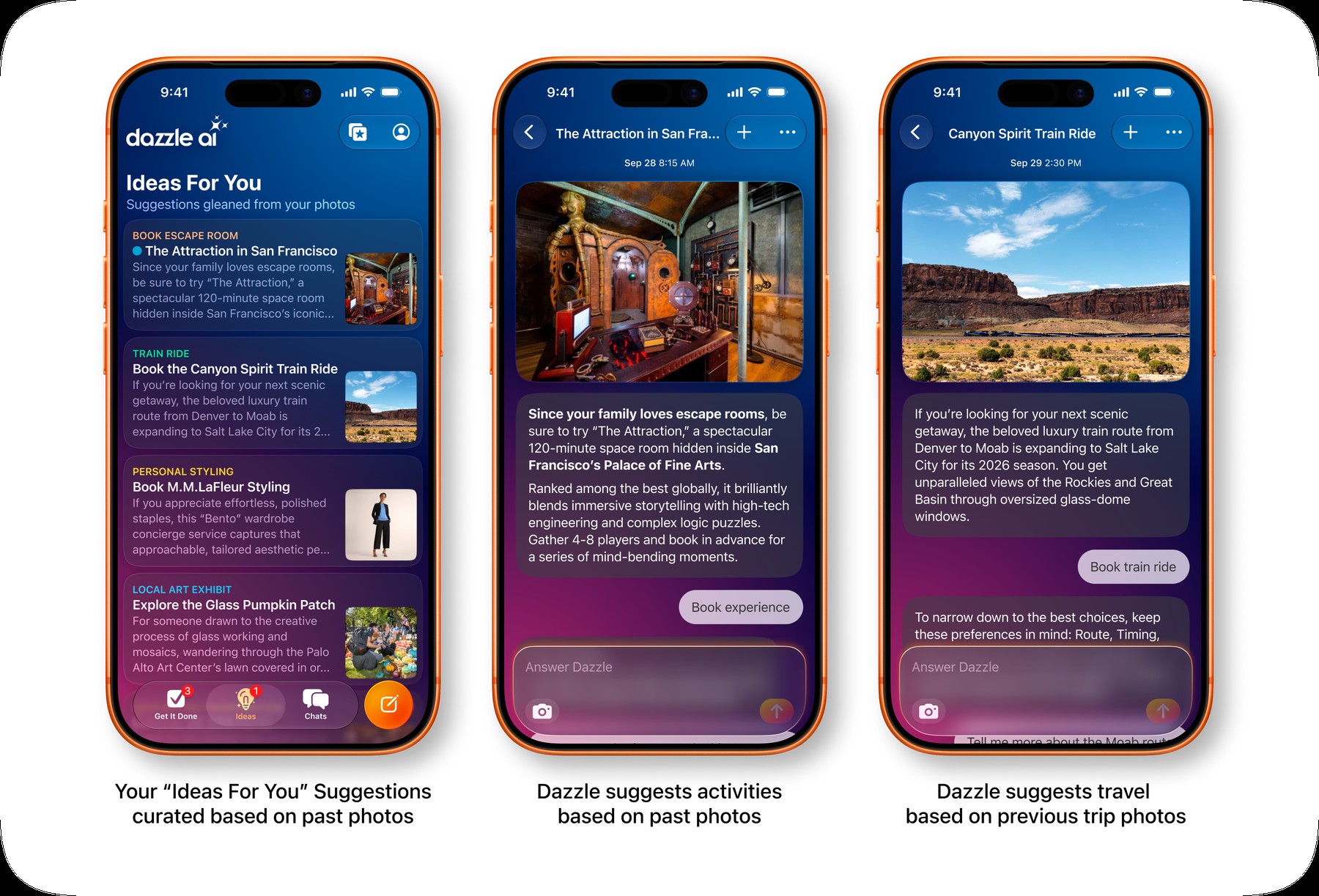
The idea follows Mayer’s earlier work at Sunshine. In 2024, the company launched Shine, an AI photo-sharing tool that drew criticism for its dated design, failed to attract a broad audience and eventually shut down. Mayer says the work nonetheless helped create “interesting intellectual property.”
Dazzle works through an app or chat and has two main modes:
Image analysis itself is not new: other tools can identify where to buy an object or find information about a work of art. The more distinctive test is whether a record of someone’s photos can produce recommendations that feel personal.
Personal, but not always right
In Mayer’s example, Dazzle noticed that her family enjoys escape rooms and suggested places around the San Francisco Bay Area she had not known about. Asked for a trip idea, it recommended destinations around the Mediterranean, apparently drawing on previous visits to Spain and Greece. It also suggested Sicily, where the user had been four years earlier.
But the assistant missed a simple piece of context: when asked whether to buy her daughter roller skates for her next birthday, it did not recall that she already knew how to skate.
Other suggestions landed better, including a local pottery studio and a kayak trip in Tomales Bay to see bioluminescence. The recommendations may improve over time, but the uneven recall points to a harder problem than spotting patterns: knowing which details still matter.
I think that is the more interesting claim behind Dazzle. Its advantage is not that it can recognize what is in a picture, but that a long-running photo history might help it make suggestions that a calendar-and-email assistant would miss. The same history can also mislead it, as the Sicily recommendation and the roller-skate lapse show.
The privacy trade-off
Mayer argues that users may be more willing to share a photo library with AI than sensitive information such as email and messages, amid concerns about services like Instinct and Muse. She says Dazzle focuses on privacy and removes personal information that its AI identifies as sensitive.
What remains unclear is how much confidence users should place in that distinction. A photo library can reveal interests, travel and family life even when sensitive details are removed. Dazzle’s pitch depends on reading those patterns closely; its privacy case has to persuade users that the same depth of access is acceptable.
For now, the product’s strongest promise is also its unresolved tension: the more it learns from a person’s pictures, the more personal its recommendations may become—and the more it must earn the right to look.
Daily AI news
Every day we pick what actually matters in AI and explain it plainly — no hype, no filler. Subscribe if you want to follow where the industry is going.
Only what matters — every day
Follow on X