Meituan has released the weights for LongCat-2.5, a model for AI agents that can independently handle long tasks, especially programming. The model has 1.6 trillion parameters, but activates about 48 billion for each token. It was trained on Chinese hardware and, according to Meituan’s tests, approaches leading Western models on several benchmarks. For running it independently, the company describes a cluster of 194 Huawei accelerators; it provides no instructions for Nvidia GPUs.
Meituan releases a 1.6 trillion-parameter agent model without Nvidia GPUs
A model for long tasks
LongCat-2.5 was developed by the LongCat team at Chinese company Meituan, known for its food delivery service. The model’s weights became available a week after its official unveiling. The company says LongCat-2.5 is close to leading Western models on several tests.
It is a mixture-of-experts model: for each token, it activates only some of its specialized subnetworks. Of its 1.6 trillion parameters, about 48 billion are active. The API accepts up to one million tokens at a time, and responses can be up to 128,000 tokens long. The model accepts text, images and video, responds with text, and lets users turn reasoning on or off.
Image processing and agent training
Unlike many multimodal models, which had an image encoder added later, LongCat-2.5 converts images into tokens and processes them alongside text, much as modern large language models handle textual data. The approach is based on the research model LongCat-Next and is intended to improve tasks involving visual programming, design and 3D.
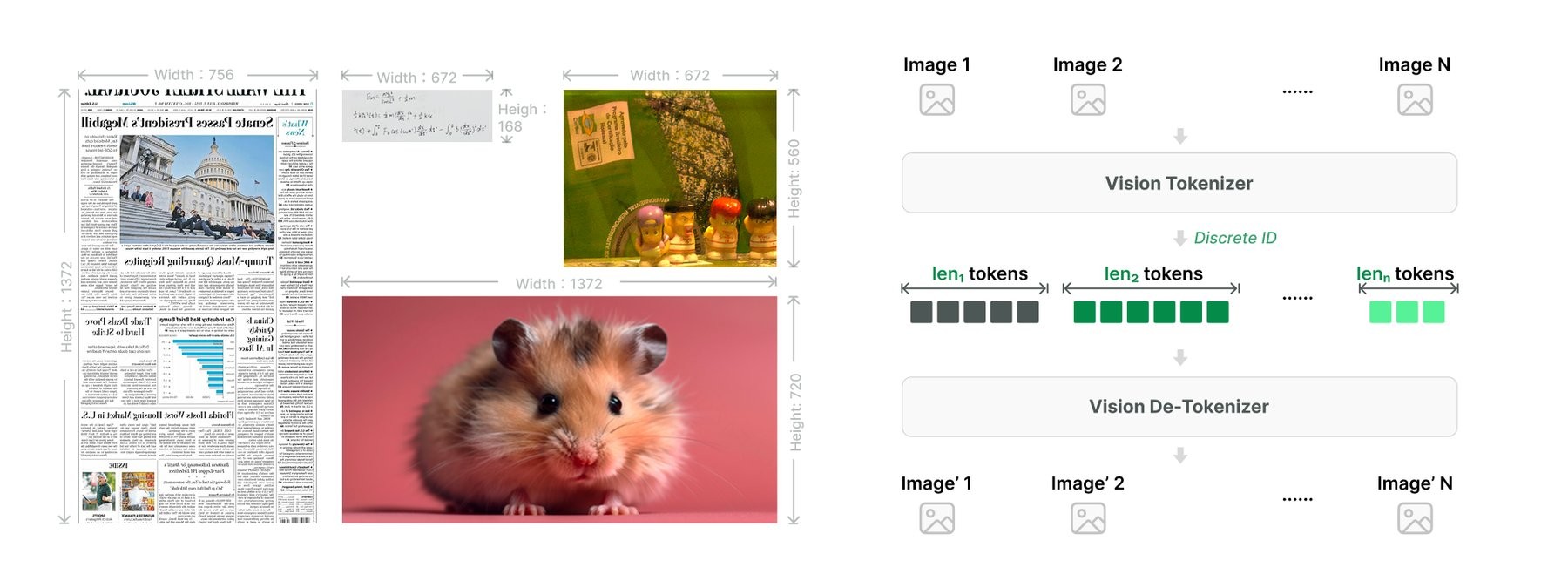
LongCat-2.5 breaks images down at their native resolution into discrete tokens that the model processes alongside text. | Image: Meituan
Source: the-decoder.com
For reinforcement learning, the team used real tasks from GitHub pull requests and reproduced errors made by AI agents. To make sure the model actually solved tasks rather than finding shortcuts, the developers disabled internet access in the training environments, removed Git history and cached files, and checked solutions with a language model.
The team also transferred to LongCat-2.5 capabilities from several specialized mentor models trained for agent use, reasoning and dialogue.
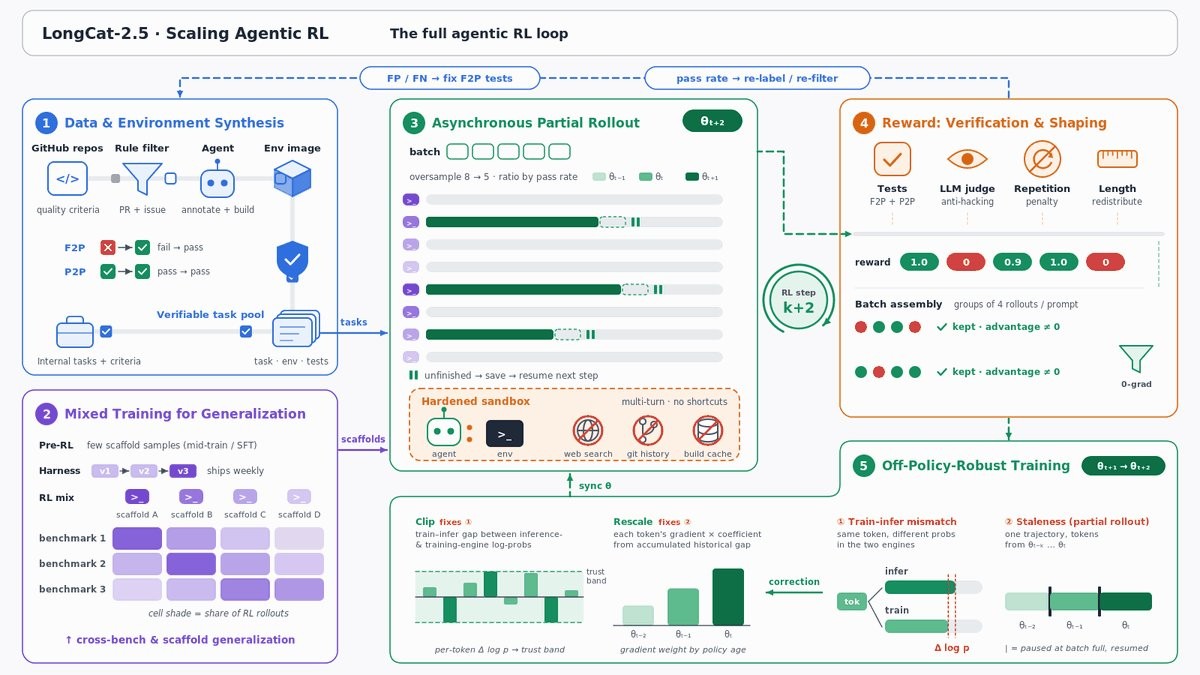
Meituan generates training tasks from real GitHub repositories and blocks shortcuts like web search and Git history in the sandbox. | Image: Meituan
Source: the-decoder.com
Running on Huawei accelerators
Meituan quantized the weights and expert activations to 4 bits, a precision that Chinese chips can process directly. In the company’s load tests, compared with the 8-bit version, prompt processing was 43.3% faster and response generation was 42.77% faster. Meituan says accuracy remains at the level of the uncompressed model.
This version is hosted in a separate repository. The guide to running it independently describes a cluster of 194 Huawei Ascend accelerators from the Atlas A2 series:
There is no guide for running the model on Nvidia GPUs.
Benchmark results
On Terminal Bench v2.1, which tests how well agents handle command-line tasks, LongCat-2.5 scored 88.4. Meituan’s table lists Claude Opus 5 at 89.1 and GPT-5.6 Sol at 88.8, with Deepseek-V4.1-Flash in the lead at 90.6.
DeepSWE measures how well models fix bugs in real software repositories. LongCat-2.5’s score rose from 9.7 to 64.6. In the table, it beat only Claude Opus 4.8; the leaders were Deepseek-V4.1-Flash at 74.2 and GPT-5.6 Sol at 72.7. The newer Claude Opus 5.5 and GPT-6.1 Sol were not included in the comparison.
On the more difficult Terminal Bench v4.0 test, LongCat-2.5 scored 38.5: slightly more than GPT-5.6 Sol at 37.3, but well below Opus 5 at 53.9. On the web search benchmark BrowseComp, the model scored 91.9, the highest result in the table. Meituan, however, ran the test in its own environment.
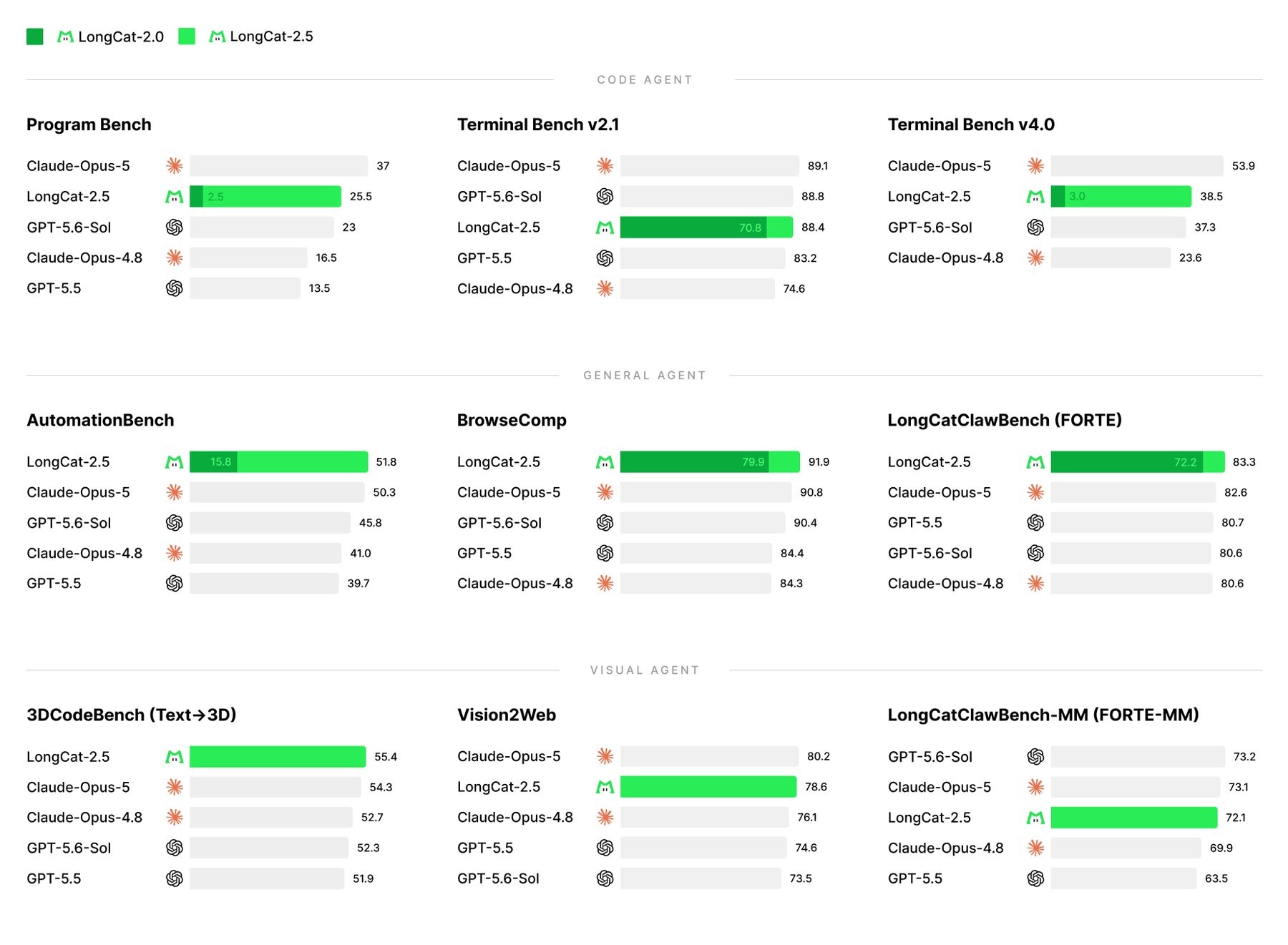
In Meituan's own evaluation, LongCat-2.5 improves substantially over its predecessor and comes close to Claude Opus 5 and GPT-5.6 Sol on several agent benchmarks. | Image: Meituan
Source: the-decoder.com
Access and pricing
LongCat-2.5’s weights are released under the MIT License, which permits commercial use, modification and redistribution. The model can be tried in a chat interface at https://longcat.ai/. Its API supports OpenAI and Anthropic formats and is compatible with the AI agent tools Claude Code, Codex and Hermes.
At launch, Meituan is offering a temporary promotional price of about €0.27 per million input tokens and €1.07 per million output tokens.
The company said it trained LongCat-2.0, the predecessor, entirely on a cluster of more than 50,000 Chinese AI chips in late June. Before its official unveiling, the model ran anonymously on OpenRouter under the name “Owl Alpha.” Chinese open-weight models, including Kimi K3.1 and GLM-5.3, have largely caught up with leading US models on widely used benchmarks.
Open-weight models initially optimized for Chinese chips could make that hardware more attractive beyond China. Alongside multimodal agent models, Meituan is developing image generators: the company previously released LongCat-Image, an open text-to-image model with 6 billion parameters that prioritizes efficiency over size.
Dataist's take
LongCat-2.5’s results show that it can compete with leading systems on some tests, but the instructions for running it describe a Huawei cluster, not Nvidia hardware. The comparison also leaves out the newest versions of Claude and GPT, and one of the model’s best results came from a test run in Meituan’s own environment.
Daily AI news
Every day we pick what actually matters in AI and explain it plainly — no hype, no filler. Subscribe if you want to follow where the industry is going.
Only what matters — every day
Follow on X