
Meta has released Muse Spark 1.1, a multimodal model built for agentic work, and opened it to outside developers for the first time through a new Meta Model API now in public preview. The model manages a one-million-token context window on its own, runs as either the lead agent or a subagent inside parallel multi-agent setups, and operates a computer by switching between writing scripts and clicking through interfaces. Meta frames it, alongside the recent Muse Image launch, as a step toward what the company calls personal superintelligence — systems that help users reach goals, build what they have in mind, maintain relationships and act on their priorities. Evaluation details are published in a separate report.
Source: ai.meta.com
The agentic claims are the centre of the release. Muse Spark 1.1 is aimed at personal agentic tasks that require planning across several external applications and services, and Meta says it generalises to unfamiliar built-in tools, MCP servers and custom skills without being shown examples first. On complex projects it finishes faster than Muse Spark, which Meta attributes to training specifically on multi-agent coordination and on reducing total execution time. As the lead agent it assembles context, writes a plan and splits work across parallel subagents; as a subagent it stays inside its assigned task, accounts for the tools it has, and recognises when to hand control back up.
The context window is self-managed rather than merely large. The model records what it has already done, pulls details back from much earlier stages of a task, and compacts its own context to keep the steps it needs to continue.
Source: ai.meta.com
On the desktop, Meta says the model handles workflows that run across several applications at once while the information inside them changes mid-task. It holds context through long sessions, adjusts when requirements shift, and learns unfamiliar interfaces with minimal human input. It does not reason about every desktop action in isolation — it decides when writing a script is faster than driving the UI, and it can group actions into batches for each stage of a job. In one scenario, organising a dinner party, the model encounters new information while placing a food order, notices the task has changed and updates its own plan.
Source: ai.meta.com
Coding is where Meta reports the clearest gain. The company cites real work on large, complex codebases: finding and fixing difficult bugs, adding features to enterprise systems, running large code migrations. On building web applications and end-to-end question-answering systems, it says the model is substantially ahead of the first Muse Spark. It was trained to move between different runtimes and to hold together long multi-step scenarios, and it supports the features agentic coding tools now expect — plan mode, goal anchoring, delegation to subagents, context compaction.
In an OpenCode demo the model builds a chat web application, takes screenshots of it automatically, spots user-visible bugs, traces them to the responsible code, fixes them and verifies the result — coding, multimodal perception and tool calls in one loop.
Meta's own developers and researchers use Muse Spark 1.1 daily, and on the company's main internal coding benchmark it improves markedly on Muse Spark and is, in Meta's words, comparable to leading alternatives. Researchers also use it to automate development work and model evaluation.
A second demo, built around DeepSWE and OpenCode, has the model evaluate itself on a subset of DeepSWE tasks at several reasoning levels and then assemble an analysis dashboard from the results.
Source: ai.meta.com
The multimodal side covers visual understanding, multimodal reasoning and tool use, with outputs tied back to the source material: image-to-code artifact generation, detailed descriptions of images and video, and agentic workflows in multimodal settings. Meta's argument is that this matters most where perception and action have to happen together — the model reads an image and audio, keeps the details through a long workflow, and uses them when acting on the user's computer. The demonstration is a Facebook Marketplace listing: the model takes a phone video, selects usable stills from it, analyses the item, opens the user's browser and posts the listing itself.
Before release, Meta ran extended safety testing under its frontier AI scaling framework, which sets the evaluations, threat models and thresholds required to deploy the company's most capable models. Across the frontier risk categories — chemical and biological, cybersecurity, and loss of control — the company says Muse Spark 1.1 stays within safe limits. It also reports resistance to direct jailbreaks and to indirect attacks through untrusted data, prompt injection and developer-prompt attacks, plus fewer hallucinations and less tendency to agree with a user against the facts. The full account is in the evaluation report.
Early API partners describe it as a viable foundation for agents. They single out the combination of a million-token window, image, video and PDF input, built-in search with citations, reasoning, coding, structured output and parallel tool calls, delivered through an OpenAI-compatible interface. Cline, whose developers were given early access, says Muse Spark works well with tools and is cheap enough to run real coding tasks at scale. Box says that on its internal enterprise task set Muse Spark performed comparably to leading frontier models, and highlighted structured procedural workflows in professional services, the public sector and industry; Yashodha Bhavnani, Box's VP of AI products, called it a fit for organisations. The developer of OpenClaw praised its speed and capability for running agents.
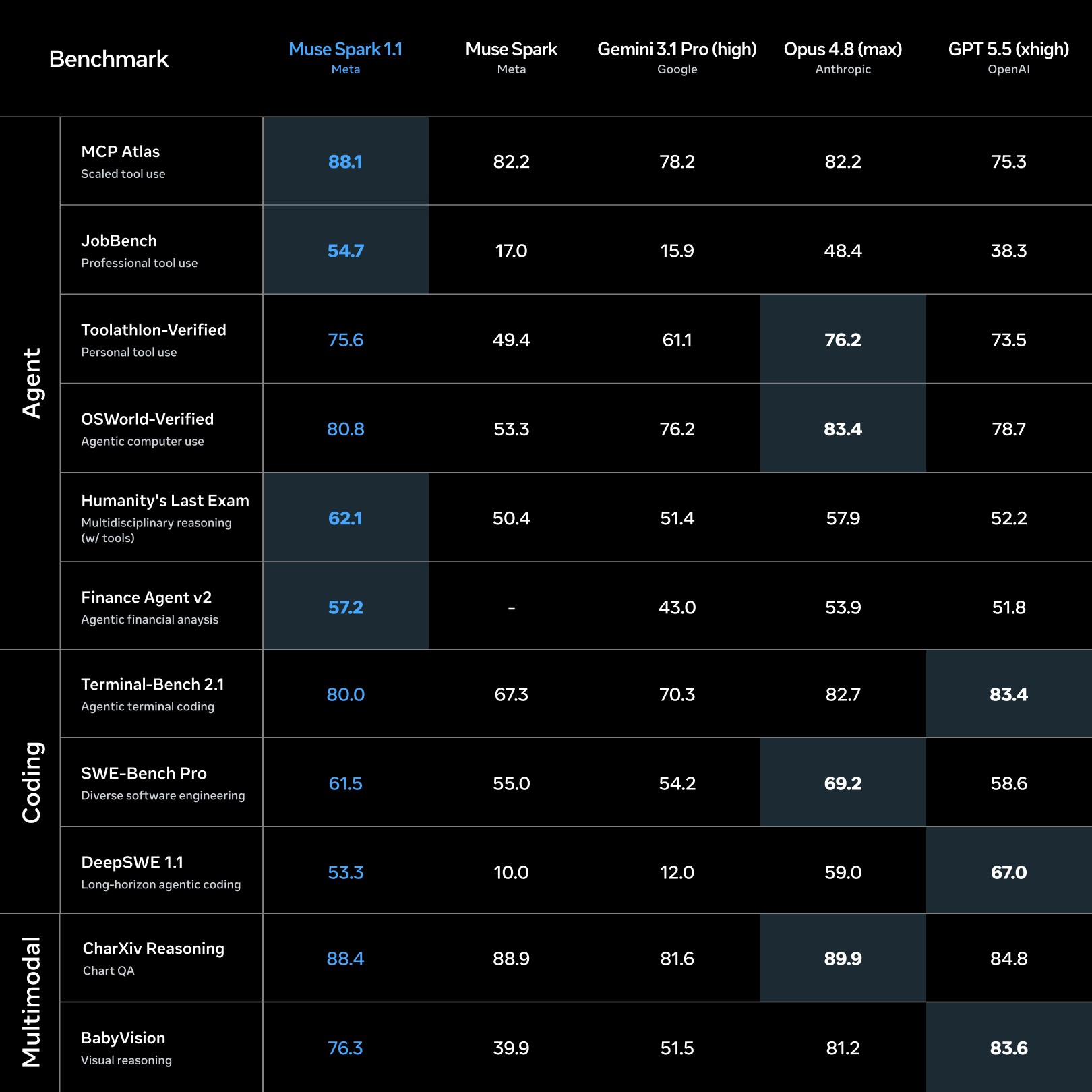
Read the announcement for hard numbers and it thins out quickly. The one figure in it is the million-token context window, which is now table stakes rather than a differentiator. Every comparative claim — better than Muse Spark, comparable to leading alternatives — rests on Meta's own internal coding benchmark, with no competitor named and no score given. The detailed evaluations exist in a separate report, but the announcement itself is built on demos and partner testimonials, and demos are chosen by the vendor. That is a defensible way to launch a point release. It is not a way to establish where a model sits against Gemini, Claude or GPT, and the framing around personal superintelligence is doing work the benchmarks are not.
The gap the release is quietest about is price. Cline's endorsement is explicitly economic — the model is cheap enough to run real coding work at volume — and for agentic workloads that burn a million tokens of context per task, cost per token is the entire product decision, not a footnote to it. Meta named no price. Publishing a partner quote about affordability while withholding the rate card is a choice, and it usually means the rate card is not final.
Meta says it is already training more capable models and will say more later. That is the tell: a company presenting version 1.1 as movement toward personal superintelligence, while pointing developers at a public-preview API and asking them to build agent infrastructure on a model it has already begun replacing.