Meta Superintelligence Labs has shipped its first real-time audio perception model. Muse Voice Transcribe writes down speech, separates the speakers and marks sentence boundaries while the conversation is still going, and Meta has priced it at $0.18 per hour of audio, or $3 per 1,000 minutes — against $4 for Cartesia Ink-2 and $6.50 for both ElevenLabs Scribe v2 Realtime and Deepgram Flux. It already powers voice input in Meta AI and Muse Code, and Meta is unusually direct about the destination: this is meant to be the hearing layer for assistants that run on glasses and never stop listening.
The technical idea worth understanding is how the model handles the trade every streaming transcriber has to make. Part of the Spark family, it cuts incoming audio into 80-millisecond chunks and, after each one, decides whether to keep listening or commit the next word to text. Wait longer and accuracy rises; wait longer and so does latency. Rather than fixing that dial, Meta varies it per word: easy words are emitted quickly, hard ones get more listening time before the model commits. The behaviour was trained with reinforcement learning, rewarding a low error rate and a short delay at once.
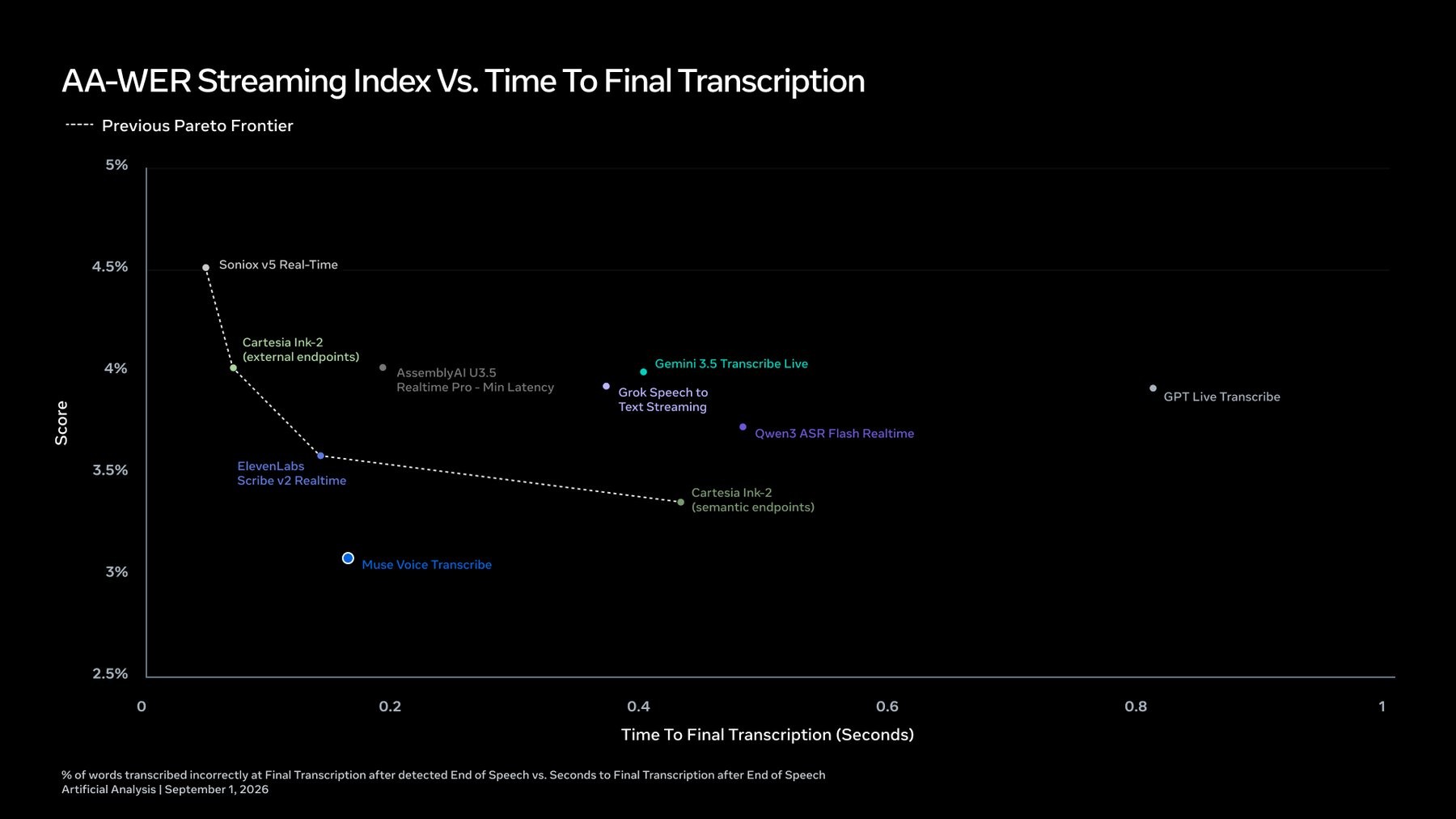
Adaptive latency shifts the trade-off between speed and accuracy, since the model decides for each word how long to keep listening
Source: the-decoder.com
The rest of the stack has been folded into the same network instead of bolted on beside it. When the speaker changes, the model marks the switch in the running text and assigns each segment an identifier from A to Z. It places sentence boundaries where each utterance starts and ends. Both skills were trained jointly with recognition rather than trained separately and stitched together afterwards. Meta says the model can tell apart more than 20 speakers at once and process recordings longer than an hour with no post-processing; in a demonstration with eight people in one room, it attributed words to individual participants live.
Meta says it trained the model on more than 70 languages and verified 25 of them in detail. It handles code-switching mid-sentence, and prompts carrying the language, keywords or context can raise accuracy further, particularly on proper nouns such as "Meta", "Muse" or "Menlo Park".
Artificial Analysis checked the claims independently and confirmed them. In English, Muse Voice Transcribe recorded a 3.1% word error rate and 0.16 seconds of latency after the end of a turn. ElevenLabs Scribe v2 Realtime came in at 3.6% and 0.14 seconds. AssemblyAI Universal-3.5 Pro Realtime hit 4.0%. Cartesia Ink-2 landed at 3.4% or 4.0%, depending on whether it detects the end of a turn itself or leans on an external system.
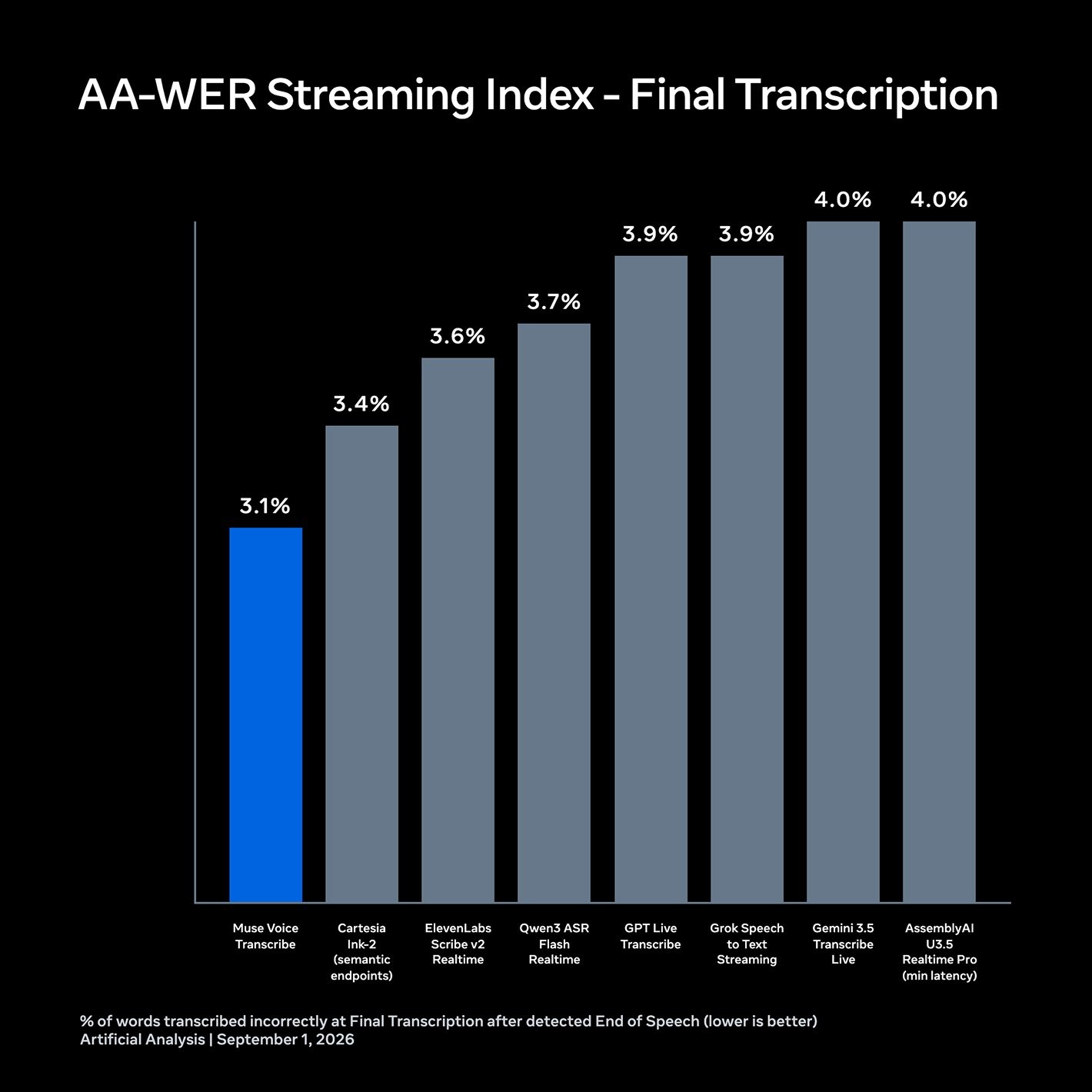
In Artificial Analysis testing from September 1, 2026, Muse Voice Transcribe produces the most accurate final transcript after end-of-speech detection
Source: the-decoder.com
Read that table without the launch framing and the lead is narrow. Meta is half a percentage point of word error ahead of ElevenLabs and three tenths ahead of Cartesia's better configuration, while ElevenLabs is the faster of the two on turn-end latency. For dictation, the difference between 3.1% and 3.6% is a word every few hundred. The number that actually separates these products is the price: $3 against $6.50 is not a margin, it is a different budget line, and it is the same move Meta made with Muse Spark 1.1 and 1.2 — compete on cost rather than on the top of the leaderboard. Competition here is live. OpenAI released GPT-Realtime-Whisper for the same job in May and cut its transcription prices in July.
What is missing from the announcement is the part that used to be Meta's identity in AI. The company has not disclosed the parameter count, the volume of training data or where the audio came from, and it has not released the weights. A speech model trained on more than 70 languages implies an enormous corpus of recorded human conversation, and the question of whose conversations those were is the one the release does not touch. Priced this aggressively and shipped closed, this is an API business, not an open-weights contribution.
The staffing context matters too. Meta reorganised its AI division in the summer of 2025 and consolidated it under the Superintelligence Labs brand, hiring senior researchers away from OpenAI, Google DeepMind and Apple with packages reaching $300 million over four years. Not all of them stayed; some went back to OpenAI within weeks. This is the first audio model to come out of that structure.
Source: the-decoder.com
Meta ties the launch to Mark Zuckerberg's stated ambition of "personal superintelligence". In a staged demonstration, Meta employees said that reliable speech recognition is the foundation for personal AI agents capable of listening to real conversations through AI glasses. Germany has already debated banning Meta's camera glasses, though the Federal Network Agency decided not to pursue the matter.
That regulatory near-miss is the frame for everything above. Adaptive latency, 20-plus speakers, hour-long sessions with no post-processing and code-switching are not features a dictation app needs; they are the requirements of a device sitting on someone's face in a room full of people who did not buy it. At $0.18 an hour, leaving that device listening all day costs less than a coffee, which removes the last practical reason to ever switch it off.