

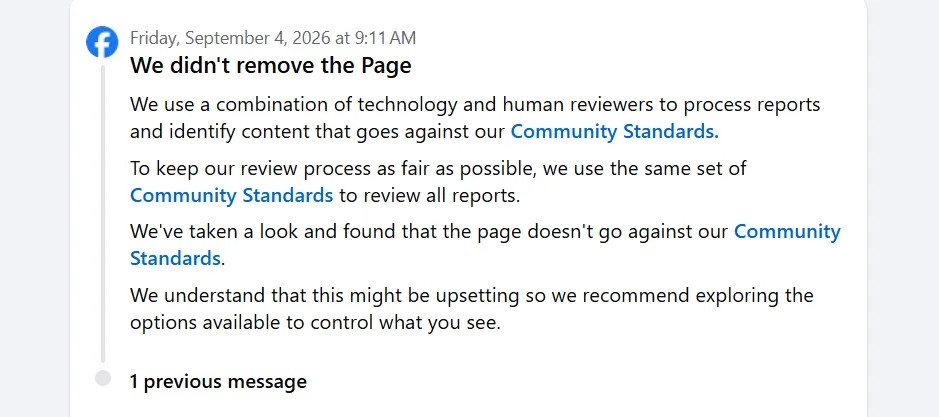
A Futurism investigation has found a large population of Facebook accounts pumping out AI-generated video of children being beaten, burned, caged and starved, and found that Meta leaves most of it up. Reporters filed complaints against eight of these accounts. Meta removed two, one of them only after reversing an initial rejection, and the responses took more than a week. The six that survived moderation were still posting scenes of an infant hit in the face with a frying pan, a girl beaten with a baseball bat, a child being kicked.
The detail that should worry Meta most is how the accounts were found. The reporters did not need search tricks or leaked lists. They opened one such account and scrolled Facebook's recommendations, and the service supplied an endless feed of more of the same. The ranking stack that Meta says cannot find this material is demonstrably very good at finding it, and is using that skill to distribute it.
The catalogue of what the videos depict is long enough that it reads as a product line rather than a fringe. Across the accounts, infants and small children were shown:
- hit in the face, kicked and beaten with heavy objects - dragged by the hair, burned with stoves and irons - chained, locked in cages and freezers - pushed down stairs, threatened with knives and guns - starved and forced to eat dog food and rubbish off the floor
In one video, a woman screams at a small girl to stop crying. The girl, cuts and bruises on her cheeks and forehead, begs through tears that the woman not hit Noah and hit her instead, while another child hides nearby. In another, a visibly dirty boy asks a woman for money for food; when he asks for a few dollars, she hits him in the face twice and he falls to the floor with his nose bleeding. In a third, a man drips hot wax from a burning candle onto a boy's bound hands, and the child flinches and says it hurts.
Some of the scenes are specific in a way that gives away the production method. A child who needs an inhaler is denied it. Children with allergies are made to eat shellfish. Adults tip snakes and cockroaches onto crying children. In many clips, Black children are whipped or beaten by white adults while doing hard labour in settings that evoke colonial Africa. These are prompt templates, run at volume with variations, not individual pieces of content.
The output is not quite photorealistic, but it is clearly made with capable tools and it is hard to watch. Plenty of viewers do not appear to understand that they are looking at synthetic footage. Clips collect thousands and sometimes tens of thousands of reactions; some commenters are furious, others ask for the next instalment of the storyline. Under a video in which a woman hits a boy in the face with a belt and leaves a bloody mark near his eye, one user called her a psychopath and said she deserved severe punishment.
The reporters initially intended to map the full set of accounts and gave up. After several days of checking, they were still turning up hundreds more, with new material appearing at roughly the rate they could find it.
Meta's own rule is written ambiguously. The policy bans videos or photos depicting real or unreal non-sexual child abuse, regardless of the purpose of sharing, then carves out exceptions for art, cartoons, films and video games from the real world. Nowhere does the document say whether those exceptions cover AI-generated material. That is not a drafting oversight left to chance; it is the sentence on which every enforcement decision in this story turns, and it has been left undefined while the volume of synthetic content on the platform has grown.
Presented with questions and examples, Meta sent a short statement saying it has strict rules against material showing physical harm to children, whether real or AI-generated, and that the clips had been removed. Asked whether it would seek out and remove such material proactively, a spokesperson declined to comment on the record and instead sent a link to a company page about automated removal of child abuse content. The figures on that page are hard to read for this purpose: they do not show how many abuse videos are taken down, or how many of them were generated.
The spokesperson also offered a defence of the format, saying that in many of the clips the violence is followed by an adult stepping in to protect the child. For many of the examples this is true. To me it looks less like mitigation than like craft: a tacked-on rescue is exactly what a creator would append either to survive moderation review or to get a video generator to produce the scene at all. The mass-produced nature of the output shows through anyway, since some clips decay into incoherent brutality where the abuse of children gives way to adults hitting each other.
Meta took down most of the videos the reporters put to its press office and left others. Among the survivors: a small girl locked in a chest freezer, a boy thrown into a rubbish bin where he gnaws on bones, and a girl in a classroom forced to eat garbage.
It has not been a good week for the company's record elsewhere either. Wired reported that Meta took money from advertisers to run hundreds of ads for nudify apps that generate sexual images of children, in some cases built on photographs of real minors scraped from social networks and stock libraries.
Source: futurism.com
The resource question does not get Meta very far. The company has put hundreds of billions of dollars into building superintelligence and has reportedly offered leading researchers more than a billion dollars each to join; last year Mark Zuckerberg said whoever reaches that goal first will hold a long-term advantage in building one of the most significant products in history. The classifier needed here is nothing like that. In casual testing, the reporters found that Anthropic's Claude reliably identifies whether a clip depicts violence against a child.
That is the heart of it. This is not a capability gap, and framing it as one is the company's most convenient move. An off-the-shelf commercial model, tested informally by journalists, does the classification; Meta's own recommender already clusters the accounts tightly enough to serve them one after another. What is missing is the decision to point the second system at the first. Two of eight accounts removed after more than a week, and a policy that declines to say whether AI counts, describe an enforcement posture, not a technical limit. Meta's statement that the clips were removed is a report on a manual queue of links supplied by reporters, not a claim about enforcement at scale, and the difference is the entire story.
Notably absent from anything Meta said is money. The synthetic slop filling these feeds is produced in volume precisely because volume pays through the platform's monetisation schemes, and the company was asked nothing it chose to answer about whether the accounts posting children being burned and caged were earning from it.
Once the reporters put this assessment to Meta, the last of the clips they had flagged finally came down. An unknown quantity of the rest is still up. The company's closing statement was that not all of the links passed to it violate its rules, and a request that the publication not say they do.