

What Meta is building around Muse
Muse is designed to connect to a user’s apps and services, including email and calendars. Its multimodal Muse Spark model is intended for agentic tasks across accounts and devices, with Meta positioning it as an accessible assistant that can automate everyday work from the start.
Zuckerberg described Muse as the center of Meta’s personal AI strategy. His longer-term expectation is that the agent will grow into a personal superintelligence used by billions of people to pursue goals and improve their lives.
The commercial plan is less grandiose and more concrete: keep Muse free for a large number of tokens, then take a small commission from transactions. That makes the agent’s ability to act on a user’s behalf—not just answer prompts—the foundation of its potential business.
An agent with a face, a computer and an inbox
Meta is adding a real-time video interface through a new model called Muse Realtime Avatar. Users will be able to create a separate digital avatar for Muse and speak with it live. The avatar will have a face, body and voice; Zuckerberg said its physical form will be called Jolly.
Muse is also coming to Meta’s smart glasses. Users will activate it with a special word and speak to it while it works in the background.
The agent is expected to report back when a task is complete. Meta says the glasses integration will arrive in the coming months, but has not provided an exact launch date.
On the Mac, Muse will be able to control any desktop application. Meta had previously discussed computer-use capabilities and used Connect to clarify that users will be able to assign tasks and leave the agent working. Alexander Wang, Meta’s chief AI specialist, said Muse could manage a small business or handle work tasks while the user is away.
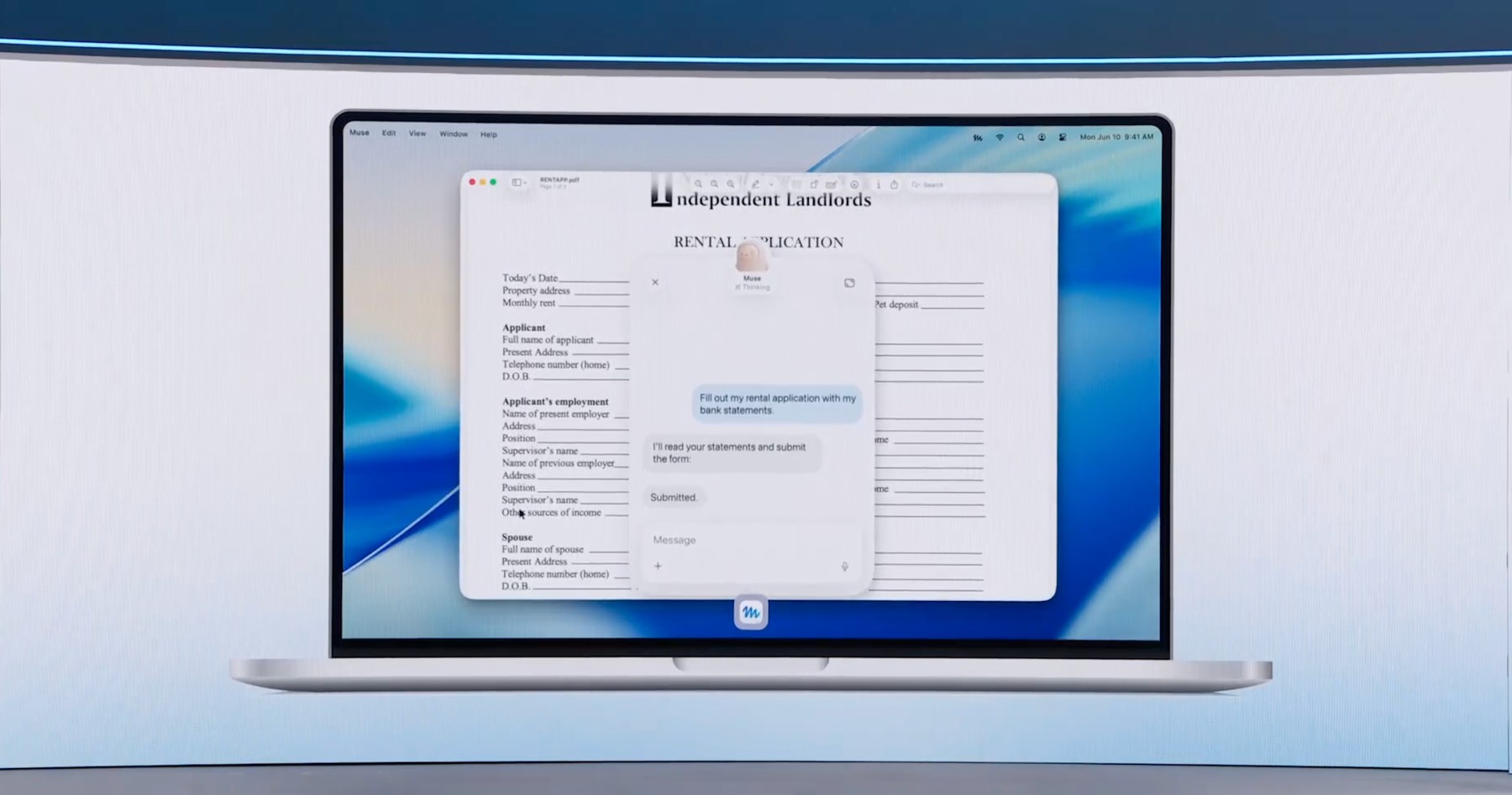
Meta is also developing a dedicated email address for Muse. The address is meant to support persistent background work: users will be able to add Muse to email threads or forward messages so it can process them on their behalf. The company says the feature is coming “soon,” without giving a more precise date.
The transaction layer
Meta’s partnerships point to where it wants Muse to become more than a general assistant.
According to Wang, Muse will be able to work across Shopify’s full product catalog. For online purchases, it will use Lync and Shop Pay, while support for PayPal payments has also been expanded.
Muse will connect to the retail apps listed above, as well as GitHub, Granola and Notion. Meta is also seeking integrations with small businesses. The company recently opened a developer platform for custom connections and received more than 1,500 applications in its first week.
My read is that Meta is not presenting a single breakthrough feature here. It is assembling the permissions and interfaces an agent needs to become useful: glasses for input, a model for reasoning, desktop control for execution, email for continuity and payments for transactions. The pieces are familiar from other AI agents, but the breadth of the planned surface area is the real bet.
The quiet part is reliability. The announcement describes what Muse will be allowed to touch, but not how Meta will prevent a background agent from making an expensive purchase, sending the wrong email or mishandling sensitive account data. I think that omission matters more than the avatar. A face may make the agent easier to talk to; dependable boundaries will determine whether people let it act.
Meta’s first-week developer response suggests strong interest in extending the system, but interest in a platform is not the same as habitual use of an agent. Muse’s ambition now depends on turning many separate integrations into one trustworthy layer without making every task require supervision.
Daily AI news
Every day we pick what actually matters in AI and explain it plainly — no hype, no filler. Subscribe if you want to follow where the industry is going.
Only what matters — every day
Follow on X