

The infrastructure behind the claim
In 2025, Mark Zuckerberg said Meta planned to invest “hundreds of billions of dollars” in computing capacity to build superintelligence. The company’s plans include several clusters with capacity measured in gigawatts. Prometheus is already partially operational, while Meta plans to expand Hyperion to 5 GW over several years.
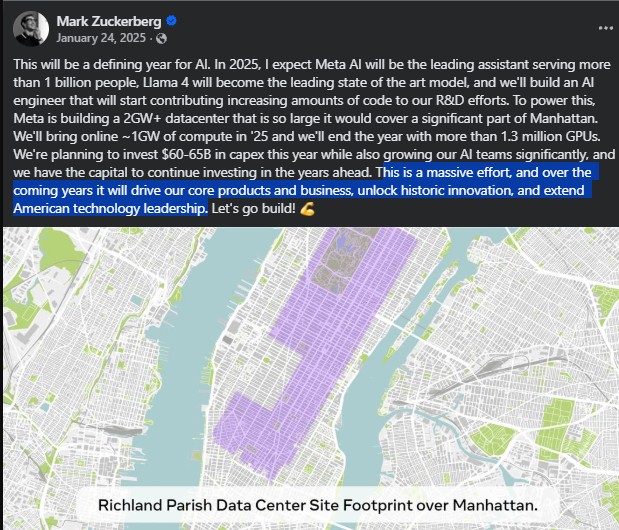
In January 2025, Zuckerberg announced plans for a 2 GW+ data center so large it would cover a significant part of Manhattan. Meta classifies these massive facilities as "pilot models" for tax purposes. | Image: Screenshot, Zuckerberg via Facebook
Source: the-decoder.com
By June 2026, Meta had described its large-scale computing infrastructure and partnerships with Nvidia, AMD, AWS, Arm and Broadcom. It is also developing its own MTIA chips. In January 2025, Zuckerberg said the data centers would power Meta’s core products and business.
That makes the tax argument harder to square with the way Meta describes the facilities elsewhere. The credit came from a 1981 law. Representative James Shannon, who introduced the bill, told The New York Times it was intended to support “people, knowledge and information.” He said Meta’s use of the credit had “gone far beyond what anyone could have imagined.”
A risky position with a long runway
Meta says it has spent $200 billion on research and development over the past five years. But the company’s filings with the US Securities and Exchange Commission warn that the tax savings could be challenged. Reserves for uncertain tax obligations rose 45% to $18.74 billion.
Even if the Internal Revenue Service demands repayment, Meta may still come out ahead: the company has had use of the capital in the meantime, and that supported the rise in its stock.
EY, Meta’s auditor, approved the strategy. The firm also helped Meta establish the tax-credit arrangement and now offers the same approach to companies seeking to offset spending on AI chips, The New York Times reports.
I think the central tension is not whether Meta spends heavily on research; it is whether infrastructure presented as essential to its core business can also be treated as experimental for tax purposes. The filing makes clear that Meta knows the position may be contested, while the time value of the savings means a later challenge may not erase the benefit already gained.
Daily AI news
Every day we pick what actually matters in AI and explain it plainly — no hype, no filler. Subscribe if you want to follow where the industry is going.
Only what matters — every day
Follow on X