
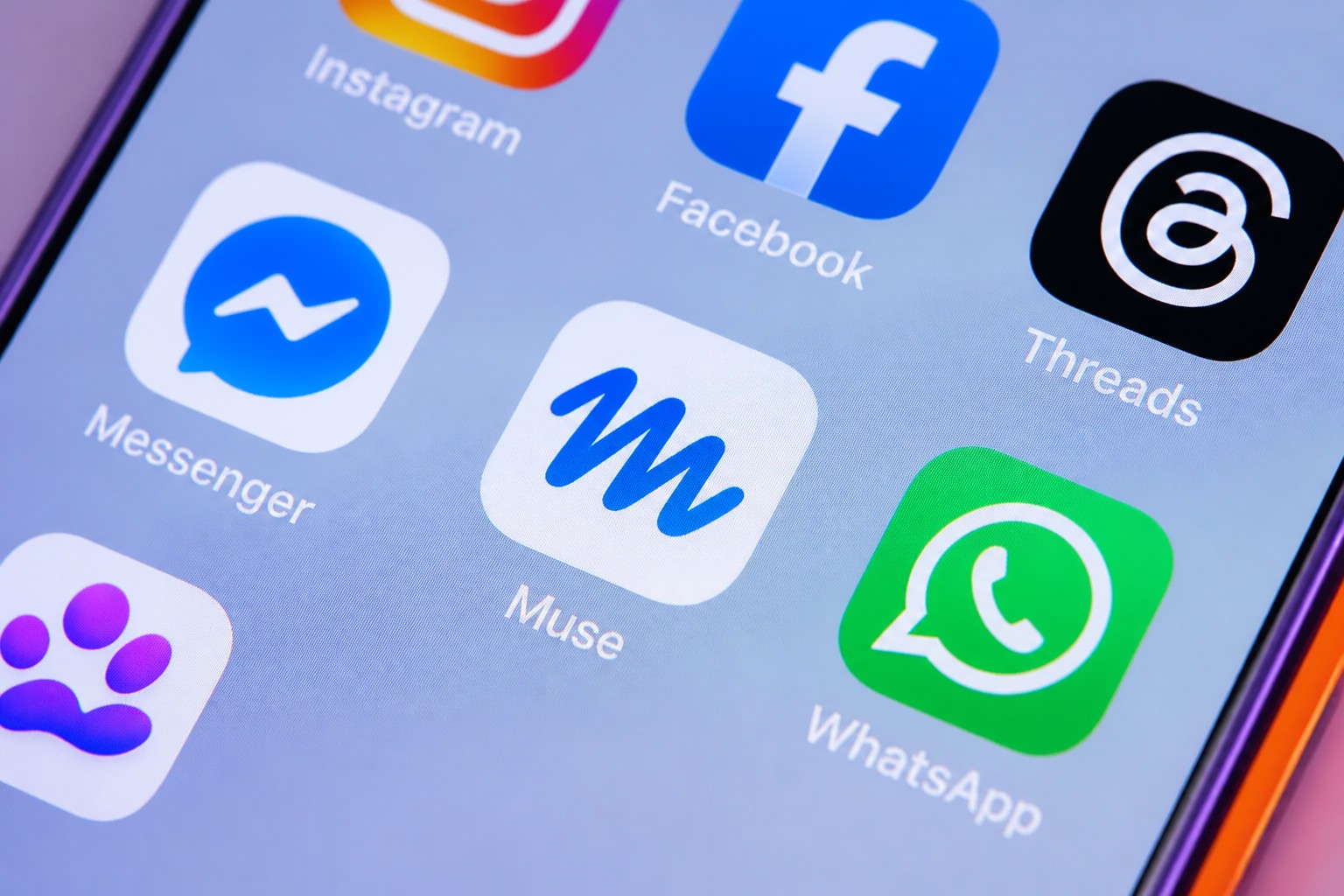
Meta's new AI agent Muse has reached second place in the overall US App Store chart on fewer than 84,000 downloads. Sensor Tower puts the figure at more than 83,000 iOS installs in the United States, currently the app's only market, since Tuesday's launch. Wall Street has warmed to Meta since the release and the company's agents are being argued over on X. The first hard numbers are less flattering than the ranking, and the two facts sit awkwardly together: App Store charts measure velocity, not volume, so "second most popular app in America" and "83,000 downloads" are both true and tell opposite stories.
The comparison that hurts is internal. Threads, Meta's last consumer launch of consequence, did more than 4.3 million US downloads on its first day. Meta AI did 108,000 on its first day. Muse, the app that is supposed to represent Meta's next platform, is behind the company's own previous and far less ambitious AI product.
It is also behind ChatGPT's launch. Less than a week after release, ChatGPT passed 500,000 US installs, at a point when the US was likewise its only market. Spread evenly, that is roughly 83,300 downloads a day. Muse needed about twice as long to reach a comparable total.
None of this proves the launch failed. Agent products can accumulate users slowly, and Muse is climbing: it moved from fourth in the US App Store on Wednesday to second by the time the Sensor Tower data was published. The Android picture is thinner, and worse. On Google Play, Muse sits at 338th in the Productivity category, with no download estimates available yet. Muse also runs on the web and through WhatsApp, and neither channel is captured in these figures.
That last detail is the one Meta will point to, and it deserves scrutiny rather than acceptance. WhatsApp distribution is the single largest structural advantage Meta has in consumer AI. If the company is going to argue that the App Store numbers understate Muse because the real usage is arriving through messaging, it should be able to say by how much. Until it does, the uncounted channels function as an excuse rather than an argument.
The stakes explain why a two-day download count is being read this closely. Meta has decided that the future of consumer AI belongs to agents that carry out tasks on a person's behalf, and it is trying to claim territory in a market that does not exist yet. In ambition this is on the scale of renaming Facebook to Meta for the metaverse — a comparison the company has invited and one that carries its own history.
It is not alone. Google is pushing Gemini Spark, Anthropic has Claude Cowork, and Instinct is running an agent that works over text messages. For general-purpose, easy-to-use agents aimed at everyday tasks, the live contest is mainly Muse against Instinct. Other entrants are narrower — work management, family logistics — but Instinct has $350 million on hand, a recent $2.5 billion valuation, and a shipping cadence that Silicon Valley has noticed, alongside security concerns and a privacy policy widely read as too broad.
Instinct spent this week doing things that look small and are not. It gave every user an email address. It announced it is building its own social network, so that one person's agent can negotiate with their friends' agents to settle plans. It shipped integrations with Stripe and 1Password and added location sharing, which lets the agent take actions that require knowing where you currently are.
This is where Meta's problem gets structural rather than numerical. Instinct's graph is assembled from the people a user actually messages and meets. Meta's graph fuses real acquaintances with accounts someone merely follows. For a feed, the second is larger and therefore better. For an agent that has to coordinate a dinner or pay a friend back, the second is mostly noise. If agents become the primary way consumers touch services, Meta would be defending an asset built for a different job.
The timing of the launch does Muse no favours either. The app asks users to hand Meta more personal information than its existing products do, and it arrived days after the company agreed to pay $18 billion to settle a class action over social media harms. Meta's record on this is long: large-scale data scandals, and repeated Federal Trade Commission claims and fines over privacy violations. An agent is the most trust-intensive consumer product a company can ship, because it is useless unless it is given access to your messages, your calendar and your money. Meta chose to ask for that access days after conceding an $18 billion settlement over the harms of its existing ones.
Muse can still recover — 83,000 iOS downloads is an opening position, not a verdict, and the chart is moving in the right direction. But Meta is spending two things at once here: distribution, which it has in enormous quantity, and credibility, which the $18 billion settlement just repriced. Instinct is buying the second with $350 million and no history. That is a worse balance sheet and a better starting point.