
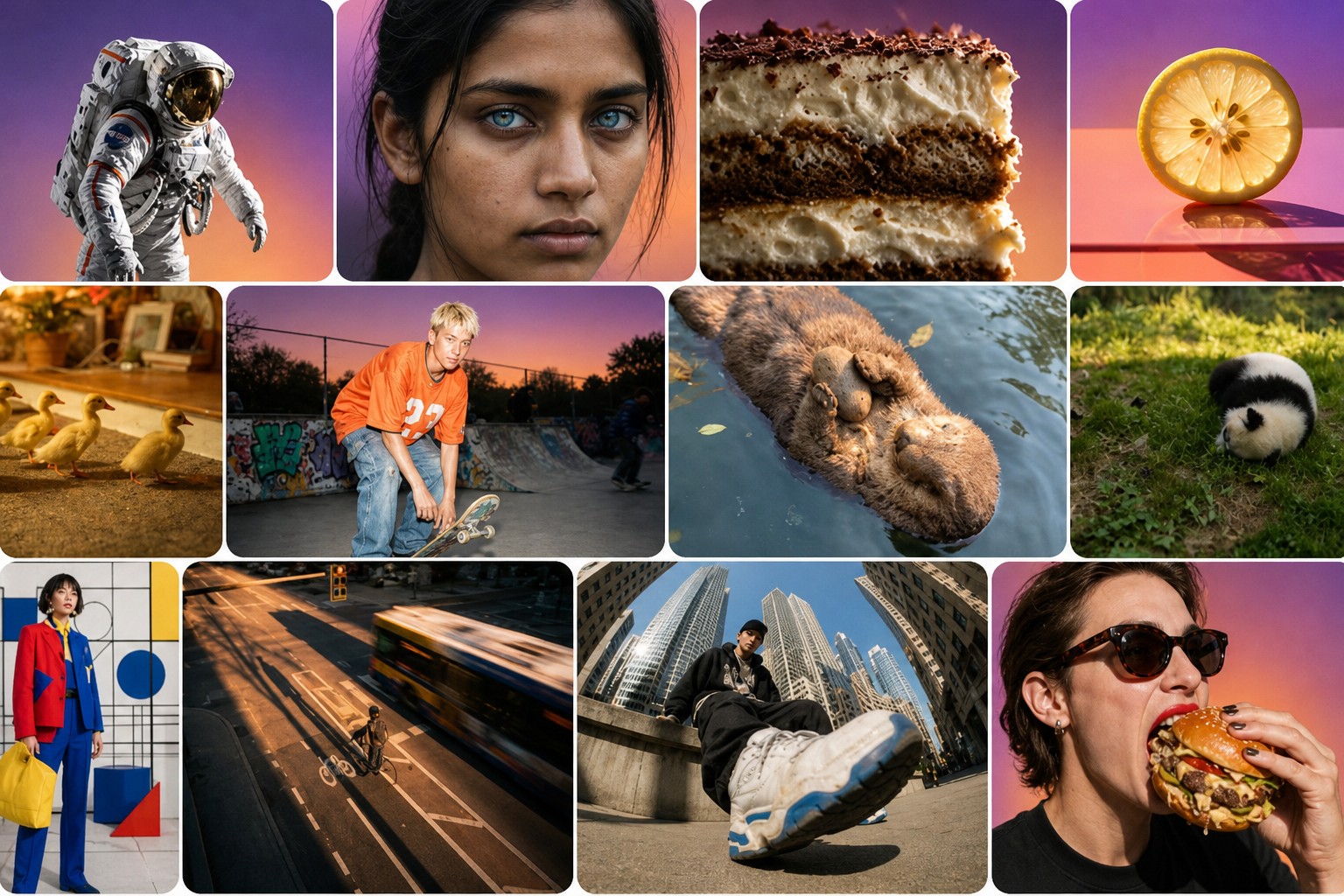
Meta has introduced Muse Image, an image model that does not go straight from prompt to picture. It runs as an agent: it searches the web, writes and executes code, criticises its own drafts, and keeps working as long as it has inference budget. Meta showed an early version of Muse Video at the same time. On Arena's human-preference Elo, Muse Image sits second in three categories at the time of publication — text-to-image, single-image editing and multi-image editing — while Muse Video sits third in text-to-video. The argument Meta is making is that image quality has become a function of how long a model is allowed to think.
Source: ai.meta.com
The agent framing is concrete rather than decorative. Meta gave Muse Image two tools. During reinforcement learning, it learned to write and run code to produce accurate charts and QR codes, then feed the rendered result back as an additional condition on the generation. Paired with Muse Spark, the two models exchange tools and plan media jobs together, producing animated GIFs, websites with embedded images and interactive visual games.
That coding detour is the most candid thing in the announcement, though Meta does not present it that way. A QR code either scans or it does not. An axis label is either right or wrong. Image generators are poor at outputs with exact answers, and Meta's fix is not a better generator — it is a renderer in the loop.
The second tool is search. Muse Image looks up information on the web so that generation rests on facts, current information and visual source material. Meta says this raises accuracy on knowledge-dependent prompts, particularly around current events and real-world detail, and that internal ablations show quality improving when the search tool is available.
Source: ai.meta.com
Then there is self-correction. The model inspects its own output mid-reasoning. For small problems it edits the current draft locally; for serious errors it regenerates the image or switches approach entirely, for instance by reaching for a tool that grounds the output in facts. Meta says this behaviour was not specified by hand. It appeared during reinforcement learning, because self-critique produced better images and therefore earned more reward. Internal ablations, again, show a quality gain.
Source: ai.meta.com
The scaling result is the part Meta clearly considers the headline. Like a language model, Muse Image produces better output when given more time to reason at inference. A larger compute budget buys longer reasoning, more tool calls and more self-correction steps, and human-preference Elo rises roughly log-linearly with it. The compute covers two different kinds of work — text tokens for reasoning, visual tokens for generation — and quality tracks the combined volume.
How the budget is spent matters. Best-of-N, where the model produces several images and picks one, improves quality quickly and then plateaus. The same compute directed into sequential reasoning keeps paying off considerably longer. Reasoning and tools reinforce each other: search supplies missing facts and source material, code reproduces details that reasoning alone cannot pin down. Meta's internal ablations show Elo improving as inference-time compute scales.
Source: ai.meta.com
On editing, Muse Image changes the elements a user asks about and leaves the rest alone. It handles several kinds of instruction and holds consistency across successive edits, which makes it usable for iterating toward a result rather than rolling for one. A single prompt can combine elements drawn from many source materials — people, objects, clothing, styles, environments — and text and images can be interleaved inside the prompt to assemble complex compositions.
Source: ai.meta.com
Muse Video is explicitly an early version. Meta describes competitive results on prompt-following, visual fidelity and motion consistency over time, and names the areas still giving it trouble: synchronising audio with image, and rendering fast movement in a physically accurate way. It will reach creators and Meta AI users soon.
Source: ai.meta.com
Muse Image also ships with Content Seal, Meta's invisible watermarking system. Images generated in the Meta AI app and on meta.ai carry a hidden provenance signal that survives cropping, compression, resizing and screenshots. Meta plans to extend Content Seal to video shortly, and is running preview tests of a tool that checks for the watermark and helps determine whether an image came from Meta AI.
Source: ai.meta.com
Three times the announcement states that internal ablations showed improvement, and three times it gives no magnitude. Second place in three Arena categories and third in a fourth, and the announcement does not say who holds first or by how much. Elo gaps at the top of a leaderboard are sometimes a rounding error and sometimes a chasm; without the numbers a reader cannot tell which this is. This reads like a launch measured against the field rather than against a specific rival, which is the posture of a company that is close but not ahead.
Source: ai.meta.com
The number missing from all of it is cost. If quality is log-linear in inference compute, then each increment of quality is exponentially more expensive to produce, and the place Meta intends to put this model is its consumer products — the Meta AI app and meta.ai. The announcement carries no pricing, no latency figures, and no statement of how much thinking a Meta AI user actually gets per image. That figure, not the Arena placement, determines what most people will experience.
Source: ai.meta.com
Meta's closing note is that Muse Image is tightly bound to its own ecosystem, and that further investment in image and video generation should widen what creators and businesses can make inside Meta products. That framing contains the tension. The agentic loop that earns Muse Image second place is the same loop that gets throttled first when a model moves from a leaderboard into a consumer app. Second place with unlimited thinking time and second place at product scale are not the same model.