
At its Ignite conference, Microsoft AI introduced seven specialized models for coding, cybersecurity, image and speech processing, and workflow management. They are designed to cut costs for AI agents that run continuously and to compete with OpenAI and Anthropic models on value for money. Microsoft says MAI Code 2 averages 98% of GPT-6.1 Sol’s results across four benchmarks at 40% of its cost, while MAI Cyber 2 Flash slightly outperforms GPT-6 Astra on a vulnerability-finding test. Enterprise customers can also fine-tune selected models on their own data in Azure.
Microsoft brings seven in-house AI models to business
Models for coding and workplace tasks
Microsoft released all seven models at once rather than spreading the rollout over a year, as it did at its Build conference in June. The main bet is on cost at a given level of quality: Microsoft says customers’ token costs rise quickly when AI agents run around the clock. The coding models are intended for everyday enterprise tasks, but are not yet optimized for foundational research or long-running tasks involving AI agents.
MAI Code 2 averages 98% of GPT-6.1 Sol’s score across four benchmarks at 40% of its cost. Compared with Claude Opus 5.5, it scores 96% and costs 5% as much. Microsoft tested the model on DeepSWE 1.1, Terminal Bench 2.1, SWE-Atlas, and FrontierCode v1.1. Three tests ran on Microsoft’s internal MSBench platform through GitHub Copilot CLI, without subagents. In calculating cost, Microsoft applies a 50% promotional discount to its own model.
In blind comparisons of interfaces, games, data visualizations, and SVG graphics, evaluators preferred MAI Code 2’s output to GPT-6 Sol’s in 64% of cases, Microsoft says.
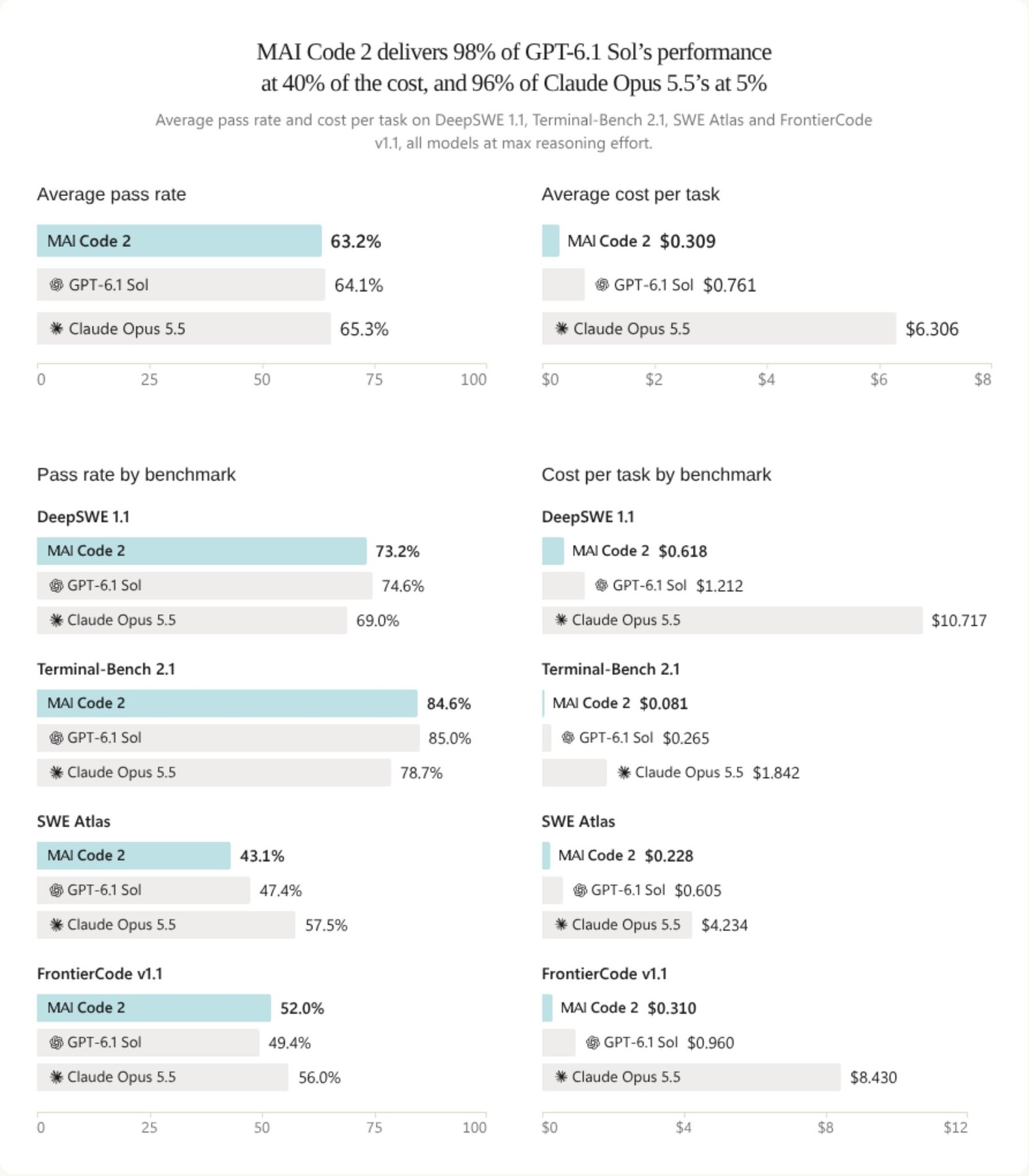
MAI Code 2 trails GPT-6.1 Sol and Opus 5.5 slightly on success rate but costs only a fraction per task, calculated at the promotional price. | Image: Microsoft
Source: the-decoder.com
MAI Code 2 Flash, the successor to MAI-Code-1.1-Flash, is designed for code explanations, targeted edits, and routine fixes. Microsoft says it is comparable to GPT-6 Luna and Claude Haiku 5.5, while costing 65% and 20% of their prices, respectively.
Microsoft built MAI Work Flash for Microsoft 365 and Fabric IQ on the Flash model. On internal Excel and PowerPoint benchmarks, it matched GPT-6 Luna. In Word, it scored at the level of GPT-6.1 Sol while using about 42% fewer input tokens. For generating DAX queries in Power BI, it outperformed GPT-5.6 Sol, GPT-6 Astra, and Opus 5.5.
In GitHub Copilot, the promotional price for MAI Code 2 through May 17, 2027, is $0.50 per million input tokens and $2.50 per million output tokens. After that date, the price will rise to $1 and $5, respectively. For MAI Code 2 Flash, rates through the same date are $0.05 per million input tokens and $0.25 per million output tokens; after that, they will be $0.10 and $0.50.
Cybersecurity and benchmark validation
On the CyberGym-E2E vulnerability benchmark, MAI Cyber 2 Flash solves 92.3% of tasks, compared with 91.5% for GPT-6 Astra. GPT-6 Astra requires twice the reasoning budget, however. A task costs Microsoft less than 2% of what it costs to run on OpenAI’s model, and token prices are about a hundred times lower. On WebExploitBench, MAI Cyber 2 Flash scores 40.4%, above GPT-5.6 Cyber’s 38.4%.
During validation, Microsoft found that about 10% of the roughly 900 CyberGym tasks rely on the same open-source projects and vulnerability reports as parts of the company’s training data. Microsoft says the reference solutions were not included in training. Even so, the company removed those tasks from the evaluation of all models and compared results on the remainder.
There is no comparison with GPT-6 Cyber yet: that model is available only to select customers. Microsoft says additional safeguards are still needed for benchmarks involving AI agents and tools. The company plans to publish results in the coming weeks.
MAI Cyber 2 Flash has a context window of one million tokens—four times larger than MAI Cyber 1.1 Flash’s. Output tokens cost 86% less than they did for its predecessor. According to Microsoft’s press release, MAI Cyber models already handle nearly 40% of checks on the MDASH security platform.
MAI Cyber 2 Flash costs $0.10 per million input tokens and $0.50 per million output tokens. The corresponding prices for GPT-6 Astra are $10 and $50. On CyberGym-E2E, a task costs $0.45, compared with $34.38.
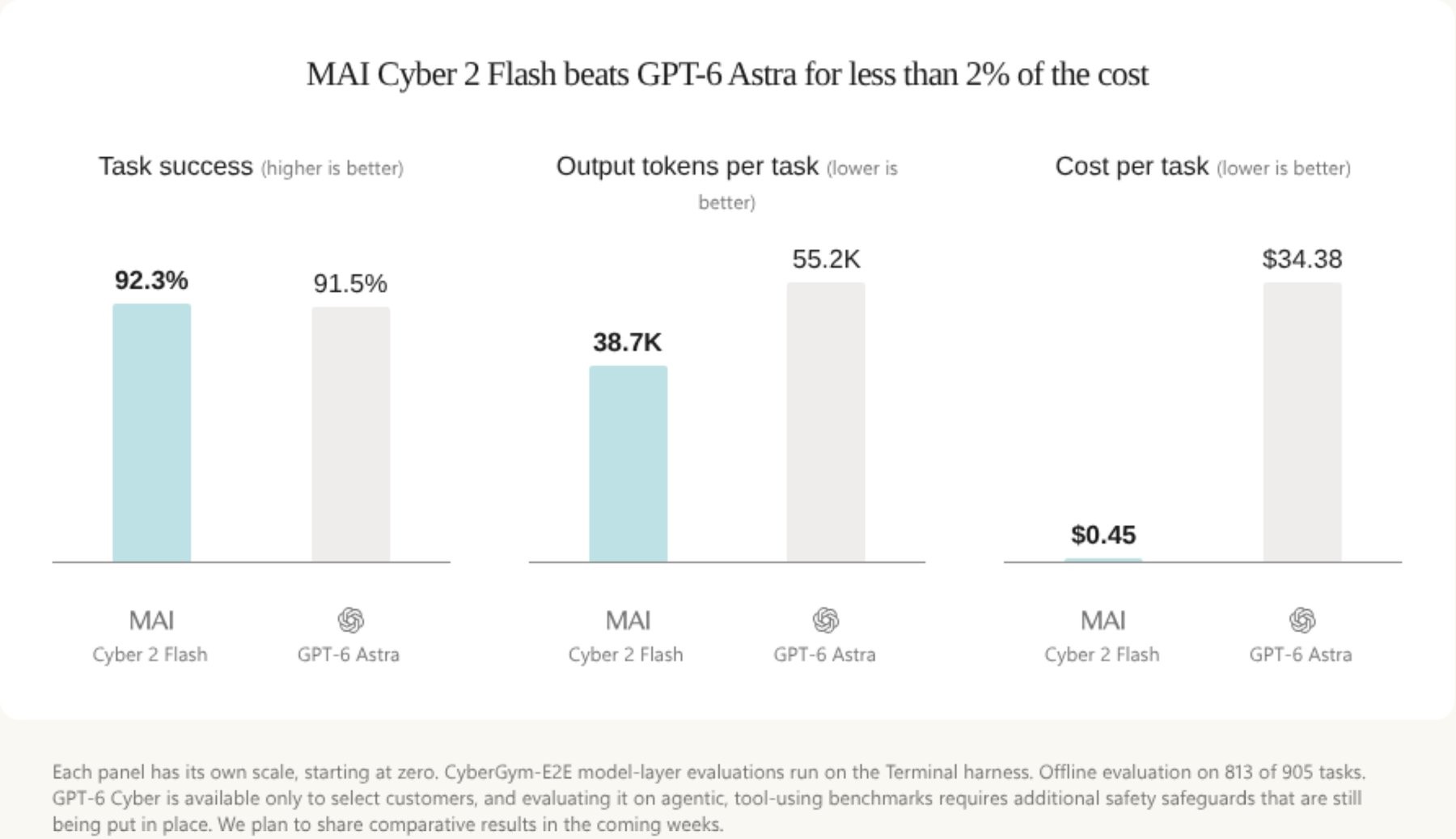
MAI Cyber 2 Flash solves slightly more tasks than GPT-6 Astra on CyberGym-E2E while using fewer tokens at a fraction of the cost. | Image: Microsoft
Source: the-decoder.com
A decision-making model built on Gemma
Microsoft-Decision-1.1 routes, classifies, and prioritizes requests, and manages workflows. It selects from actions approved by developers and provides calibrated confidence scores. If confidence is low, an application can pass the decision along rather than act on a guess. When data is incomplete, the model is supposed to abstain.
The model is based on Google’s Gemma 4 26B A4B, a mixture-of-experts model. The previous version used Qwen3.5-9B. Microsoft trained the new model with supervised learning and reinforcement learning on hundreds of synthetic and licensed datasets. It runs on Microsoft’s own inference system.
On Artificial Analysis’s Decision Index v2.1, Microsoft-Decision-1.1 scored 68—six points more than its predecessor and higher than Jev 1.14, Gemini Decision 1, and GPT-6 Luna (Decisions). Microsoft also tested the model on 102 internal benchmarks with more than 385,000 questions. Among eight decision-making models, it had the highest average accuracy.
The model now accepts images, including screenshots. In Copilot, it determines whether to route a request to Copilot or Cowork. Microsoft says the model delivers the accuracy of a large language model while running 2.2 times faster and costing 4.4 times less. In Cowork, the Auto feature decides how much reasoning effort to allocate to a task.
Microsoft-Decision-1.1 costs $0.042 per million input tokens, or $0.05 in the EU data-processing zone. Output tokens are free.
Microsoft described another specialized model, Microsoft-Retriever-1, in its Ignite news roundup. It finds relevant information in enterprise documents for AI agents in Foundry IQ. Rather than performing a single search, the model plans queries, checks results, and makes additional searches until it has gathered enough material to support an answer. Microsoft says this approach is faster and more effective than previous methods. Retriever-1 is launching in preview. Model Router in Foundry now also automatically selects models from an expanded set.
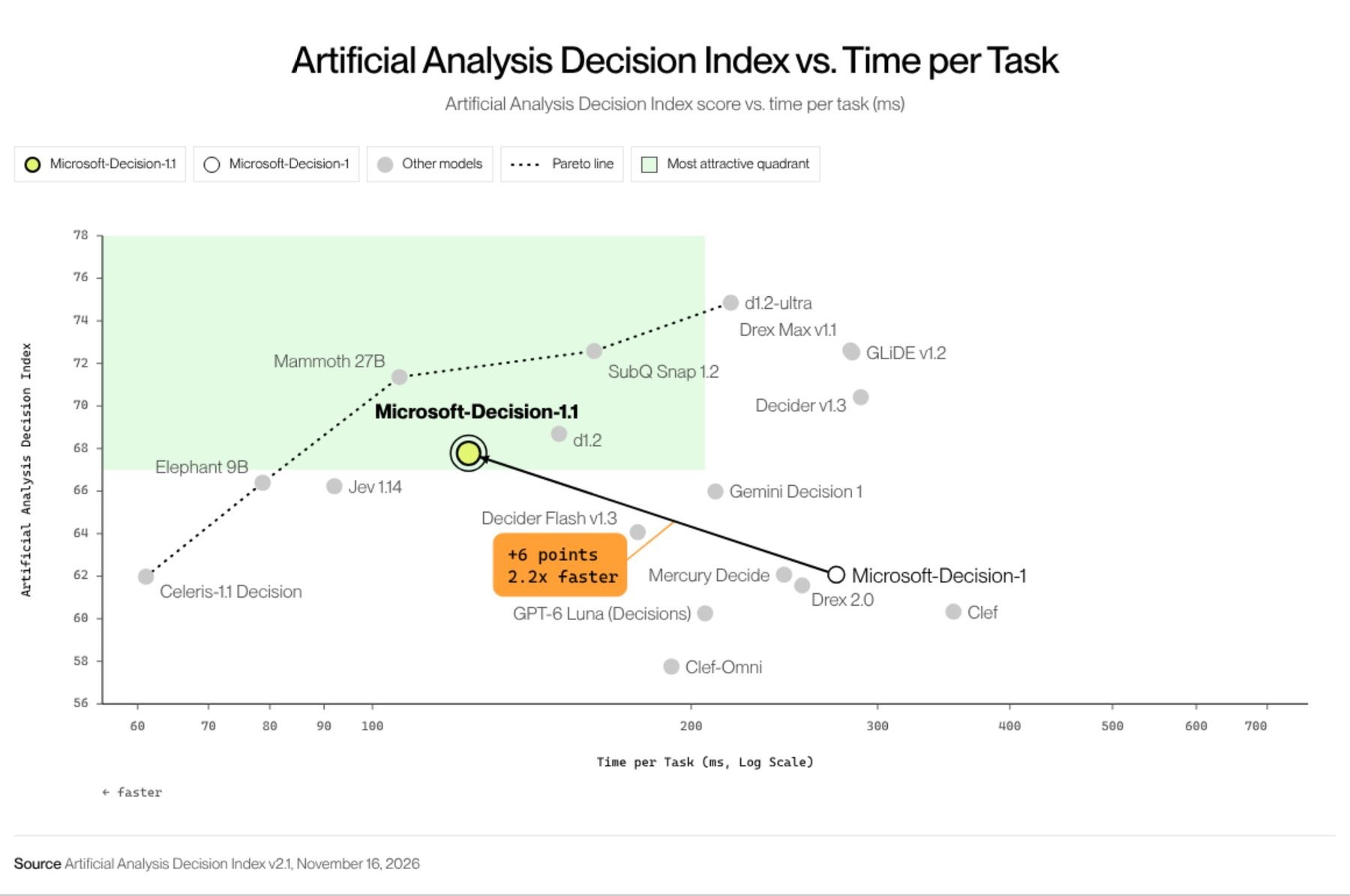
On the Decision Index from Artificial Analysis, Decision 1.1 gains six points over its predecessor and responds more than twice as fast. | Image: Microsoft
Source: the-decoder.com
Image editing and speech
MAI Image 2.7 ranks first on Artificial Analysis’s image-editing leaderboard, with 1,215 Elo points based on 5,478 votes. That is four points above GPT Image 2.6 Sunburst (max), at one-fifth the cost. In text-to-image generation, the model ranks fourth on the same leaderboard. A thousand images generated with MAI Image 2.7 cost about $35; the Flash version costs about $10.
The model can change the color, material, or position of individual objects without affecting the rest of an image, and can create transparent backgrounds. The smaller Flash version costs less than a third as much as the full model and is used in Canvas, a new image editor in MAI Labs. Since June, MAI Image has been the default in Bing Image Creator. Microsoft says Adobe, Figma Weave, Minute (Sports Illustrated), Wirestock, and Manus also use the model.
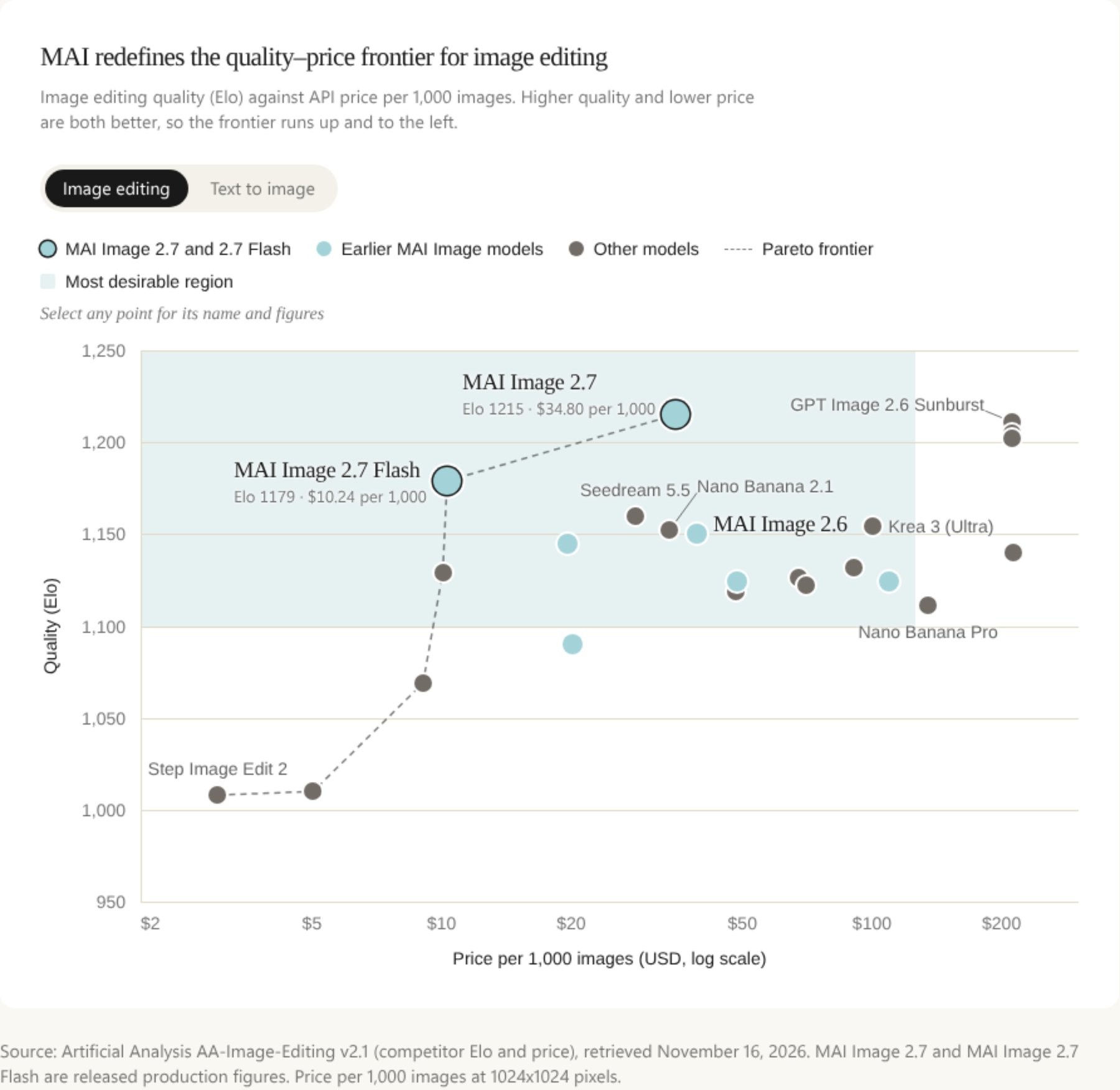
According to Artificial Analysis, MAI Image 2.7 and 2.7 Flash match GPT Image 2.6 Sunburst's editing quality at much lower prices. | Image: Microsoft
Source: the-decoder.com
MAI Realtime 1 is Microsoft’s first speech-to-speech model. It is designed for conversations with interruptions, can wait for a speaker to finish, and can recognize requests amid background noise. For complex tasks, the model switches to a more powerful reasoning system, billed by token; the base rate is charged by audio minute. Microsoft says the model outperforms GPT Realtime 2.1 on Big Bench Audio, τ-Voice, and tests with Dynamics 365.
MAI Realtime 1 is compatible with the OpenAI Realtime API, so existing voice applications can switch to it. Agoda and Reservations.ai are testing the model. Microsoft also plans to add it to Dynamics 365 Contact Center and Dragon Copilot, where nurses will be able to use the system to practice conversations with patients.
Dragon Copilot Transcribe, powered by MAI Transcribe 2, now processes all doctor-patient conversation recordings in Dragon Copilot—10 million conversations a month, Microsoft says. In multilingual workflows, the number of errors is cut in half. Microsoft now uses Maia 200, the second generation of its AI accelerator, for its own large models. The company says it delivers 1.7 times more tokens per watt.
One minute of audio on MAI Realtime 1 costs one U.S. cent. Use of the reasoning system is billed separately: $1 per million input tokens and $5 per million output tokens.
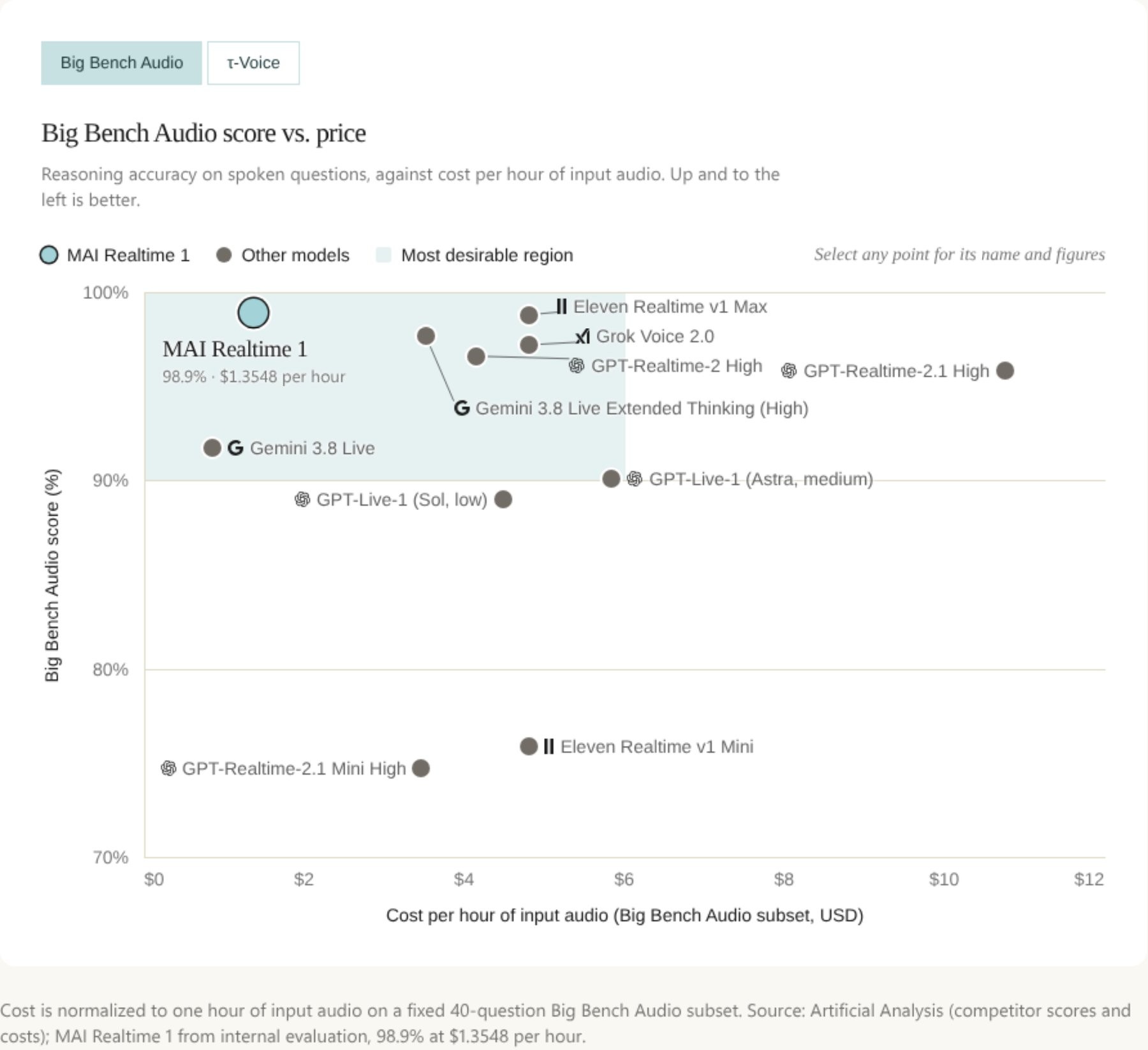
MAI Realtime 1 scores highest on Big Bench Audio at comparatively low cost, according to Microsoft's own measurement. | Image: Microsoft
Source: the-decoder.com
Model customization and availability
With MAI Licensed Weights, companies will be able to fine-tune MAI models on their own data and run them in their Azure environment. The data and settings will remain with the customer. Microsoft says it will use them to train its own models only with explicit consent.
The company contrasts this offering with open-weight models, arguing that organizations have difficulty verifying their provenance and behavior. Microsoft cites U.S. carrier AT&T as an example. According to available information, a customized model for analyzing 5G network performance outperformed GPT-6.1 Sol on standard tasks and cost about fifty times less. Microsoft has not announced a launch date or pricing. The offering is expected to arrive “soon” as part of the Frontier Company program; interested companies are invited to contact Microsoft representatives.
MAI Code 2 and Code 2 Flash are available in GitHub Copilot. Code 2 Flash can also be tested in a limited preview in Foundry. The models are expected to become available on OpenRouter, Vercel, Hermes, Open Code, and Kilo later.
MAI Image 2.7 and Flash are available in public preview in Foundry, as well as on fal, Genspark, OpenRouter, and Vercel. Decision 1.1 is available to all Foundry users, on OpenRouter, and through Vercel’s AI Gateway. MAI Realtime 1 can be tried in MAI Labs; in Foundry, it is available in preview for free until public testing begins. MAI Cyber 2 Flash is offered only in Microsoft security products. Starting in mid-December, MDASH will automatically replace the existing model in the MAI profile with it for eligible customers.
In April, Microsoft and OpenAI revised their partnership terms. OpenAI gained the ability to sell its products through any cloud provider, but Azure remains its primary cloud partner. Microsoft’s non-exclusive license to OpenAI models and products runs through 2032.
Dataist’s take: Microsoft is building a lineup of in-house models around the costs of running AI agents continuously, and already offers prices well below those of OpenAI models in some scenarios. Some comparisons, however, rely on Microsoft’s internal benchmarks, and the company has yet to publish results from evaluations of AI agents using tools. The option to customize models on customer data broadens the enterprise offering, but launch timing and pricing for MAI Licensed Weights remain unknown.
Daily AI news
Every day we pick what actually matters in AI and explain it plainly — no hype, no filler. Subscribe if you want to follow where the industry is going.
Only what matters — every day
Follow on X