
A model built to connect evidence
Microsoft Research says its work across computational biology and related fields spans more than two decades, including immunology, virology, genomics, biomedical imaging, cell biology and protein engineering. Quine turns that experience toward a broader ambition: a system that links a model of biology with scientific papers, laboratory experiments and the researchers using it.
The motivation is practical. Biological experiments take time, and many questions involve interactions and downstream effects that are difficult to study experimentally alone. A world model could help researchers explore possible interventions computationally, rank them and decide what to test. It would support experiments, not replace them.
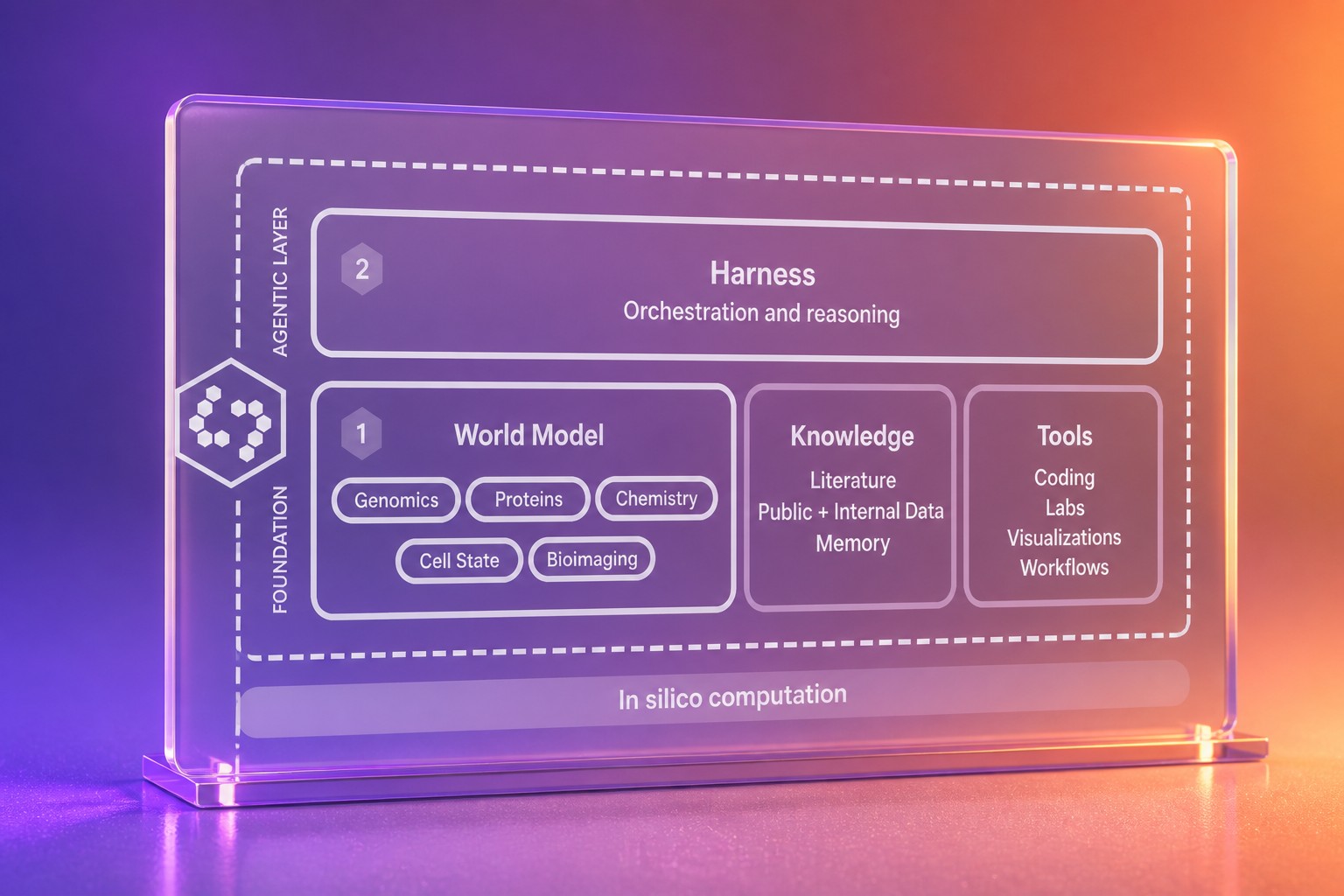
Quine combines a model trained across several forms and scales of biological data with a layer connecting it to models for coordination and reasoning, scientific tools, publications and research teams. Its model learns shared representations of sequences, structures, functions, cell states and images. Microsoft says information from one data type can then help predict another, allowing the system to capture relationships that separate specialist models might miss.
Figure 1: Quine’s two frontier components — a world model of biology and an interactive harness — sit inside a loop that begins and ends with the scientist. A question becomes a set of proposals, proposals become designs worth testing, and the experiment returns measurements that sharpen both the scientist’s next question and the model itself.
Source: microsoft.com
A cancer study as a test
One example comes from research on pancreatic ductal adenocarcinoma, or PDAC, the most common form of pancreatic cancer and one of the hardest to treat. Working with researchers at the Broad Institute of MIT and Harvard, Microsoft had spent several years developing and applying ex vivo models based on patient samples.
The team investigated whether cancer cells’ transcriptional state, as well as their genetics, could influence how tumors respond to drugs. Quine predicted and ranked thousands of compounds for their ability to move tumor cells from one treatment-relevant state to another.
In laboratory tests of a transition from the classical state to the basal state, the highest-ranked compounds produced the strongest expected changes. The researchers said the process, from narrowing the compound list to selecting candidates for testing, took one weekend. They estimate this could save months of experiments and substantial research costs. Some of the strongest effects came from compounds with unexpected mechanisms of action.
The reverse transition, from basal to classical, proved harder. Quine predicted that available compounds would have weaker effects. It also predicted that several compounds would move cells toward a distinct third phenotype, a result the laboratory experiments confirmed. The findings suggest that pancreatic cancer cell states do not fit neatly on a single classical-to-basal axis.
Figure 2: Biology is multiscale and multimodal. (A) Biological evidence stacks from molecules to cells to tissues to patients, with scientific language running underneath all of it. (B) The modalities Project Quine trains on — genomics, proteins, chemistry, RNA and cell state, bioimaging — each observe a different span of that range, and they overlap. Reading down is the causal path from genotype to phenotype; reading across is physical scale. Because the model learns these representations jointly rather than orchestrating separate specialists, evidence at one level can inform predictions at another.
Source: microsoft.com
That is the more interesting result: the model did not just help prioritize experiments, but also pointed researchers toward a biological pattern they had not fully anticipated. I think this is a more meaningful early test than a benchmark score, though the account does not quantify how often Quine’s predictions succeed or how the team measured the “strongest” changes.
Further work will add RNA datasets, improve predictions of transitions between cell states and assess the model’s confidence. The intended cycle is straightforward: experiments produce new evidence, which can inform the next version of the system.
Figure 3: Quine-guided exploration of pancreatic cancer cell states. In pancreatic ductaladenocarcinoma (PDAC) cell lines, top-ranked compounds produced the largest classical-to-basal transcriptional shifts as validated by wet lab experiments. Weaker reverse shifts and unexpected movement toward an additional phenotype were also consistent with Quine’s predictions.
Source: microsoft.com
Access, and what remains unclear
Microsoft is opening the Quine Fellows program to researchers working in biology and medicine. Initially, access will be limited to Fellows and selected research groups, with internal reviews and safeguards. Microsoft says it may expand access through products such as Microsoft Discovery as the technology develops.
The announcement leaves an important question open: how will researchers distinguish a useful prediction from a persuasive but unreliable one when data are sparse and the biological question is new? The pancreatic cancer example shows that Quine can help generate and test hypotheses. It does not yet establish how reliably that process generalizes across the other fields where Microsoft says the system is being used.
Quine’s value will depend less on whether it can describe biology in the abstract than on whether researchers can trust its guidance when choosing what to test. For now, the limited rollout keeps that judgment with a small group of scientists; wider access will make the evidence harder to keep within the lab.
Source: microsoft.com
Daily AI news
Every day we pick what actually matters in AI and explain it plainly — no hype, no filler. Subscribe if you want to follow where the industry is going.
Only what matters — every day
Follow on X