
MiniMax has released M3.1 Flash, a model that pairs competitive benchmark results with a reported cost of about $0.22 per task. It beats Deepseek on some tests and loses on others, while using fewer output tokens in the comparison. The trade-off is stark: Artificial Analysis reports a 93% hallucination rate, because the model attempts every test question even when uncertain. That makes M3.1 Flash less a clear performance winner than a sharp example of how far Chinese AI pricing can fall—and what users may have to accept in return.
A mixed scorecard
On Humanity’s Last Exam, M3.1 Flash scored 48%, ahead of Deepseek at 43%. It also scored 22% on CritPt, a 71-question test of research-level physics reasoning. That was above GLM-5.3-Flash at 15% and Gemini 3.8 Flash at 18%, but below Deepseek at 24%.
On AA-Omniscience, which tests factual accuracy, MiniMax answered 56% of questions correctly. Deepseek scored 43%, and GLM-5.3-Flash 28%.
The head-to-head with Deepseek V4.1 Flash 1017 is less decisive. Deepseek leads the Intelligence Index, 45 to 42, and edges MiniMax on CritPt. MiniMax leads on the other two tests:
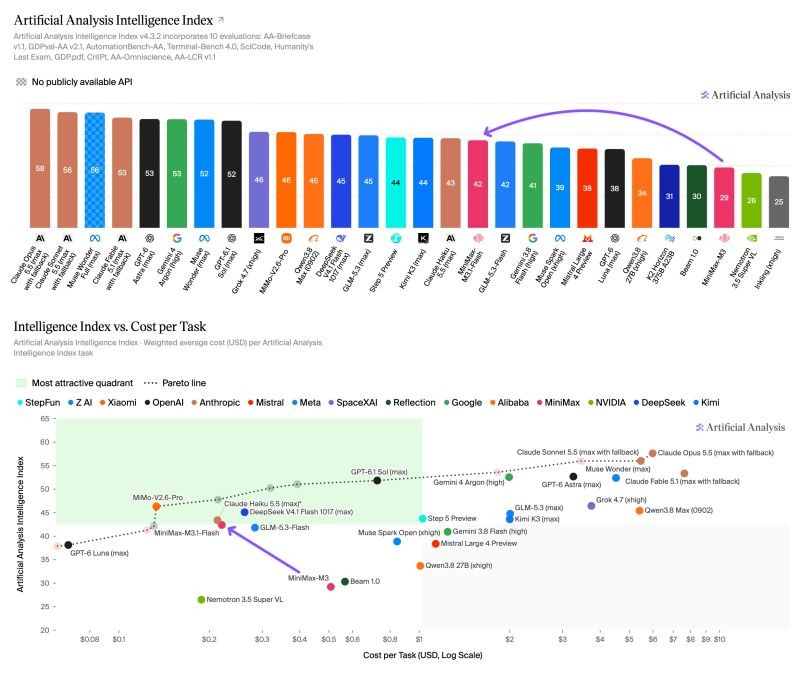
MiniMax-M3.1-Flash jumps from 29 to 42 points on the Artificial Analysis Intelligence Index compared to M3, while cutting cost per task sharply. | Image: AA
Source: the-decoder.com
What the price leaves out
MiniMax says M3.1 Flash runs three times faster than M3 and uses substantially fewer output tokens than competing models. In the benchmark comparison, it used about 189 million output tokens, against 224 million for Deepseek. The resulting estimated task cost is $0.22 for MiniMax and $0.26 for Deepseek.
The API charges $0.15 per million input tokens and $0.60 per million output tokens; cached input tokens cost $0.015 per million. The model accepts text and images and has a context window of up to one million tokens. Its API is available at platform.minimax.io, and MiniMax also offers the MiniMax Code desktop app.
I think the 93% hallucination rate matters more than the small price gap with Deepseek. A model that answers even when unsure may be cheap to run, but benchmark accuracy alone does not show how much checking a real workflow would require.
Open weights, different evidence
Both models are due to have open-weight versions. Deepseek is already available on Hugging Face; MiniMax plans to release its model on October 23.
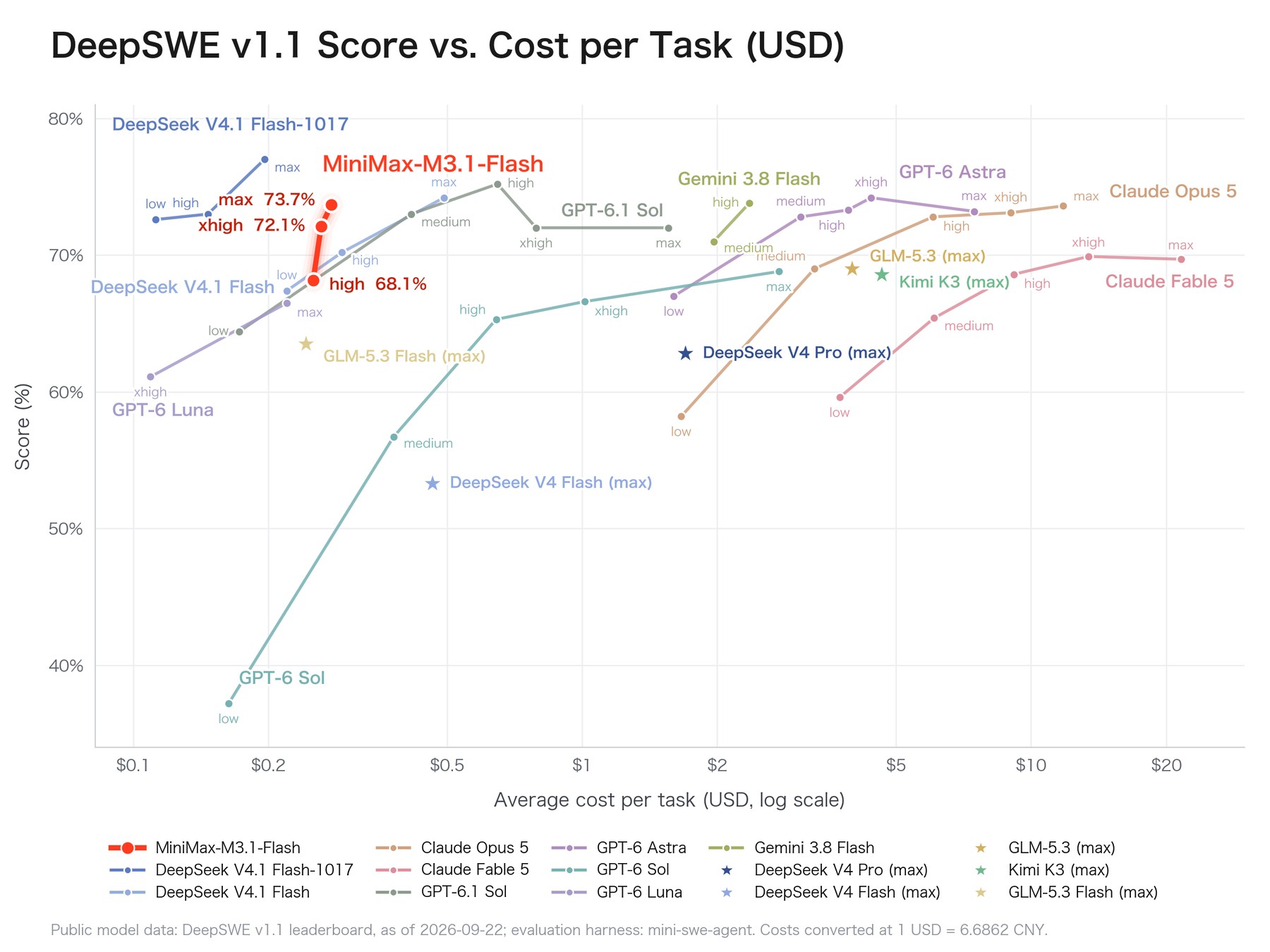
On DeepSWE v1.1, MiniMax-M3.1-Flash scores up to 73.7 percent at under $0.30 per task. | Image: MiniMax
Source: the-decoder.com
MiniMax’s results make a case for low-cost inference, not dependable answers. Until the open-weight release gives developers a chance to test that trade-off for themselves, the headline price tells only part of the story.
Daily AI news
Every day we pick what actually matters in AI and explain it plainly — no hype, no filler. Subscribe if you want to follow where the industry is going.
Only what matters — every day
Follow on X