
One wing design, two fluids
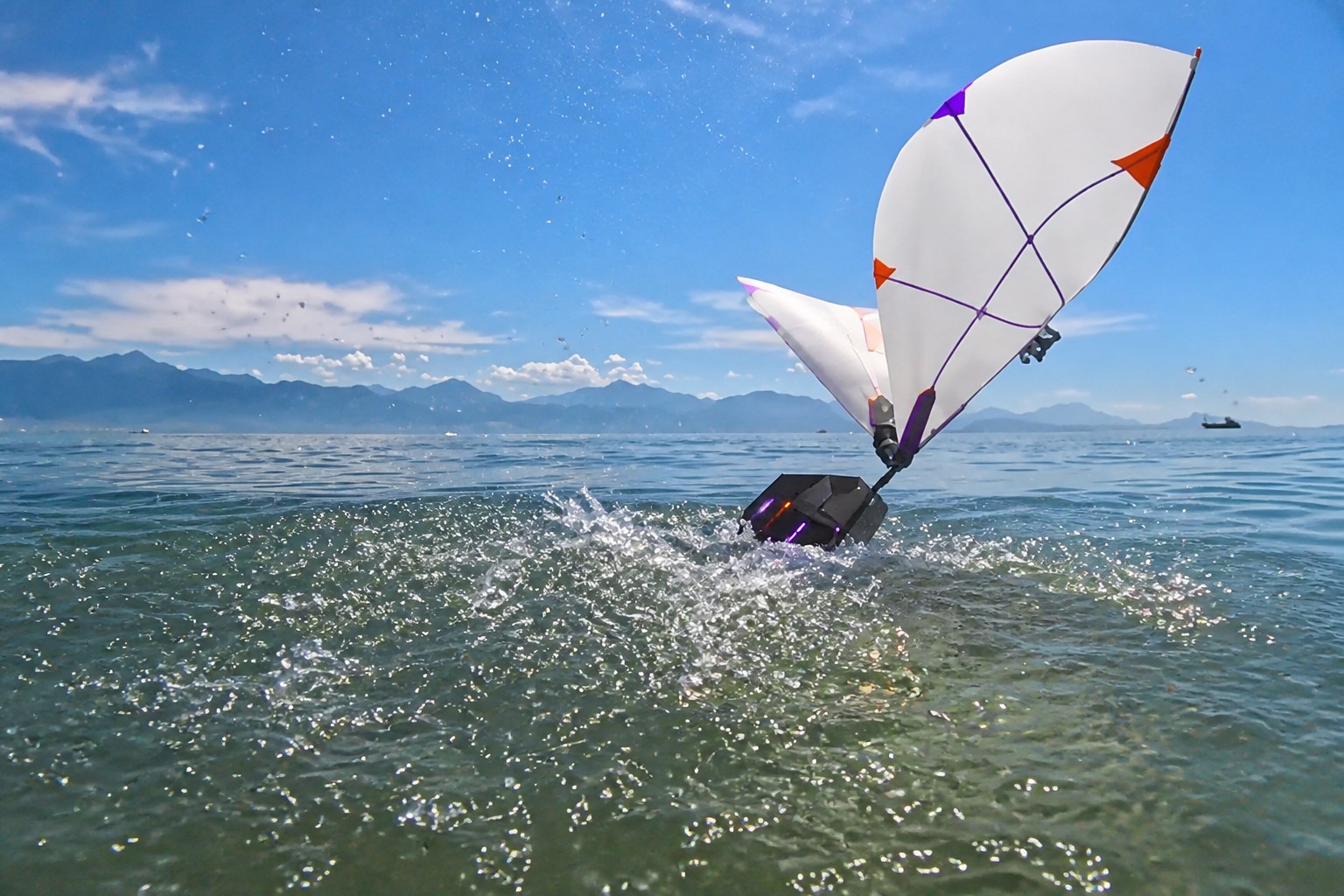
The researchers call it a flapping-wing aerial-aquatic vehicle, or FAAV. Its central body houses a battery and a waterproof motor, which turns a crankshaft to drive two flexible wings at a set frequency. A motorized tail changes angle to control whether the robot climbs or dives. The wings use thin membranes with a water-repellent nanoparticle coating.
Water is roughly a thousand times denser than air, so a mechanism suited to one medium does not automatically work in the other. The team, led by MIT associate professor of mechanical engineering Rafael Zufferey, tested the robot in a pool and on Lake Geneva to find combinations of wing size, flap rate, and tail angle that would allow a smooth transition between swimming and flight.
What the tests revealed
Medium-sized wings worked best. They could reduce their range of motion in water while remaining stiff enough to support the robot in flight. Its speed and flapping frequency were close to those of birds, and a steep 70-degree angle helped it launch out of the water.
Some diving birds push off the surface with their feet. The robot did not need them.
The proposed use is fieldwork in places that are difficult or expensive to reach by boat. Zufferey described oceanographers, marine biologists, or coastal residents launching the robot from shore or a vessel. It could fly to an iceberg, a port structure, or a pod of whales, dive to take a measurement or collect a sample, then return with data. The team says this could cost much less than traditional methods, and the robot could be sent out again after returning.
The gap between a demonstration and a tool
The next work is practical: wings that can both flap and rotate, plus tests in rough water and windy conditions. The team hopes to use the robot for oceanographic tasks, where frequent measurements across many locations are difficult to collect.
I think the more consequential claim is not that the robot can move through air and water, but that it might repeat the trip often. Zufferey’s envisioned cadence is hourly missions instead of weekly ones: fly to a site, dive, bring back data, and go again. That ambition depends on capabilities the team has not yet demonstrated in the reported tests. Until the robot handles rough water and wind, its promise is a new way to reach sampling sites, not yet a dependable alternative to existing field methods.
Source: technologyreview.com
Daily AI news
Every day we pick what actually matters in AI and explain it plainly — no hype, no filler. Subscribe if you want to follow where the industry is going.
Only what matters — every day
Follow on X