
What the lab actually automates
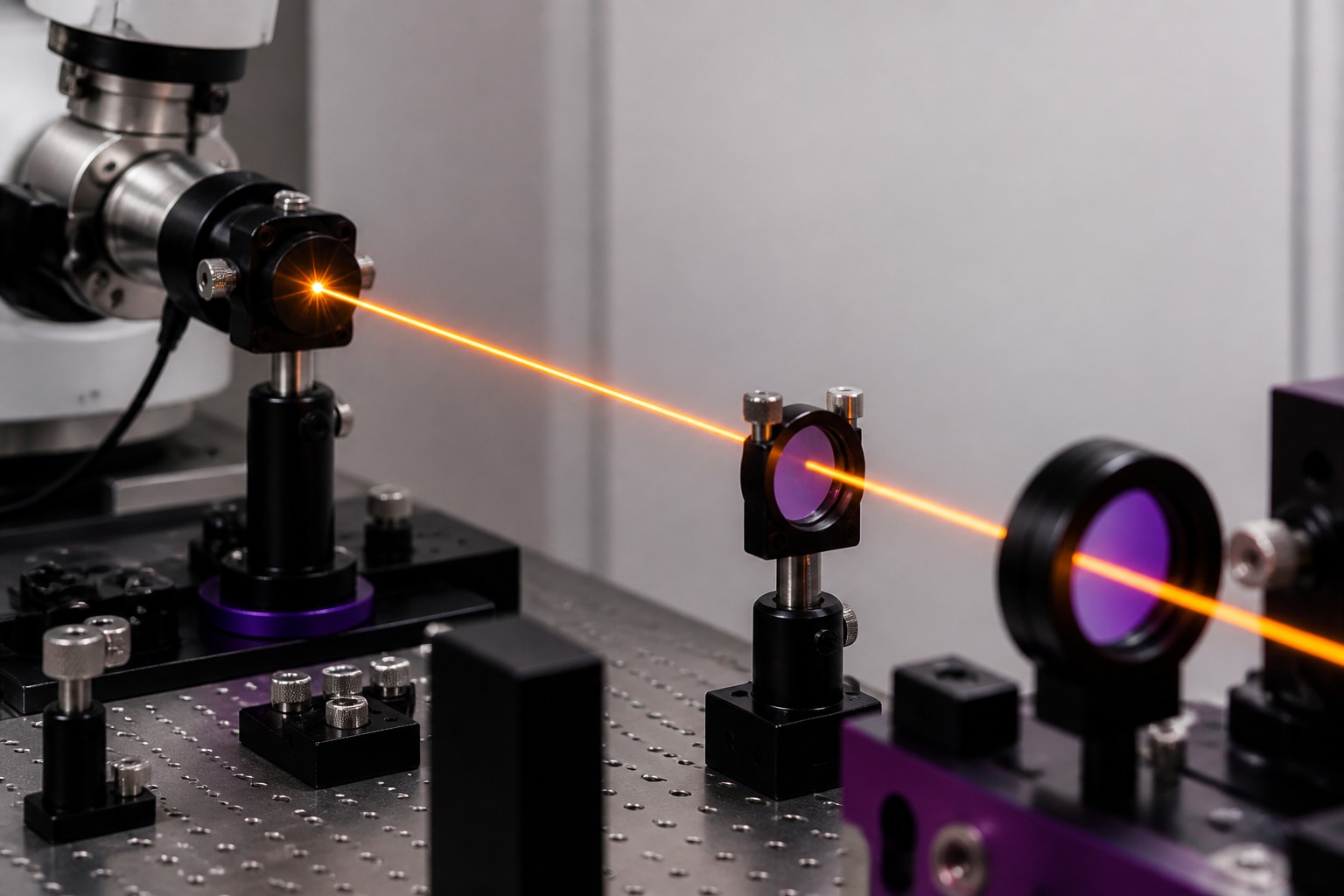
According to Jennifer Chu of MIT News, the laboratory can independently arrange standard optical components into the required configuration. It then changes the position and angle of mirrors and lenses to produce light beams with defined properties.
After an experiment, the robot can safely take the apparatus apart and build a different one from the same parts. Researchers can also access the laboratory remotely.
That combination is more significant than simple robotic handling. The useful capability is not just picking up a lens; it is moving between experimental configurations without requiring a human to rebuild the optical path each time.
Marin Soljačić, MIT’s Cecil and Ida Green Professor of Physics, said the robot does not get tired of repetitive tasks and can work 365 days a year, 24 hours a day. The intended benefit is to give scientists more time for developing theories and testing what else can be done.
A robot built for reconfiguration
The system is based on a robotic arm with seven movable joints, mounted on a metal tabletop. Its workflow depends on standardized containers rather than direct handling of loose optical parts:
Engineers also built a virtual user interface that lets a person involved in the work control the experiment directly.
That interface is an important detail. The project is not presented as a laboratory with no human role; it is a system for making the physical setup more adaptable while keeping a researcher in the loop. The robot handles repeatable positioning and assembly, while the scientist can still direct the experiment.
Why light matters to quantum mechanics
One possible use is quantum mechanics, where researchers study very small objects that appear to follow rules of their own. Atoms are the building blocks of matter, while light waves are electromagnetic fields.
A laser, for example, can hold atoms in place through an optical dipole force. This gradient force acts on polarizable particles, drawing them toward regions of highest light intensity or pushing them away. It results from the interaction between the gradient of the light field’s intensity and the particle’s induced dipole moment.
That principle underlies optical tweezers. The force can fix an atom in place and let researchers act on its own electric field.
The system could help scientists develop ways to test predictions involving:
I think the project’s strongest claim is therefore narrower than “AI will accelerate science.” It shows how automation can reduce the physical friction between one optical experiment and the next. If changing an apparatus becomes faster and more reliable, researchers can spend more of their time deciding which experiment deserves to be built.
What remains unclear is how much of the scientific process the system can handle beyond assembly and alignment. I would want to know how researchers specify a new experiment, how often a human must intervene, and how the laboratory responds when a component or measurement behaves unexpectedly. Those details will determine whether this is mainly a highly capable robotic workbench or a broader research system.
The distinction matters as AI systems expand into scientific work. The immediate advance here is not an autonomous scientist. It is a robot that makes optical hardware less static—and that may be enough to change how quickly researchers can explore the fundamental properties of matter.
Daily AI news
Every day we pick what actually matters in AI and explain it plainly — no hype, no filler. Subscribe if you want to follow where the industry is going.
Only what matters — every day
Follow on X