
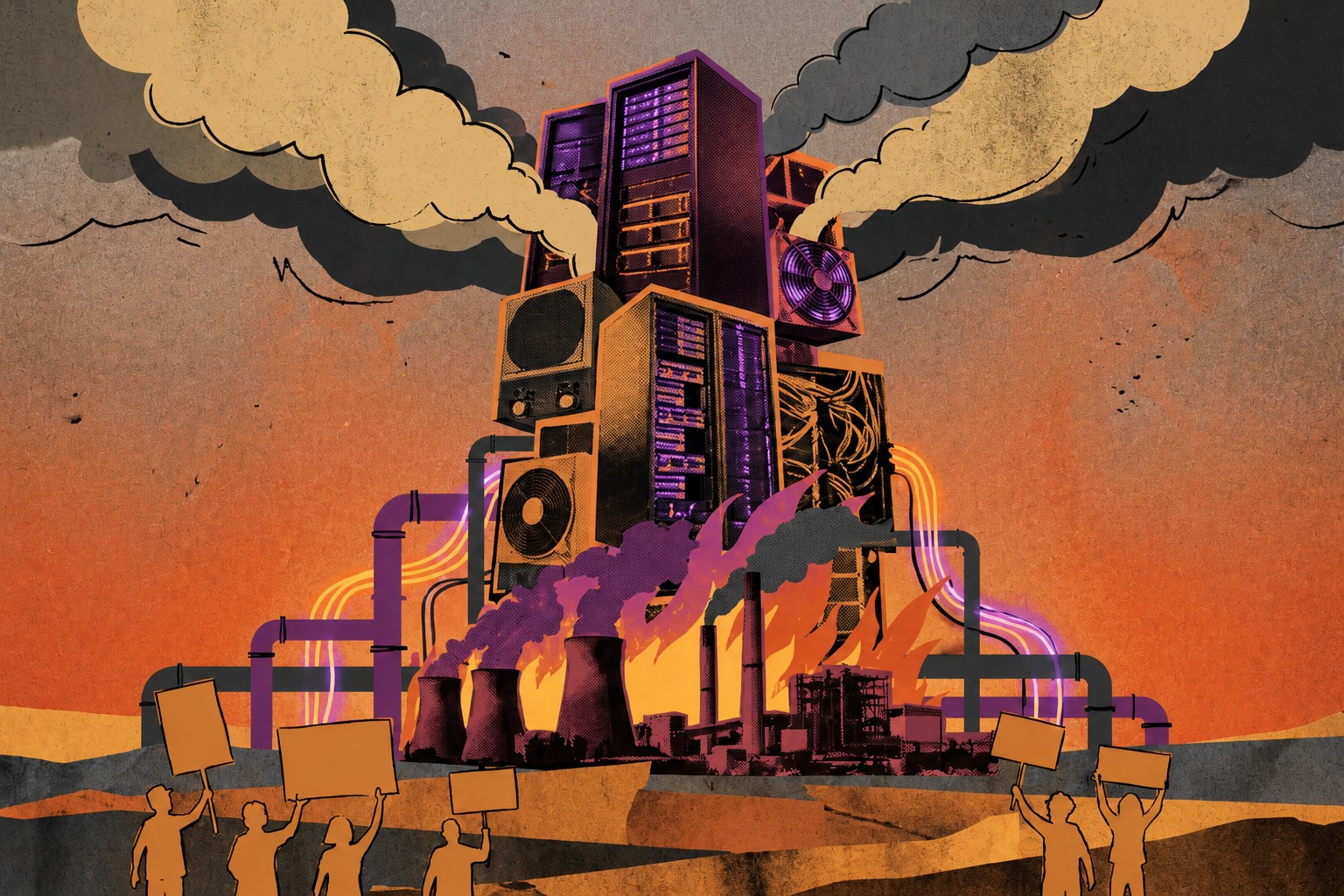
Around 400 of the largest data centers in the US consumed about 82 TWh of electricity over a year, with 54% of that energy coming from fossil fuels. Researchers at Harvard University estimate that the associated CO₂ emissions reached 25.7 million metric tons — as much as or more than Denmark emits in a year. The International Energy Agency (IEA) expects global data center emissions to rise to around 350 million tons a year by 2035. At COP31, a voluntary climate agreement for the industry was presented, but it is not binding.
More than half the electricity used by the largest US data centers comes from gas and coal
How much energy data centers consume
A Harvard University study published in Nature Sustainability is one of the first estimates of energy use and emissions at the level of individual large data centers. A team led by Gianluca Guidi and Francesca Dominici identified 403 sites using satellite images and compared their estimated energy consumption with emissions data from regional power grids. The calculations covered the period from May 2024 to April 2025.
Depending on the assumed utilization of the sites, annual consumption ranged from 68 to 99 TWh. The upper estimate is comparable to the electricity use of entire states — Indiana, Michigan or Tennessee. In the researchers’ main scenario, data centers used about 82 TWh, or roughly 1.8% of all electricity consumed in the US. More than half of that total was used in four states: Virginia, Oregon, Ohio and Iowa.
About 54% of the electricity used by the sites studied was generated from fossil fuels: 38% came from natural gas and 15% from coal. In the main scenario, this amounted to 25.7 million metric tons of CO₂ over the year. Study co-author Dominici compared that volume with the annual emissions of Michigan or a small European country such as Denmark. The resulting estimate is two to three times higher than a comparable calculation for 2018.
The authors stress that the study captures conditions only at the time of observation: data collection ended in April 2025, and demand for electricity from modern AI agents has continued to grow since then. According to a Climate Action Against Disinformation report cited by the Associated Press, energy consumption by the largest technology companies rose 240% from 2022 to 2025. As a result, they did not meet their own climate targets.
Another 2,000 data centers are planned in the US. Dominici warns that their expansion could make it harder to cut CO₂ emissions. Using electricity with a high share of fossil fuels also increases concentrations of air pollutants — fine particles, nitrogen oxides and sulfur dioxide. These are linked to heart and lung disease and premature death, though the study did not assess specific health effects.
Gas-fired power plants and pressure on grids
In its report Powering Artificial Intelligence, the International Energy Agency warns of growing pressure on power grids and the climate. The agency says the world’s largest data center operators will invest more than $700 billion in 2026, mostly in new facilities. In the IEA’s main scenario, annual CO₂ emissions from data centers will rise from around 150 million tons today to 350 million tons by 2035.
Plans by US operators to build gas-fired power plants directly at data center sites played a significant role in the revised forecast. This would let them avoid long waits for grid connections. Nearly 40% of the identified capacity of AI data centers is located in regions with high or extremely high water stress.
New facilities are already creating difficulties for local grids. In Texas, Virginia, Finland and the UK, the combined capacity requested for grid connections exceeds current peak demand. According to the IEA, nearly 40% of the 134 grid-integration rules it tracks were adopted in the past 12 months.
Regulators are considering different ways to limit the costs of grid expansion for households and screen out speculative applications. Possible measures include requiring operators to pay in advance for a minimum volume of electricity, deposits, project exit fees, flexible connection terms and, in some cases, requiring facilities to provide their own reliable generation under a “power first” principle.
Reducing computing loads at operators’ request is expensive. Renting AI capacity costs $20–30 billion per gigawatt per year — about 100 times more than comparable battery storage capacity.
Voluntary climate agreement at COP31
Criticism of the AI industry’s resource use has already led to protests against new sites in the US and political backlash in recent elections. The issue was also on the agenda at the UN climate conference COP31 in Turkey: the International Telecommunication Union and the conference presidency presented the “Antalya Declaration on Artificial Intelligence” on Monday. The declaration followed a 50% increase in energy consumption by AI data centers in 2025.
The declaration calls on governments and companies to:
Separately from the declaration, conference participants are discussing the use of heat generated by data centers. According to the IEA, by 2030 it could provide district heating for around 10% of households in Europe.
UN climate chief Simon Stiell warned in Antalya that people should not pay for uncertain promises of future AI efficiency through higher electricity bills and more pollution. Supporters of the technology, including former US Vice President Al Gore, expect AI efficiency gains to help cut global emissions by 6–9% by 2030. But the Antalya Declaration is not legally binding: measures on data disclosure and energy supply remain voluntary, and are due for their first review at COP32.
Dataist’s take: Forecasts suggest that the expansion of AI infrastructure will depend not only on access to computing capacity, but also on where the electricity and water to support it will come from. The Antalya Declaration sets out areas for action, but does not require operators to change their energy supply or disclose data.
Daily AI news
Every day we pick what actually matters in AI and explain it plainly — no hype, no filler. Subscribe if you want to follow where the industry is going.
Only what matters — every day
Follow on X