
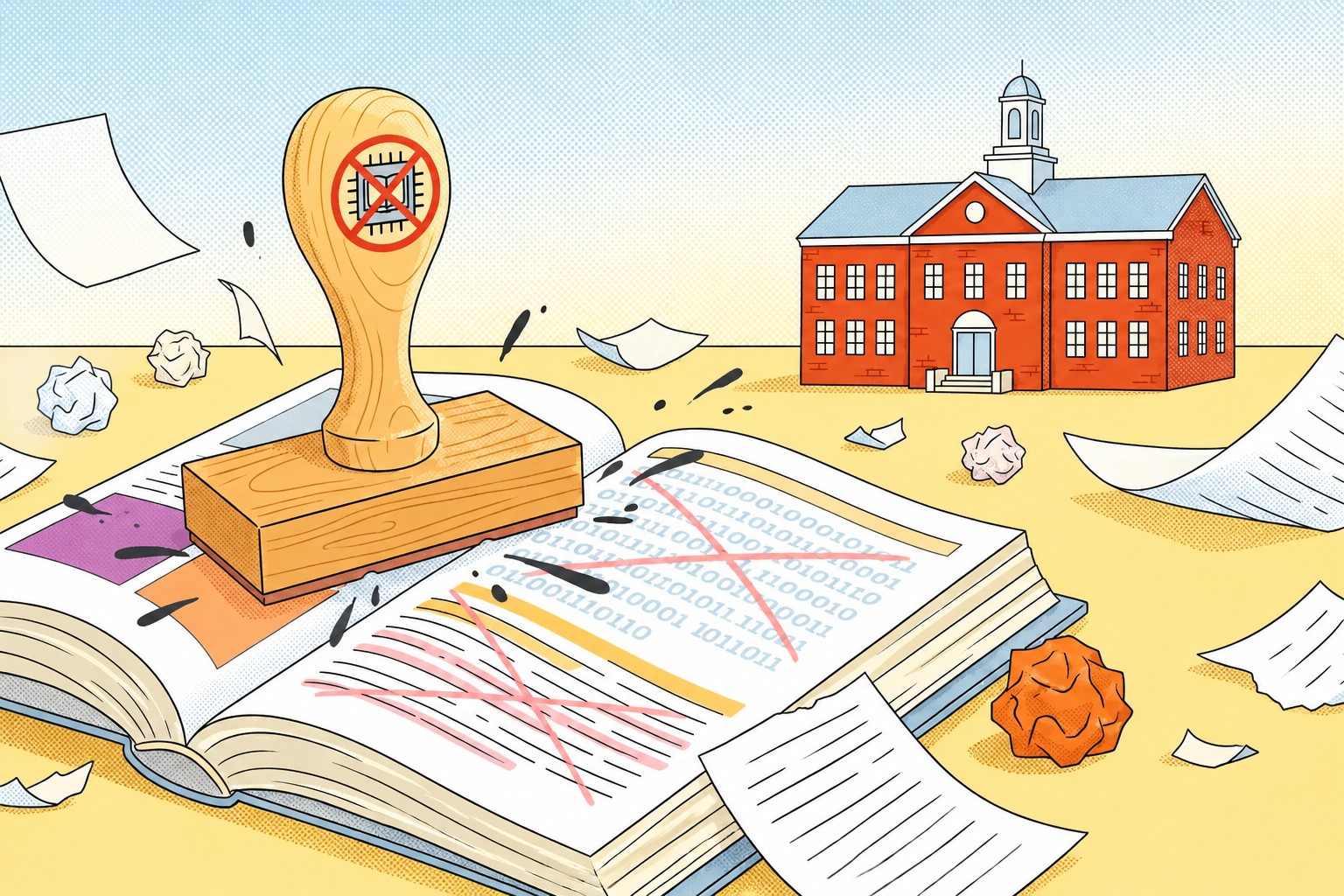
New York City has barred AI tools from its public schools through eighth grade. The decision came out of City Hall rather than a curriculum committee: mayor Zohran Mamdani, according to The New York Times, said the technology industry is trying to present learning with AI as inevitable, and that the city does not intend to accept that approach. Alongside the ban, the education department recommends that middle-school students keep screen time to 45 minutes a day. A working group of teachers, politicians, experts and union representatives has until April 2027 to produce a report that will serve as the basis for the city's future AI policy in schools.
The rules have already been called too weak. Parents for AI Caution, a parent group, is demanding a full two-year moratorium on AI in schools. Its representatives argue that children will not develop independent thinking if they hand reasoning off to software — a process British researchers recently labelled "cognitive surrender."
The interesting part of the mayor's framing is not the ban but the word inevitable. Vendors have spent the past few years selling AI in education as a question of when, not whether, and the standard municipal response has been to negotiate terms. New York has instead answered the question the industry treats as settled, and answered it in the negative for the youngest grades. That is a different kind of refusal from a procurement delay.
What the announcement is quiet about is definition and enforcement. Nothing made public says what counts as an AI tool once the model sits inside a search box, a keyboard's autocomplete, a translation feature or a word processor's suggestion bar — which is where most of it now lives, and where a district cannot simply decline to install it. A ban on identifiable AI products is enforceable. A ban on AI in software children already use is a procurement problem the city has not described solving.
The two-year moratorium demand has the same shape from the other direction. Two years is a number, not an argument, and the group has offered no account of what would be different in 2028 — what evidence would arrive, what the schools would have built in the meantime. Both the city and its critics are buying time; only the city has said what it plans to do with it.
That leaves the grades above eighth governed by nothing in particular until April 2027, which is where the homework, the college applications and the actual disputes over what a student wrote are. The working group will report into a city that has already drawn a line for the younger half. Its real task is not to justify that line but to decide whether to move it upward — and by then the ban will have seven months of precedent behind it, which is considerably more than a report has.