
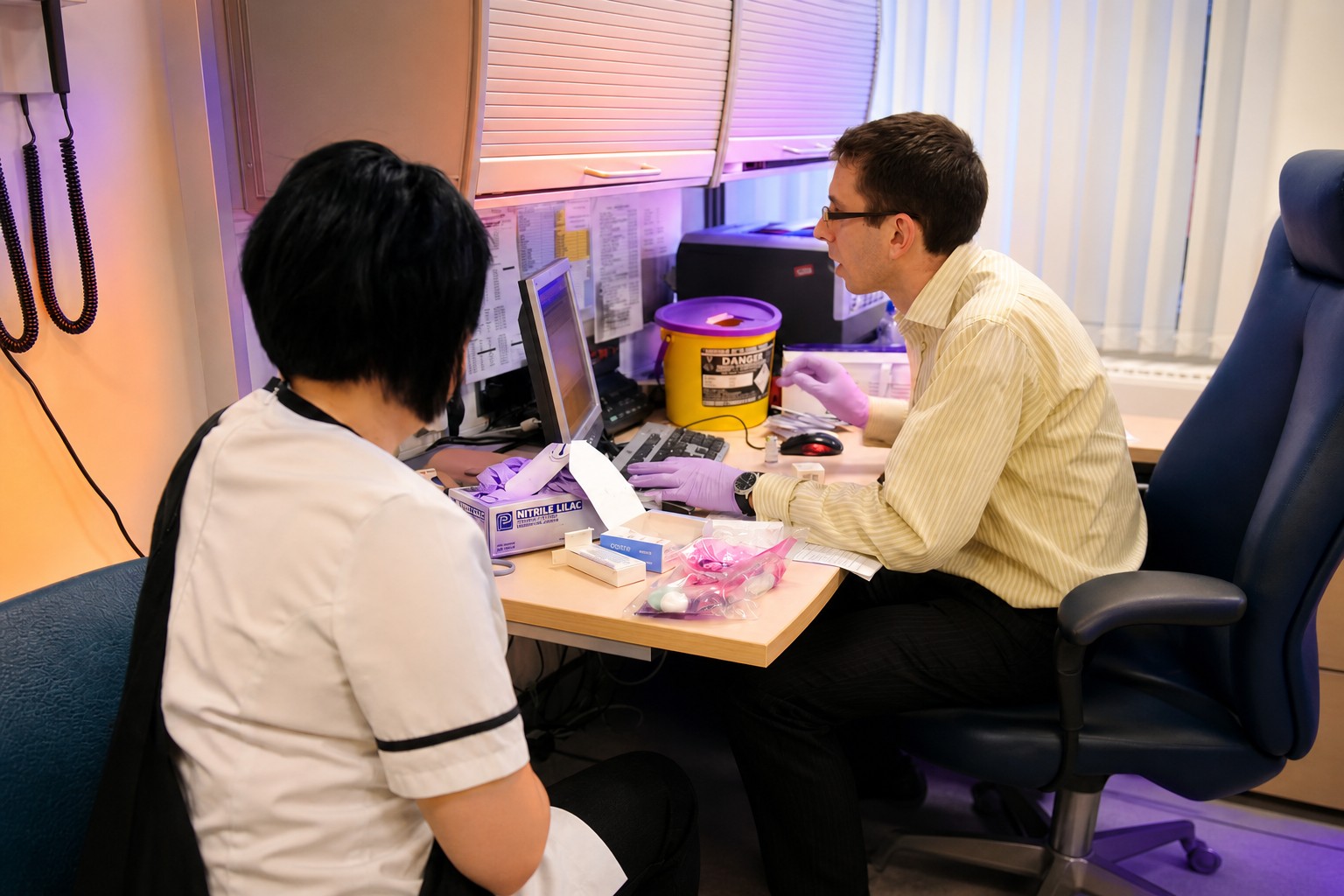
Healthwatch England, the NHS patient watchdog, says the AI scribes now sitting in on consultations across England are mishearing diagnoses and drug names, and that the errors are reaching patients' records. In the case it leads with, a woman who works in the NHS herself was left badly shaken after a scribe wrote the diagnosis "demyelination" into the summary of her appointment — serious nerve damage that can lead to multiple sclerosis. She caught it by reading her own MRI result. The hospital confirmed the record should have said "no demyelination." She was given the wrong diagnosis, she told Healthwatch, and then told it had been a typo.
Two other cases follow the same pattern. A scribe confused a drug prescribed by a GP with a different medicine with a similar name, and again it was the patient, not the doctor, who noticed. In a third, an automatically generated summary letter left out a hospital consultant's instruction that the patient get a repeat migraine prescription from their GP, which could have left them without the medication. Healthwatch, the statutory voice for NHS patients, gathered several such accounts in which patients found mistakes that clinicians had missed. If a patient does not check, the error stays in the file and shapes whatever care comes next.
These tools listen to the consultation and produce the transcript and the summary automatically. Their spread is not incidental to NHS policy; it is policy. The government's ten-year plan for the NHS in England writes AI scribes in as a way to lift bureaucratic and administrative work off staff and give them more time to treat and talk to patients, as part of the planned shift from an analogue service to a digital one. GPs and hospital specialists in England are already using 27 different AI scribes. Ministers have also been told that the NHS and individual clinicians could face legal claims over errors these systems make.
Healthwatch called it alarming that the Medicines and Healthcare products Regulatory Agency has decided not to classify AI scribes as medical devices. The consequence is straightforward: there is no single body in England checking whether any of those 27 products are safe or effective. The watchdog's own ask is narrower — that patients urgently be told how to report errors by AI scribes and by doctors, and how to get them corrected. Rachel Power, head of the Patients Association, said trust in the technology depends on good communication and genuine partnership with patients, and that both are currently missing.
Accuracy had already become an issue locally. Patients in Rotherham told their local Healthwatch branch that an AI receptionist used by some practices could not understand a strong Yorkshire accent.
The clinical warning is older than the watchdog's report. Last year the London GP Shir Ziser Dawood wrote in the British Journal of General Practice that AI scribes could turn out to be a tool with the opposite of the intended effect for family doctors. She described a scribe recording that she had advised a patient to keep taking Prozac, a drug she had neither prescribed nor discussed — a hallucination, the machine adding to the record something that did not happen in the room. Doctors therefore have to read every transcript to find the errors, which is why the tools do not reliably save time. NHS leaders expect the scribes to end note-taking during appointments, and Dawood noted that GPs may be asked to see two more patients a day as a result, in a system where consultations are already among the shortest in the world.
Charlotte Blease, who studies the use of AI in healthcare at Uppsala University in Sweden, said the systems do make mistakes. Her research found that GPs consider errors more likely when several people are present at the consultation, when the patient has a complicated medical history, or when English is not their first language. Doctors make mistakes without AI too, she said, and in her view it cannot yet be ruled out that the error rate goes up with it.
That is the accounting problem at the center of this, and it is being done backwards. The ten-year plan has already booked the productivity gain — two extra patients a day — while the only clinician quoted here on how the tools behave in practice says the verification burden eats the saving. A time dividend is being spent in advance of any evidence that it exists, and the cost of the shortfall lands on whoever is supposed to read the transcript.
Nobody has said who that is. Every case in the Healthwatch material was caught by the patient: the woman who read her MRI report, the patient who knew which drug they had been prescribed. That is the safety mechanism actually working, and it is the one nobody designed, funded or measured. It only works for patients who read their records and understand the words in them — the demyelination case was found by someone who works in the NHS. Set it next to the survey finding that more than half of 1,003 UK GPs polled last year said notes produced by ambient recording technology seemed more accurate than the ones they write themselves, and the picture sharpens: clinicians rate the machine above themselves, which is precisely the condition under which a dropped negation is signed off and filed.
The hospital called it a typo. A typo is a slip in a word. What the record contained was a sentence with its negation missing, describing nerve damage the patient did not have, produced by a system the regulator has declined to treat as a medical device, sitting in a file until she read it herself.