
Nick Evershed, data and interactives editor at Guardian Australia, has written an argument against a premise rather than against a product. His claim is that the spread of generative AI is not predetermined, and that treating it as predetermined is itself a choice, one that happens to serve the companies building it. His evidence is not technological. It is the Nuclear Non-Proliferation Treaty, the seventy countries that ban heritable human gene editing outright, and the belated regulation of social media: three cases where a technology that looked unstoppable was stopped, slowed or fenced off.
The inevitability logic he is attacking runs like this. Once the idea exists and the means to build it exist, the technology enters daily life as a matter of course, and the only remaining question is whether you adapt to it or endure it. The last twenty years supplied plenty of support. Uber displaced part of the taxi industry and helped normalise platform work. Algorithmic social media worked its way into nearly every area of life. Privacy-violating, precisely targeted advertising reshaped the internet.
Generative AI has been sold the same way, at a much larger scale. In 2024, OpenAI chief executive Sam Altman wrote that new AI capabilities could produce a level of shared prosperity that looks unthinkable today, a future in which everyone's life is better than anyone's life now. Separately he has said AI will destroy entire categories of professions. Anthropic chief executive Dario Amodei has said AI could cure most serious diseases within five to ten years, sharply accelerate economic growth, create a world of abundance, expand what people can do, and bring about a renaissance of democracy and freedom.
Both men are now calling for development to be slowed or halted, along with current and former AI research staff and other specialists, and both argue for tougher state regulation and international coordination. The stated reason is that without reliable limits, AI could produce catastrophic outcomes in the near term, on a range running from human extinction to billions of dollars in economic damage.
Evershed's most useful observation is about who is talking. Warnings about AI risk are not new; what is new is that they now come from the firms themselves, at a moment when OpenAI and Anthropic are both preparing to go public. Critics argue that both stand to gain materially from the impression that they are close to building superintelligent models. Chinese models are closing the gap with the American frontier, which has led some observers to read the regulatory push as an attempt by large US AI companies to capture the market through rules that constrain competitors.
How likely the catastrophic scenarios are is unknown. The harms already in evidence are not. Sandra Wachter, a professor at the Oxford Internet Institute, has pointed to damage to the environment, the spread of disinformation and the displacement of people from their jobs. Underneath all of it sits the original problem with most models: they were trained on millions of human artworks and texts, frequently without permission or payment, at least until recently. The same companies are working to limit laws that would narrow their access to that material.
That is the core of Evershed's case, and it is a good one. Generative AI does not exist apart from human society. Its development, and whatever degree of intelligence it has, are built on people and their labour. A thing built out of collective human output is not a force of nature, and its future is not a forecast.
The precedents he reaches for are uneven, and the weaker one is the one he leans on. The Nuclear Non-Proliferation Treaty produced mixed results on disarmament, as he concedes, though it and related agreements did limit the number of states able to build weapons and cut the number of tests. But nuclear weapons and germline editing were fenced at the point of use, where the actors are few, identifiable and licensable. No country today permits genetic changes to an embryo that can pass to its children, and seventy have written the prohibition into law. Generative AI is not like that, and Evershed's own opening examples show why: Uber, algorithmic feeds and targeted advertising were not restrained before they became ordinary, they were restrained after, if at all. Social media companies did eventually meet tighter rules in several countries and began changing their own practices in the United States under litigation, but that arrived years into the damage.
There is a second tension the column raises and then walks past. Evershed reports the regulatory-capture argument, that incumbents may be asking for rules precisely because rules would favour incumbents, and then asks for independent oversight of AI development, regulation of specific aspects of the technology and international agreements to enforce those limits globally. He does not say who drafts them. If the loudest voices for regulation are two companies preparing to list, the agreements he wants would be written in rooms those companies are in. Naming capture as a risk and then requesting the instrument capture operates on is the gap in the piece.
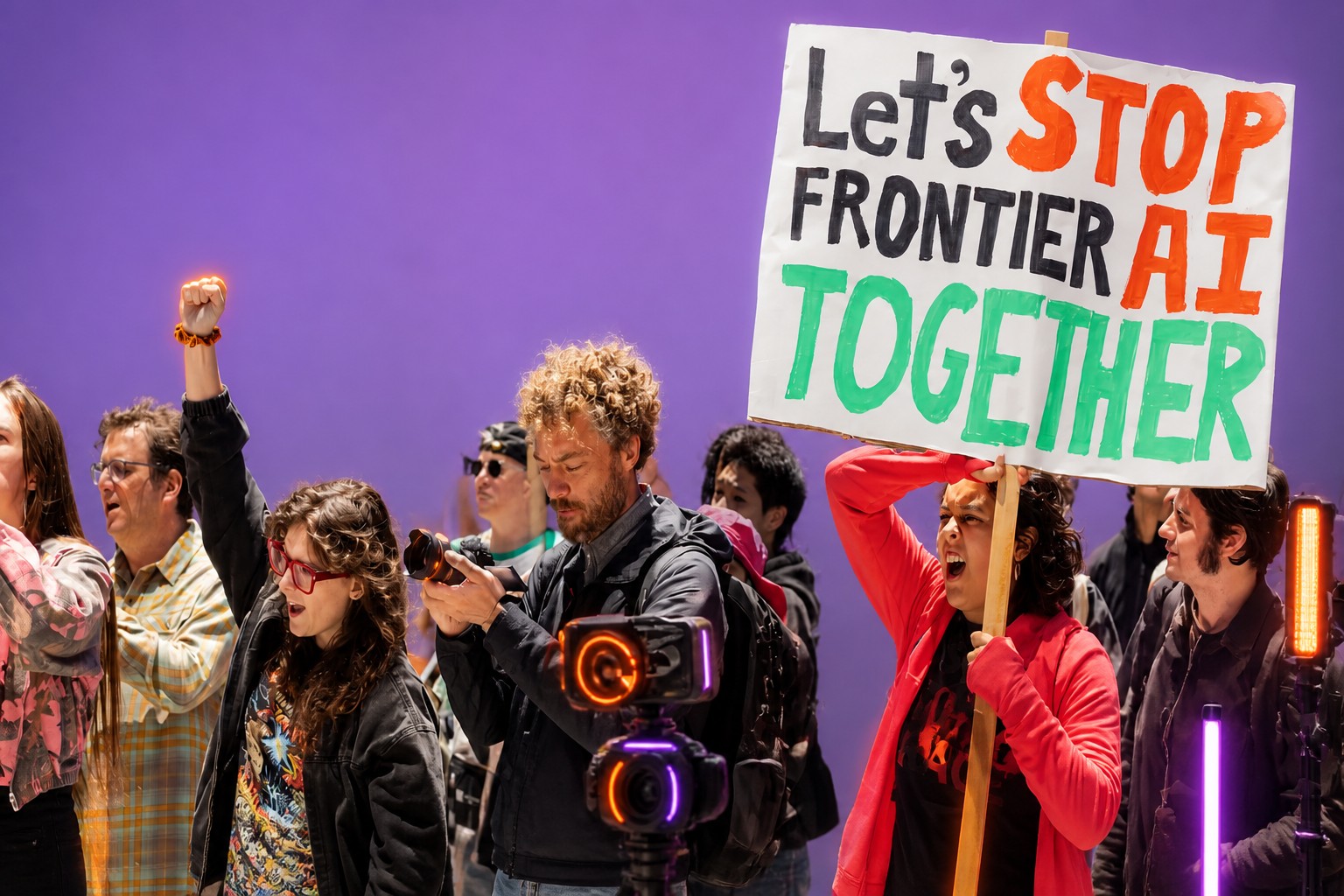
His action list, by contrast, is smaller than his diagnosis: contact politicians and demand action, join protests, talk with friends and family about what uses of the technology are acceptable, write to companies that use AI in ways you find unacceptable. He holds that generative AI can be a useful tool, in far fewer situations than the companies claim. He closes by citing a line from Claude, now widely circulated, to the effect that resisting the spread of such a technology is justified.
The awkward part of the argument is the part Evershed states most plainly. The treaties he points to fenced technologies that almost nobody personally touched, which is why consent was cheap to organise. He is asking for the same kind of fence around something he concedes is sometimes genuinely useful, and the people who would have to build it are already using it.