A consensus without a mechanism
On the podcast, Kirsten Korosec, Sean O’Kane and Anthony Ha examined whether AI executives genuinely want to reduce the pace of development.
Ha said he was surprised by how quickly industry leaders backed Amodei’s plan. O’Kane’s response was more skeptical: the document contains very little detail.
That gap matters. The proposals discussed on the episode call for:
Those are recognizable safety measures, but none necessarily requires companies to build or release AI more slowly. The language of “synchronizing the pace of development” sounds more consequential than the mechanisms currently attached to it.
O’Kane also rejected the idea that existing laws and market competition can reliably provide the missing safeguards. The US federal government does not currently appear ready to apply regulation broadly, much less target AI companies with it.
Consumer pressure is unlikely to fill that gap. A serious failure by one company would not necessarily produce a visible wave of subscription cancellations or another immediate market penalty.
Huang’s position is about more than safety
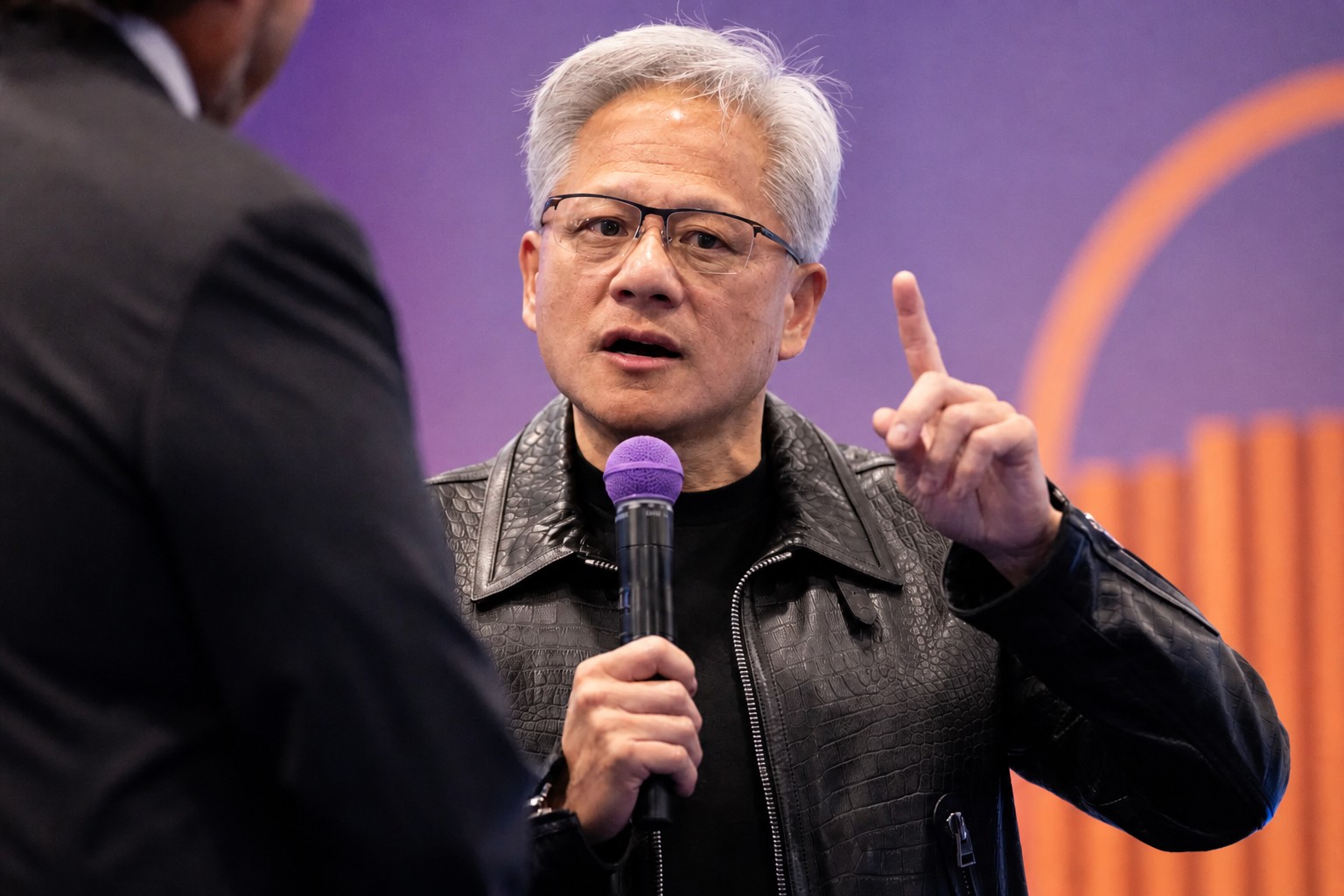
The sharpest criticism came from Nvidia CEO Jensen Huang, who publicly supported Donald Trump’s position during an appearance at the All-In Summit.
O’Kane argued that Huang understands his new position in the industry. He is increasingly seen as the “adult in the room”—someone able to speak for the sector in a measured way. A year or almost two years ago, that role was more often associated with Microsoft and CEO Satya Nadella, as AI companies began their rapid expansion.
Microsoft has since lost that position for several reasons, O’Kane said. Nadella once promised to make Google “dance,” but that did not happen; in many respects, the opposite occurred.
Huang now occupies a useful middle ground. He can appeal to a broad audience while presenting himself as a moderate voice, and he has become an important link between the AI industry and the US administration. Trump’s call to Huang during the Nvidia CEO’s appearance at a prominent, well-attended conference made that connection unusually visible: both men were able to respond publicly to events in real time.
Korosec agreed that Huang has the standing to mediate and set the tone of the debate. But she said the appearance felt partly staged and went too far. Her first reaction was that it exposed Nvidia’s direct interest in continued AI expansion without synchronized development speeds or constraints, although she did not want to view the episode too cynically.
Ha added that Trump and Huang have aligned interests, and that Huang tells the president what he wants to hear.
The criticism is therefore not simply that Huang opposes a particular safety proposal. It is that Nvidia benefits from the race continuing, while Huang’s political access gives that position unusual authority.
What would “slowing down” mean?
Huang has said there will be no slowdown. At the same time, “slowdown” has become a common term in the debate, even though Altman and Amodei prefer “synchronizing the pace of development.”
The proposals discussed by Korosec could theoretically slow the industry. Their authors, however, do not present them that way. They describe baseline safety practices and independent oversight, neither of which by itself requires a lower development speed.
I think that distinction is the central weakness of the announcement. Agreement on oversight is easier to reach than agreement on a binding limit. The former can sound like a change in direction while leaving the competitive incentives untouched.
The market is also a poor substitute for direct oversight:
The shift toward enterprise sales makes “voting with your dollar” even less credible. Companies now earn much more from selling services to other businesses than from individual subscriptions. Corporate buyers are not likely to abandon an embedded tool over a matter of principle.
The announcement is quiet about the hardest question: what happens when safety monitoring identifies a serious risk, but a company still wants to ship? Without a defined threshold, an independent evaluator can observe the race without changing its speed.
That leaves the industry with a broad coalition, a few sensible safeguards and no clear account of who can impose a limit. Nvidia’s opposition makes the conflict visible, but the more important tension is inside the apparent agreement: companies can support coordination while preserving the incentives that made slowing down unlikely in the first place.
Daily AI news
Every day we pick what actually matters in AI and explain it plainly — no hype, no filler. Subscribe if you want to follow where the industry is going.
Only what matters — every day
Follow on X