
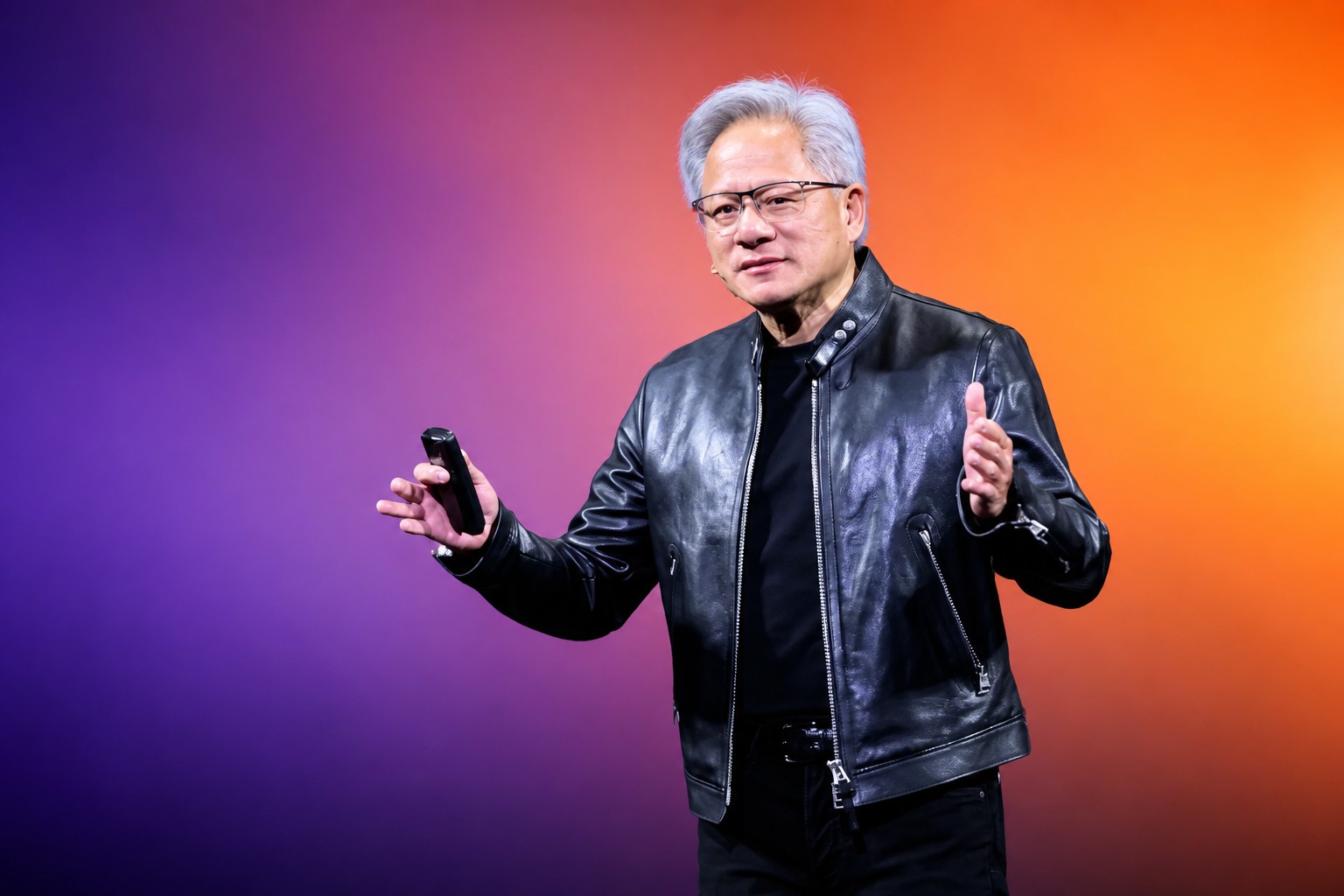
Jensen Huang has a new definition of a GPU: a system that costs $8.5 million, contains 2 million parts, draws 250,000 kilowatts and is stitched together over NVLink. Nvidia ships those by the thousands. The redefinition is the load-bearing part of the forecast he repeated — that Nvidia can grow revenue 70% year over year. Analysts expect the current fiscal year to close near $400 billion, which puts next year around $680 billion. Huang first said the 70% number out loud last month, alongside another record quarter, and he says the company is confident in it.
He delivered it against a backdrop that is supposed to be closing in. Amazon, Microsoft and Google are all designing their own chips, and so are Anthropic and OpenAI. Cerebras has recently gone public. Startups such as Etched are in the field. Huang's response is not to rebut any of them individually but to argue that Nvidia is still being misread as a maker of discrete graphics chips, which is what it was when GPUs were bought mainly by people who wanted better-looking games.
That is the move worth watching. If a GPU is a part, Nvidia has many competitors. If a GPU is an $8.5 million machine with two million components drawing a quarter of a gigawatt, then a chip-to-chip comparison with an in-house accelerator is a category error, and the relevant question becomes who else can build and deliver the whole object.
Huang also cited demand for a system combining 36 Grace processors and 72 Blackwell GPUs, whose sales are rising 27% every month. He gave it as a monthly rate and stopped there, sensibly: 27% compounded across twelve months is roughly seventeen times, which no one is forecasting. A monthly growth figure that steep almost always describes an early ramp from a small base, and it is doing rhetorical work here that the annual revenue number cannot.
The confidence, in Huang's telling, comes from position rather than prediction. Nvidia runs every model and any lab can use it — he named Anthropic, OpenAI and Google alongside open models — which he says makes the company the base platform of the AI ecosystem and industry, and lets it see where the market is going before the market does.
He then described what that sightline actually consists of. Nvidia's reach runs from suppliers, memory chip makers included, through data center projects to startups. The company tracks, worldwide, every gigawatt of available land and power, plus finished shells — Huang's term for a data center building that has been constructed but not yet filled with computers. The information comes from neocloud providers, OEMs, cloud companies and firms built around AI from the start. Working with all four categories, he says, is why Nvidia knows where things are happening.
Saying that out loud invited the obvious question about Nvidia's circular deals: the company invests in firms that then buy its products. That structure helped destroy a generation of internet infrastructure suppliers, Lucent Technologies among them.
Huang rejected the framing. Nvidia puts in a small amount and gets back a much larger one, he said, offering the hypothetical of investing $1 and receiving $100, and joking that in that case the company should do more such deals. Then the qualification: before investing, Nvidia checks whether the target has real customer contracts already producing revenue. He has seen $100 billion of such contracts in total. Nvidia does not take risks, he said, and invests only where the outcome is predictable.
The $100 billion is the number I would push on, and not because it is small. It is the entire body of verified customer commitments Huang cited, and it sits against a forecast of roughly $680 billion in revenue for a single year. Diligence on the investment portfolio, however rigorous, covers a fraction of the demand the forecast assumes. The two numbers are not measuring the same thing, which is precisely the problem: the answer about circularity is scoped to the deals Nvidia funds, while the risk people are asking about is scoped to the whole order book.
Notably absent from the account is where the incremental money comes from. Going from $400 billion to $680 billion requires roughly $280 billion in additional customer spending in one year, and Huang himself supplies the uncomfortable half of the answer: a significant share of current AI growth comes from startups that have raised enormous sums and are routing most of it into their own AI systems. He expects companies to use infrastructure and tokens more efficiently as the market matures, which is another way of saying the revenue per deployed system should fall.
So the two claims Huang made sit awkwardly together. Nvidia can see the market coming because it is embedded in every part of it — and much of that market is venture capital passing through startups on its way to Nvidia. Those are the same fact viewed from opposite ends, and only one of them is a forecast.