
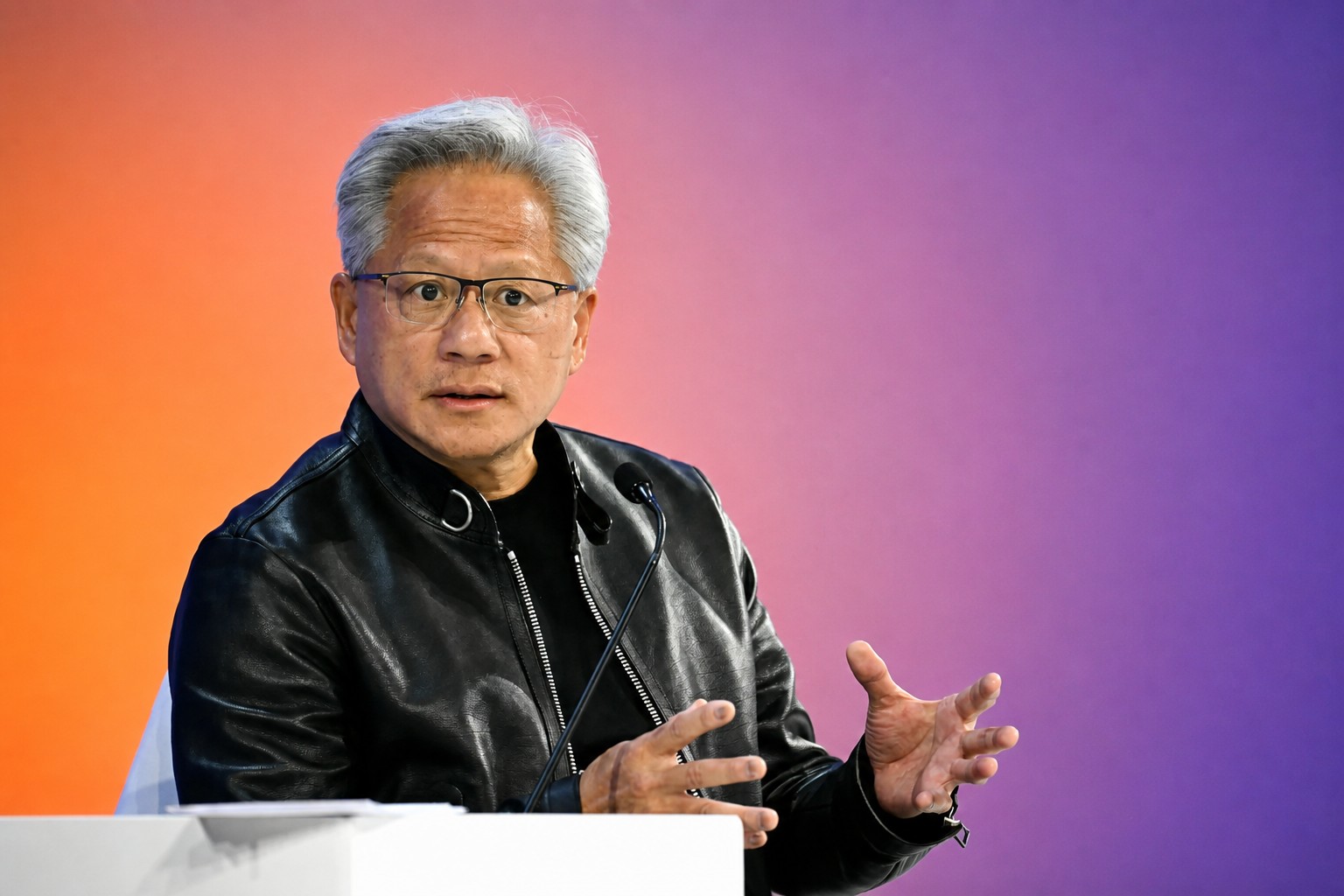
Donald Trump called Jensen Huang on Monday morning while the Nvidia chief executive was on stage at the All-In summit in Los Angeles, and Huang put him on speaker so the room could hear. The president's message was that the people asking the industry to slow down are working for whoever wants American AI stopped — political forces, he said, or China — and that the United States would not believe them or let progress be halted. Huang told him he was right and that they would not allow it. The audience applauded.
The call landed in the middle of an argument. Minutes earlier Huang had been discussing, with the All-In hosts Chamath Palihapitiya and Jason Calacanis and the White House advisers David Friedberg and David Sacks, Dario Amodei's call over the weekend to slow the pace at which AI capabilities improve. Elon Musk and OpenAI's Sam Altman had both said publicly that they agreed with Amodei. Huang does not.
That lineup is the most consequential fact of the day, and it is worth stating plainly rather than treating the phone call as the story. Asking for a slower frontier: Amodei, Musk and Altman. Arguing against it: the president of the United States and the man who sells the compute everybody else is buying. Huang's position is not less honest for that, but it is the only one in the room whose commercial logic is unambiguous. Nvidia's revenue is a function of how fast everyone else builds.
The post on X that carried the moment made the subtext into text. It described a surprise call from the president mid-talk, declared that the US will not lose the AI race, said Amodei's weekend remarks would not stop progress — and signed off with a ticker, $NVDA.
The rest of the exchange was theater and reasonably good theater. Trump joked that Huang can design the most complicated computer chip in the world but cannot work out how to turn on a speakerphone. From what was visible on stage, Huang understood speakerphones fine; he was asking the technical crew for a second microphone so the audience could hear better.
The same conversation touched the other fight the industry is losing, which is local. Trump and allies including Y Combinator's Garry Tan have cast the rising opposition to data center construction as an international psychological operation aimed at slowing US economic growth. Gallup's polling points somewhere much duller. Seven in ten Americans oppose a data center being built in their area. More than half tie that opposition to the effect on natural resources. About 20% cite the cost of living and the quality of life where they live.
For the psyop theory to hold, seven in ten Americans would have to be taking part in it. What the numbers actually describe is the oldest objection in civic life: people do not want the thing near them, and they think it will cost them something. The fifth of respondents worried about the cost of living are making a claim about a bill, not about geopolitics. Treating that as a foreign operation is not a rebuttal of it, and nobody on the stage offered one.
Trump's own instruction to Huang was two instructions. The industry should proceed carefully and prudently, he said — which does not mean stopping, because the US intends to keep developing and to lead. Then he added the line that gives the whole scene away: he had not known where Huang stood on any of this, but he had hoped they agreed.
They did, on speaker, in front of a conference. This reads less like policy being coordinated than like a consensus being assembled in public, at speed, by two people who had not previously compared notes. The pacing question has now been assigned a motive, and an argument that has been given a motive no longer has to be answered on the merits.