
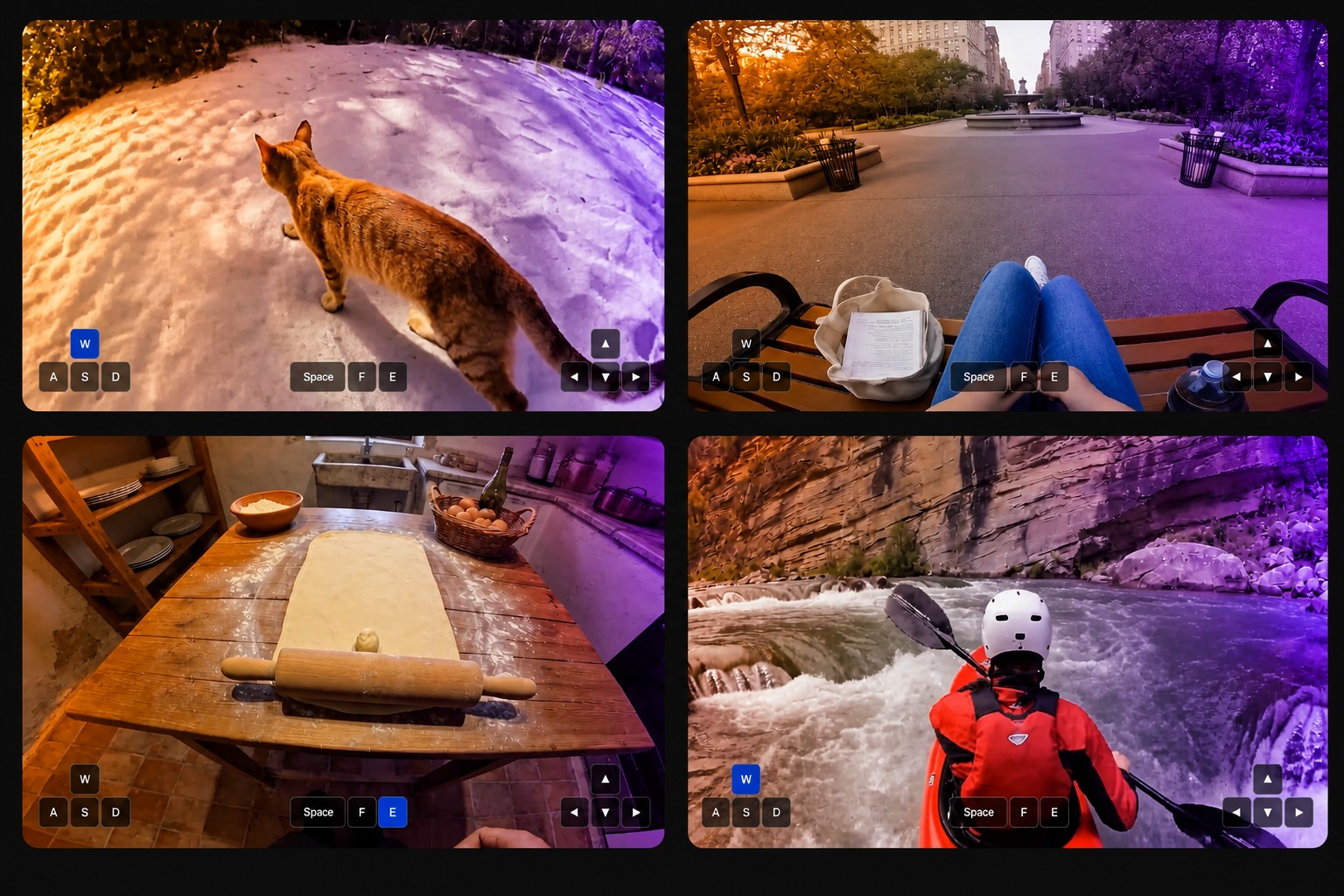
A world that responds to input
The free online demo runs on Odyssey-3 Flash. Users can move through generated environments in first- or third-person view, trigger events and watch the model respond in real time. Developers can apply for API access.
Odyssey-3 is an autoregressive diffusion transformer that generates video frames continuously, using previous frames and user actions as input. Odyssey says the model learns physical relationships and cause and effect by observing images.
Training data included internet videos with descriptions of events, gameplay recordings paired with keyboard and mouse input, and simulated physical interactions. A separate training method reduces the number of computational steps needed to generate video in real time.
The base Odyssey-3 model has 14 billion parameters and generates video at 832 × 480 pixels, according to the company’s benchmark submission. Odyssey-3 Pro supports 1280 × 720 resolution.
Source: the-decoder.com
The benchmark caveat
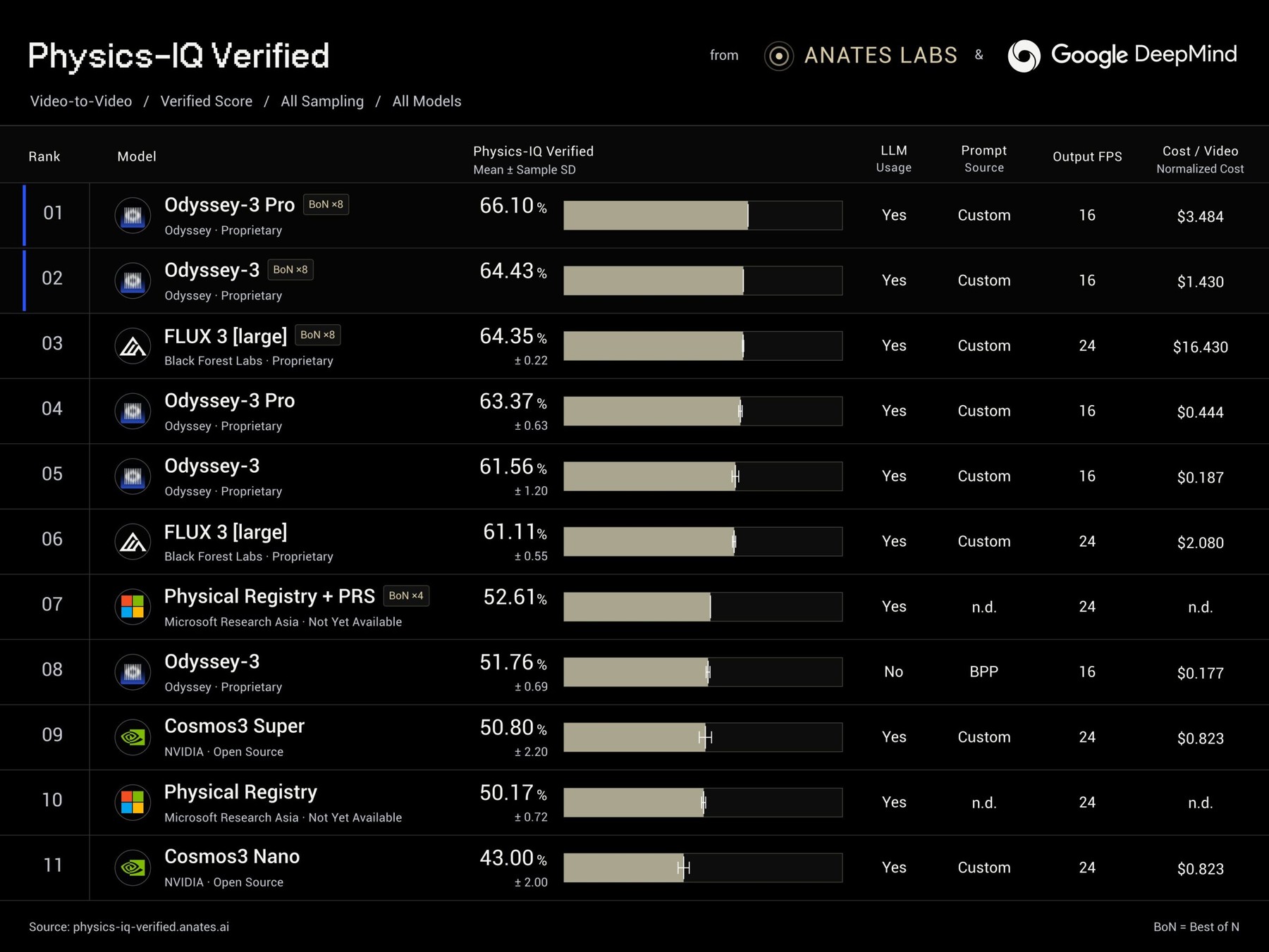
Odyssey says Odyssey-3 Pro scored 66.1 on Physics-IQ Verified, which tests whether generated video follows physical laws across fluid mechanics, optics, solid mechanics, magnetism and thermodynamics. Models continue videos of real experiments, and their outputs are compared with what actually happened.
That 66.1 score came from a single run. For each task, a selection method picked one of eight generated videos. The benchmark rules call for four runs and a standard deviation when a result is presented as a record. Odyssey’s figure does not meet those requirements. Without the selection method, Odyssey-3 Pro averaged 63.37 across four runs. Both results appear on the official leaderboard, but Odyssey submitted them itself.
On WorldMark, Odyssey says Odyssey-3 ranked first in three of four categories: First-Person Stylized at 77.2, Third-Person Real at 79.0 and Third-Person Stylized at 76.3. It placed third in First-Person Real with 80.6. WorldMark evaluates instruction-following, visual quality and whether generated worlds remain consistent over time.
The company is also testing the model as a foundation for control systems. Odyssey says AI built on Odyssey-3 has operated robotic arms, with training requiring only dozens of hours of demonstrations. The robots also recovered from failed attempts to grasp objects, although those failures were not included in the training data.
Each application pairs the world model with a specialized controller that turns its predictions into commands. Odyssey also wants to use generated environments to train AI agents: in one demo, an agent received a natural-language task and tried to complete it through its own actions. The public research version currently creates interactive environments; robotics and autonomous-system uses still require more work.
Source: the-decoder.com
One model, many claims
Odyssey was founded in 2023 by Cameron and Hawke. In June 2026, it raised $310 million from investors including Amazon and AMD Ventures. Its push comes as Google DeepMind develops Genie 3 for generating interactive worlds, while World Labs, founded by Fei-Fei Li, works on similar technology. In late September, AMD announced plans to acquire World Labs for about $8.2 billion.
I think the benchmark results are less persuasive than the breadth of the pitch. A single selected run is not the same as a result that meets the benchmark’s stated rules, and the robotics examples are still company-reported demonstrations. The more important question is whether one model can support all these tasks reliably, rather than whether it can produce a convincing demo in each.
That distinction matters because a public model for making worlds is not yet a system for controlling robots in the real world. Odyssey is asking readers to see those as stages of one trajectory; the evidence so far shows the first stage is public, while the harder applications remain under development.
Source: the-decoder.com
Source: the-decoder.com
Daily AI news
Every day we pick what actually matters in AI and explain it plainly — no hype, no filler. Subscribe if you want to follow where the industry is going.
Only what matters — every day
Follow on X