
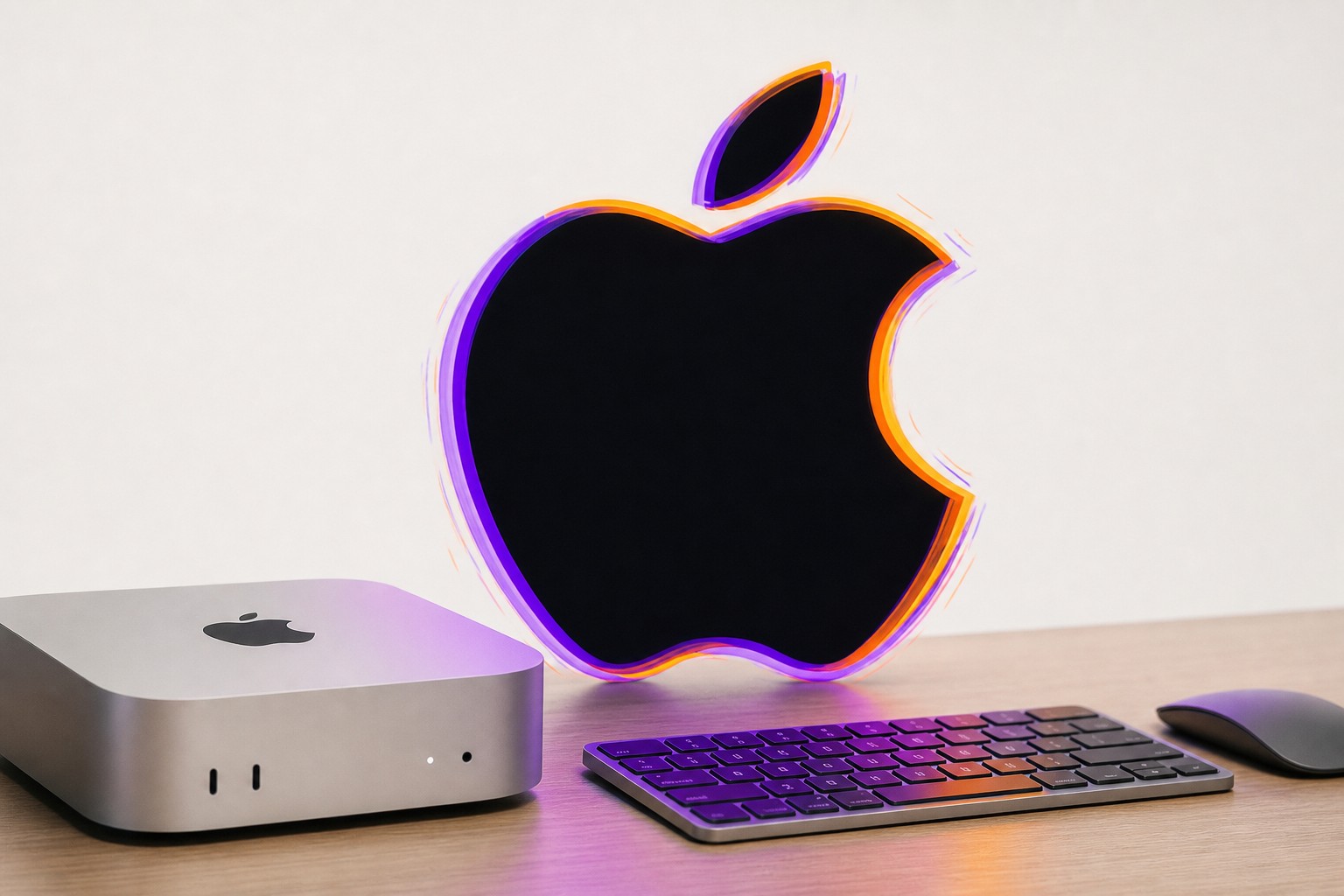
OpenAI and competing labs are buying Mac minis in the tens of thousands to train computer agents. Apple's smallest desktop has become a default machine for local AI work — strong chips, unified memory and cooling that holds up under long sustained loads — with interest in OpenClaw adding to the pull. A product line sold to developers and home studios is now being bought by the rack.
The closest compact alternative is Nvidia's DGX Spark, and it is a different bet. Spark offers dedicated GPU throughput, CUDA and tensor cores. The Mac offers one large pool of memory shared across the chip. For a lab that needs many independent machines, each holding a whole model and a whole running environment, Apple's unified architecture is the more convenient shape, whatever it gives up in raw compute.
The tooling has followed the hardware. Exo, an open source project, clusters several Macs together so that large models can run locally across them. Peter Foell, previously on OpenAI's compute infrastructure team, is building a cloud service on Apple hardware called Mount Thor — Apple silicon rented from someone who is not Apple.
The revenue number attached to all this is doing less work than it appears to. Mac sales in the quarter ending in June rose almost 29%, to $10.4 billion, and that figure covers the entire Mac line, laptops included. Nothing breaks out what the agent labs contribute, and tens of thousands of units is a modest share of a $10.4 billion quarter at any plausible unit price. The buying is real. The 29% is not evidence of its size.
Apple is the party missing from every part of this. The clustering layer is an open source project. The fleet-and-rental layer is being built by a former OpenAI infrastructure engineer. Apple supplies a consumer desktop, books the revenue, and provides none of the software or service that turns a shelf of those desktops into training infrastructure. That is a comfortable arrangement for Apple and a precarious one for the buyers: a consumer product purchased as datacenter equipment comes with no volume commitment, no support obligation and no roadmap input. If a future Mac mini arrives with a different memory ceiling or a tighter thermal envelope, the cheapest way to own a thousand real machines stops being the cheapest way, and the labs that standardised on it will have no one to call.