
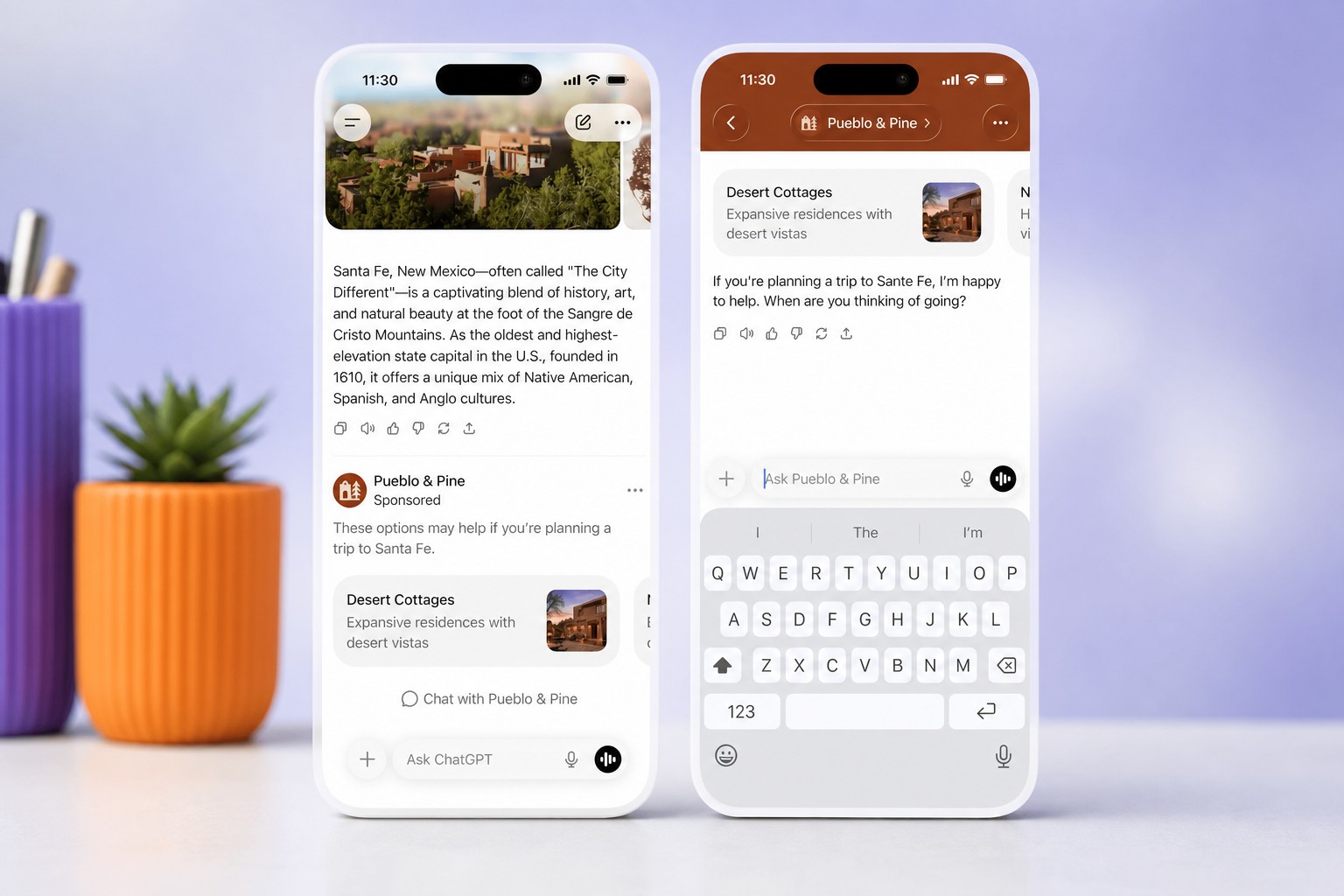
OpenAI says its advertising business, roughly 200 days old, is now running at an annualized $1 billion. The company presents the figure as confirmation that its model rests on several revenue sources rather than one. Ads are shown to free ChatGPT users and to subscribers on the Go tier. OpenAI says advertising must not influence the chatbot's answers, that ads will always be separated from them by visible labelling, and that advertisers are given no access to users' private conversations.
Start with what the number is. An annualized run rate is not a year's revenue collected; it is a recent period's takings multiplied out to twelve months. A business 200 days old has not had a year to run at anything. The $1 billion describes a rate of sale at one moment, extended forward on the assumption that the moment holds.
Held against that, the rate is still the most interesting thing OpenAI disclosed. Advertising is the one revenue line that does not require a user to decide to pay, and OpenAI put it exactly where non-paying users are: the free tier and Go. The announcement names those two audiences and, by omission, excludes the rest of the paid base. The company has built a business whose growth is tied to the part of its user base that was previously a cost.
The framing around the number is worth reading as carefully as the number. "Several revenue sources, not just one" is not a sentence written for users. It is an answer to a question about concentration risk, and the audience for that answer is the people funding OpenAI's compute commitments. A company that felt secure in subscription revenue would report an advertising milestone as a product fact, not as a portfolio fact.
The separation commitment is where this reads thinnest to me. On a web page, the boundary between editorial and advertising is physical: a banner occupies coordinates the article does not. In a chat interface there is no such geometry. The model writes the answer, and the answer is the product. A commitment that ads will not influence responses is a commitment about internal ranking and training decisions that no external party can inspect. Visible labelling proves that something was labelled. It does not prove the unlabelled text next to it was composed without reference to who paid.
Notably absent from the announcement: what selects the ad. OpenAI says advertisers get no access to private conversations, which is a statement about advertisers, not about OpenAI. The two are different claims, and only one of them was made. Also missing are the number of advertisers, the ad formats, the split between free and Go, and whether the $1 billion reflects delivered impressions or committed spend. For a disclosure whose entire purpose is to establish credibility about revenue, it contains no line item.
The structural point survives all of that. Once advertising is a billion-dollar line, the parts of ChatGPT that generate inventory become the parts that get built, and the constraint OpenAI has set for itself gets harder to hold the larger the line grows. The company has promised a wall it is the only party able to see.