
Extensions move beyond the chat window
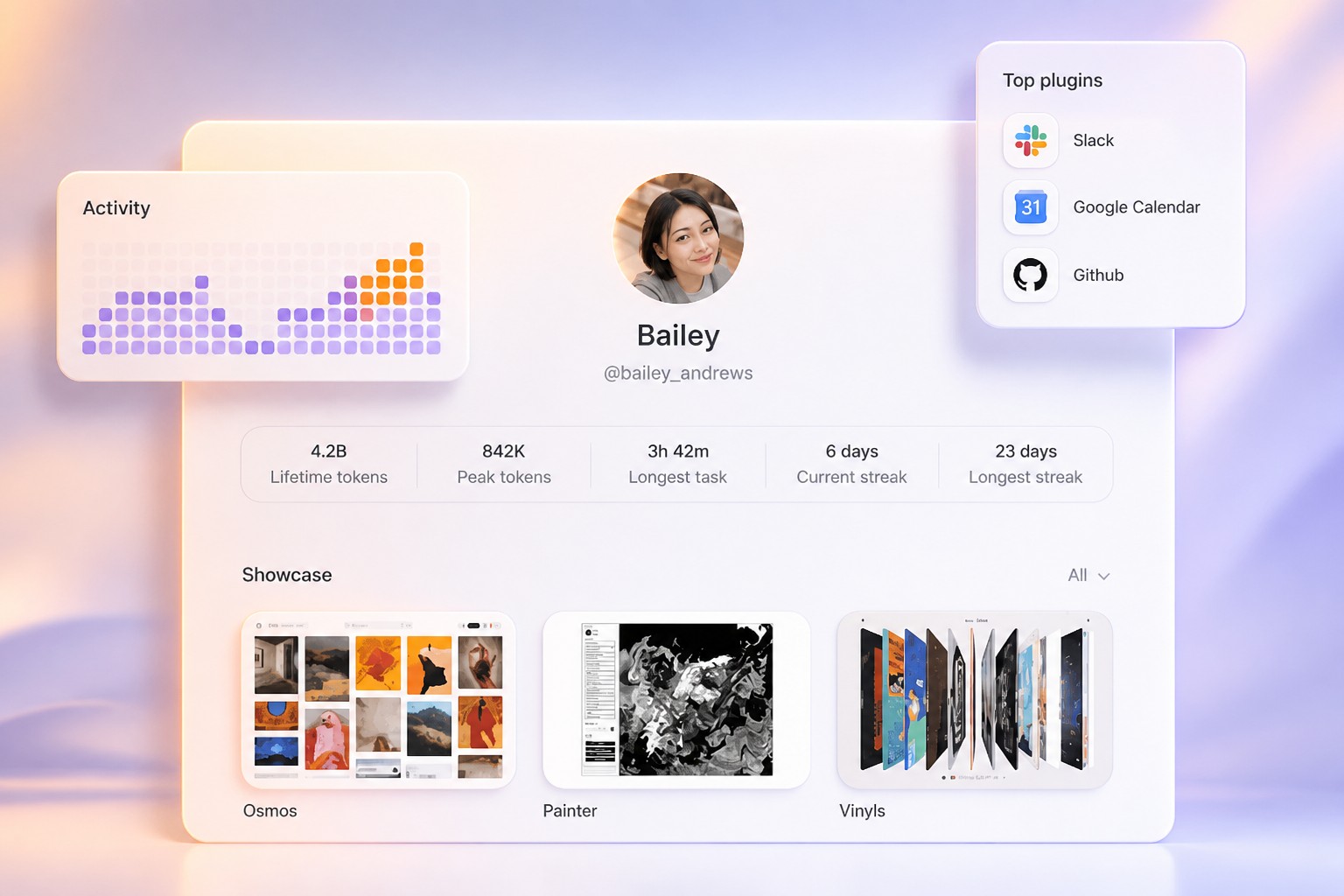
Plugin Extensions let developers build interactive panels inside ChatGPT, where users can work with them alongside a conversation. Extensions can also display supported file types. OpenAI says a new Plugin Creator will help developers build them, while a redesigned submission process will provide clearer feedback and improve how the catalog ranks extensions.
Users choose which plugins to install and approve access to their data. The feature is available on all ChatGPT plans.
Supported plugins can also be embedded in user-created websites. Team members use the same app while keeping their own data and access permissions, and users can share profiles so others can find and reuse their sites and plugins.
OpenAI is also building out products for creators. The company recently hired Patreon co-founder Sam Yam to lead a new division focused on creator products.
Shared spaces, documents and presentations
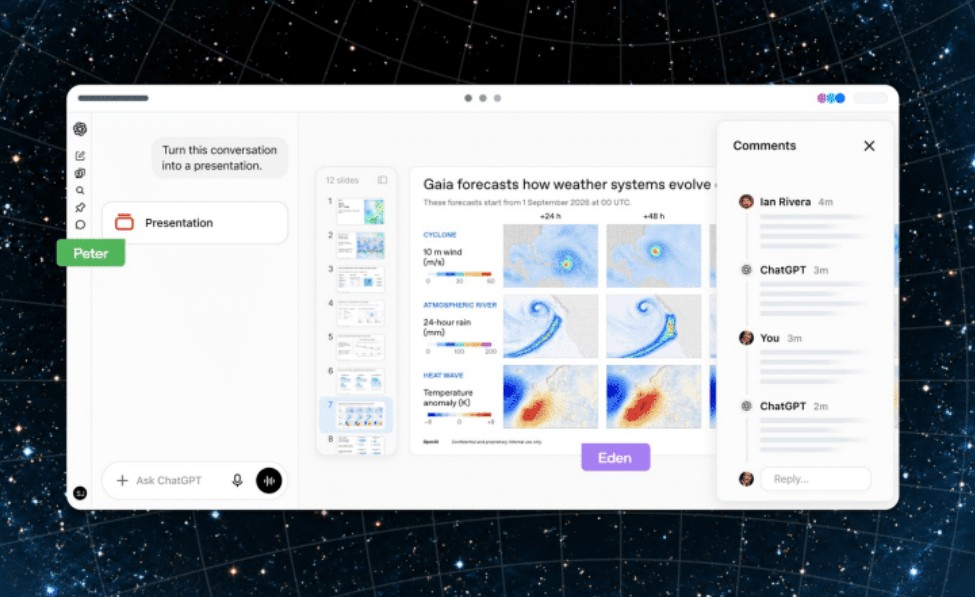
ChatGPT Space gives teams a shared workspace for files, conversations and projects, with ChatGPT and OpenAI’s new AI assistant, Dot. Users set rules for how ChatGPT organizes the space. Dot can draw on shared materials to answer questions, find discussions and pass assignments to other agents.
Space is available on Pro, Business and Enterprise plans on desktop and the web; a mobile version is planned for later.
Pages is a collaborative document format for people and AI agents. Users can write, research, make diagrams and images, visualize data and invite colleagues to edit. Its feature set overlaps with Google Docs and Notion.
OpenAI says Collaborative Slides will begin rolling out in the coming weeks. Teams and AI agents will be able to work on presentations at the same time, starting from a conversation or a user-created template, then adding comments and exporting to PowerPoint or Google Slides.
The company has tried shared work before. It tested group chats with multiple users and AI, then shut the feature down in July, saying it wanted to keep ChatGPT simple.
ChatGPT joins existing team tools
ChatGPT is now available inside Slack and Microsoft Teams. Team members can mention @ChatGPT in a channel, thread or direct message, without each person needing a separate ChatGPT license. The AI uses tools connected by an administrator or a user’s own tools, subject to the required permissions.
The Meetings plugin creates notes and summaries in ChatGPT Space, including a task list. Users can keep them private or share them with colleagues, then ask ChatGPT to update a project plan or draft a follow-up message. OpenAI says it deletes audio data after creating the summary. The plugin is in beta for macOS and available to Pro and Business users.
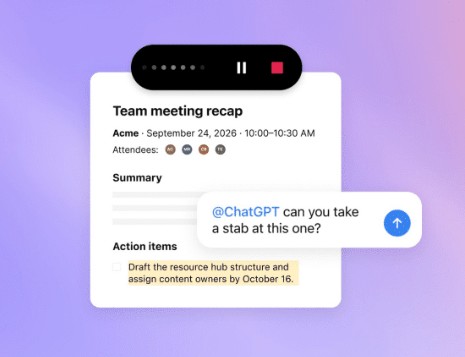
The official Meetings plugin uses AI to process meeting audio. | Image: OpenAI
Source: the-decoder.com
OpenAI is also adopting the proposed MCP Events specification, which lets plugins trigger automation when events occur in connected apps. ChatGPT could monitor a project board, open relevant documents when new tasks appear and prepare a plan, even when the user is away. The feature is available on all plans.
Business and Enterprise users can also assign recurring work to teams through Team Tasks, such as weekly project updates. ChatGPT can respond to events including new emails or Slack messages.
The account and the budget become part of the platform
A new Pro 500 plan offers the highest usage limit and access to Ultrafast mode in ChatGPT and Codex. OpenAI is also bringing back a $200 subscription, with a lower API limit than the previous version. The company says it eventually wants fixed subscription prices to align with API pricing so that the same spend buys the same usage limit. Both plans are available now.
Sign in with ChatGPT lets Plus and Pro subscribers use their plan limits across 16 partner services, including Devin by Cognition, Notion, Vercel, T3, OpenClaw and Dactyl. Their ChatGPT account also serves as their account for those external tools.
For Enterprise customers, OpenAI Marketplace lets companies direct some of their existing OpenAI spend toward software from approved partners. It launches with 32 partners, including Adobe, Figma, Salesforce, ServiceNow, Harvey, Legora, CrowdStrike, Palo Alto Networks and Baseten, an infrastructure platform for open-source models.
My read is that the bigger bet is not any one new workspace feature. It is making ChatGPT the layer that connects a team’s documents, apps, automations and software purchases. The announcement gives a long list of ways that could work, but leaves a central question unanswered: how much control will teams have over what the AI can access and do as these pieces connect? For now, users approve plugin access and administrators can connect tools; the announcement says less about how those permissions will work across a shared space, automated tasks and third-party services. That boundary will matter as ChatGPT moves from answering a prompt to acting on a team’s behalf.
Daily AI news
Every day we pick what actually matters in AI and explain it plainly — no hype, no filler. Subscribe if you want to follow where the industry is going.
Only what matters — every day
Follow on X