
OpenAI puts the cost of AI agents’ work above researchers’ salaries
How agent use is growing
In its second report on accelerating research, OpenAI described how deeply AI agents are embedded in the development of new models. The company is tracking indicators of possible recursive self-improvement: cases where AI speeds up the creation of subsequent generations of systems.
Use of internal tools, including Codex and Dots, has recently risen sharply. Measured in eight-hour workdays, agents completed work equivalent to 5.7 days per researcher per calendar day. In pre-training and post-training teams, the figure reached about eight days. During peak periods, more than two-thirds of the researchers in the sample ran at least four agents in parallel.
In September, the theoretical cost of this agent work at API rates was twice researchers’ regular salary costs. The calculation did not include stock grants, which make up 70–80% of total compensation at OpenAI. At the same time, internal agents accounted for just 2% of the company’s total compute allocated to research.
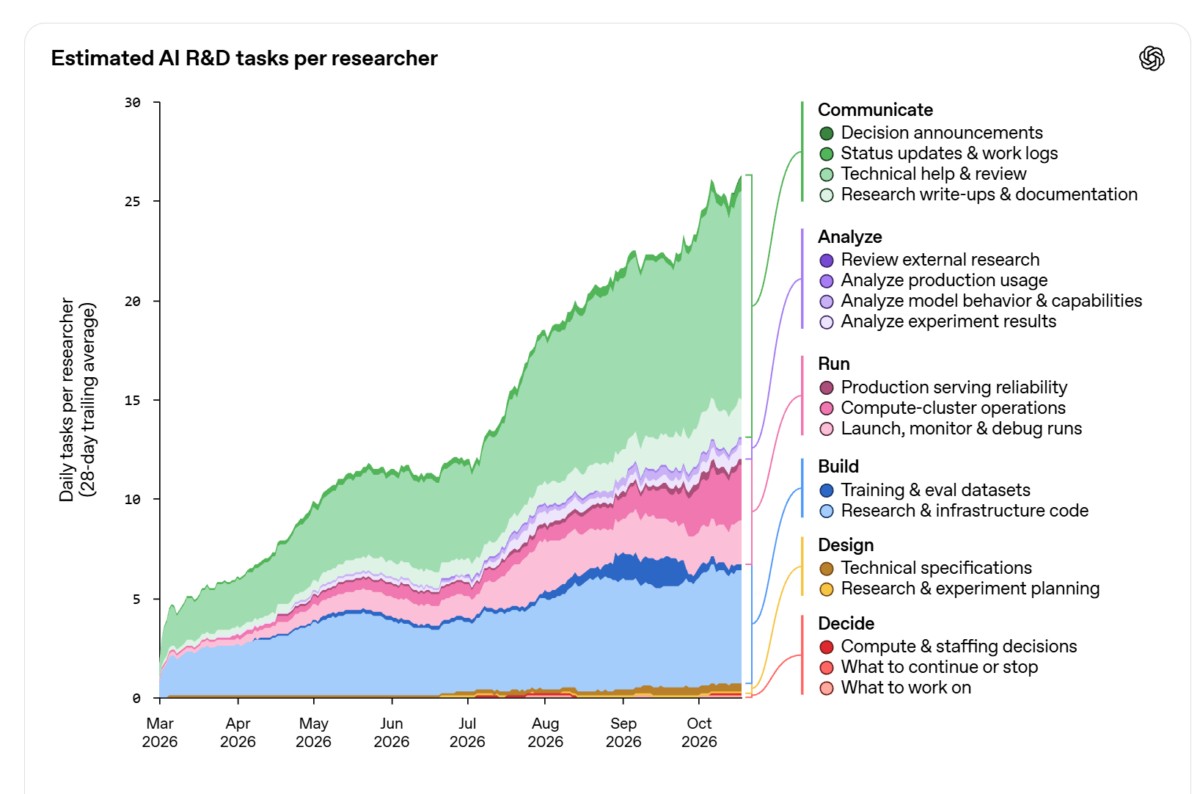
A large share of AI usage goes toward communication and coding. | Image: OpenAI
Source: the-decoder.com
Agents do better on routine tasks
From March to October, the estimated share of tasks agents completed autonomously, without human involvement, rose from 23 to 46% for assignments lasting two to four hours. For tasks lasting four to eight hours, the figure increased from 13 to 35%. However, Epoch AI’s classification shows that the systems perform better on relatively simple tasks.
Agents successfully track model training in 79% of cases and answer technical questions on their own in 72% of cases. Results are lower on more complex engineering work:
In an internal, non-representative survey of 101 employees, the median response indicated that researchers would rather lose 40% of their team’s staff or 30% of their compute resources than go three months without their current coding agents. In a separate quick poll of 28 employees, 27 preferred the latest internal model to a human engineer with mid-career experience.
Where human oversight is needed
Qualitative interviews with ten researchers revealed a downside to the widespread use of agents. Participants said models lack an understanding of which research ideas are promising and how good the code and data are. Agents get sidetracked by unnecessary steps, build analyses on faulty assumptions, suggest poor code changes, and produce unusable data. Without careful human supervision, this can lead to wasted compute.
According to the teams interviewed, the key ideas for GPT-6 Astra and GPT-6.2 Astra came only from people working on post-training and safety. In pre-training for GPT-6.2 Astra, only some researchers said they had arrived at important ideas through conversations with Codex.
In its conclusion, OpenAI cautions that current results from human-AI collaboration cannot automatically be projected into the future. The company points to recent rapid AI breakthroughs in mathematics and allows that similarly sharp changes could also occur in deep learning research as models become more autonomous.
Earlier, AI evaluation organization METR studied competitor Anthropic’s work over eleven weeks and suggested that AI use had nearly doubled development speed. In early September, in its first report on accelerating research, OpenAI said it had achieved its own stated goal of creating an automated AI research intern. In an accompanying post, Chief Scientist Jakub Pachocki warned of the risk of losing control: an audit had found numerous gaps in the oversight system.
Dataist’s take: OpenAI’s figures show that agent use is expanding rapidly, but do not establish that agents can conduct research independently: people still came up with the key ideas for two models. The company also acknowledges that current results from human-AI collaboration may not predict the pace of future change.
Daily AI news
Every day we pick what actually matters in AI and explain it plainly — no hype, no filler. Subscribe if you want to follow where the industry is going.
Only what matters — every day
Follow on X