
How agents work with medical systems
OpenAI is targeting a problem faced by healthcare organizations: many healthcare systems have no API for exchanging data. Computer-use agents, added to the Agents API in late September, work through existing interfaces, transferring information from electronic health records to external web portals and back.
For example, if a patient reports back pain, an agent is supposed to find relevant records of previous examinations, prepare an MRI referral and a response to the patient, and fill out a prior authorization request on the insurer’s portal. Doctors and responsible administrative staff review the drafts before they are sent. The features are available through the API, as well as in ChatGPT for Healthcare and ChatGPT for Clinicians.
Test results and cost
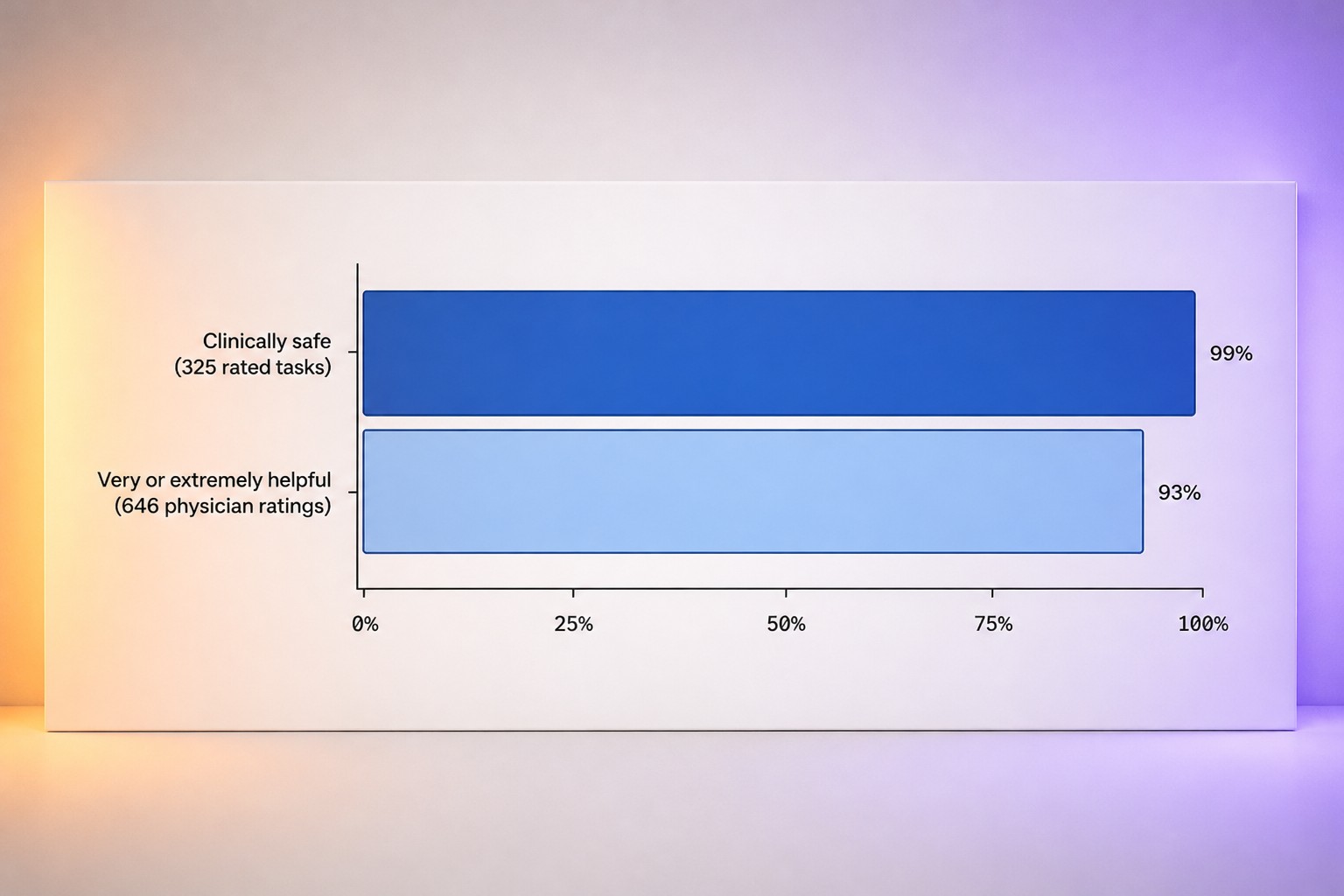
In the evaluation described by OpenAI, GPT-6 Astra handled tasks from the inbox sections of electronic health records. One example was preparing an ibuprofen dosage for a child with a broken arm. Doctors reviewed 325 tasks and judged 99% of the prepared materials clinically safe. In 93% of 646 ratings, the preparation was very or extremely useful.
For administrative processes — prior authorization requests, appeals and medical equipment orders — OpenAI cites results from HealthAdminBench, an independent benchmark developed by Stanford University researchers. GPT-6 Astra scored 94.3% of the available points, while GPT-6 Luna, designed for low-cost API use, scored 91.8%. According to OpenAI, a task handled with GPT-6 Luna costs about 8.5 cents — 98% less than with Astra. Both models took the benchmark with reasoning effort set to the maximum.
Where agents are already in use
Several organizations are helping develop the technology. At CVS Health, agents process referrals and specialist consultations across different systems. According to OpenAI, one agent cleared several months’ worth of accumulated outbound documents over a weekend, while another performs system operations every day for tens of thousands of consultations. CVS Health published the architecture of its software, called Agent Kit, on GitHub.
At insurer Cigna Healthcare, models combine patient information from more than 10 systems. Abridge is developing agents to plan patient discharges. Ambience has demonstrated additional safeguards: when a medical record is unclear, the agent stops and asks a doctor for input. Startups such as Assort use this feature in Codex to prepare referrals in practice management software whose APIs cannot complete the final step.
Patient data and privacy requirements
Because agents work directly with electronic health records, protecting sensitive data is a central concern. OpenAI says it does not use organizations’ data to train its foundation models. According to the company, ChatGPT for Healthcare supports role-based access controls and audit logs. Organizations can also configure applications and workspaces so that an agent can access only the records and actions needed for a particular task.
For processes subject to HIPAA requirements and involving protected health information, organizations must sign a Business Associate Agreement (BAA) with OpenAI. They must also use services covered by the agreement and set the required security and data-retention settings. Healthcare organizations themselves are responsible for using the system correctly, but OpenAI also has HIPAA obligations as a party to the agreement. US medical professionals who pass verification and use the free individual ChatGPT for Clinicians plan can also sign a BAA. The agreement applies only to the features it covers.
In the CVS Health project, data remains within infrastructure controlled by the company. According to OpenAI, CVS reviews agents’ actions using screenshots and operation logs. The announcement does not specify where the screenshots are processed or how long they are stored. The requirements of the EU General Data Protection Regulation (GDPR) are also not addressed: for now, the offering is focused on the US.
Dataist's take: Agents could reduce some of the administrative burden in a fragmented healthcare system, but the reported accuracy and cost figures alone do not determine the technology’s prospects. Much depends on how reliably agents work with existing systems, whether their actions can be monitored, and whether decisions with clinical or legal significance remain in human hands.
Source: the-decoder.com
Daily AI news
Every day we pick what actually matters in AI and explain it plainly — no hype, no filler. Subscribe if you want to follow where the industry is going.
Only what matters — every day
Follow on X