
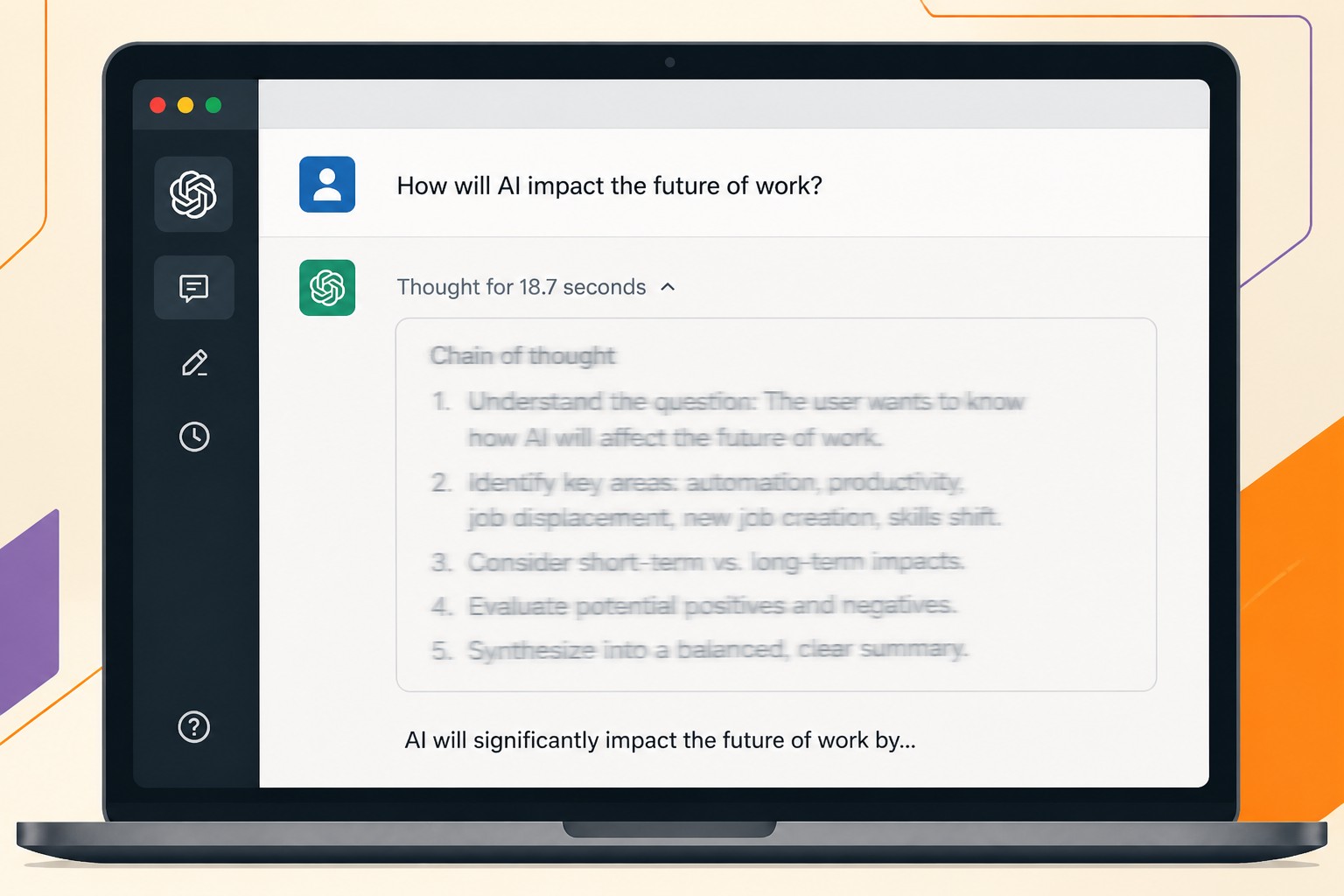
The working vocabulary of AI gained a new center of gravity this year, and it is not a capability. OpenAI's Astra, released in September 2026, is known for early use of opaque recurrence: a method in which a model pushes the same prompt through its own internal layers over and over instead of reasoning step by step in language a person can read. OpenAI says Astra preserves a legible chain of thought, and rejects comparisons to neuralese — the hypothetical worst case in which a model reasons entirely in internal numeric representations, its reasoning a fully closed mechanism. Safety researchers call Astra's use of the technique the first real step in that direction. Since the launch was reported, the term has been in constant circulation.
Engineers call the same method recurrent depth, and the press treats the two names as interchangeable. The difference is not technical. Recurrent depth is what you call it when you are describing the architecture; opaque recurrence is what you call it when what concerns you is oversight. The method delivers: small models can score above what their size would predict while consuming less compute. What it leaves behind is far less readable trace than an ordinary chain of thought — the sequential explanations a user sees after prompting a chatbot. Reasoning logs are one of the main ways researchers catch a model behaving badly, and opaque recurrence can make that oversight considerably harder.
Chain of thought is worth holding next to it. Some questions a person answers instantly — which is taller, a giraffe or a cat — and some require paper. Given forty animals with a hundred and twenty legs between them, you write the equation and get twenty chickens and twenty cows. In AI, chain of thought means splitting a task into small intermediate steps to improve what a large language model finally produces. The answer takes longer and is more likely to be right, especially on logic and code. Reasoning models are built on conventional large language models and tuned for this behavior with reinforcement learning. Opaque recurrence offers the same benefit without the paper trail, and that is the entire argument about it.
The other genuinely new term of the year points at hardware rather than cognition. RAMageddon is the ironic name for a shortage of the memory chips that sit inside nearly every consumer technology product. As the AI industry grows, the largest technology companies and labs are buying more and more memory for their data centers in pursuit of the most powerful and efficient systems, and everyone else gets less. Short supply raises prices. Console makers have had to put up prices because memory became harder to source. The shortage may produce the largest drop in smartphone shipments in more than a decade. Companies cannot get enough RAM for their own data centers. Prices are expected to stop climbing only when the shortage ends, and there is almost no sign of that happening soon.
Around those two entries sits the agent vocabulary, which has been filling in steadily. An AI agent is a tool that uses AI to carry out a series of tasks on a user's behalf — filing expenses, booking a flight or a restaurant table, writing and maintaining code — rather than answering one question at a time. The phrase means different things to different people because the underlying infrastructure is still being built. At the core is an autonomous system that can call on several AI systems to work through a multi-step task.
Coding agents are the narrow case that already works. Instead of suggesting code for a human to review and paste, the agent writes, tests and debugs on its own, doing the iterative trial-and-error that normally eats a large part of a developer's day. It can work across a whole codebase, find bugs, run tests and submit fixes with minimal supervision. The comparison that fits is a very fast intern who never sleeps and never loses focus, whose output still has to be checked by a person.
Agents reach the world through API endpoints, which are best understood as buttons on the back of a program that other applications press to make it do something. Most smart home devices and connected platforms have them; ordinary users never see them. As agents improve, they increasingly find and press those buttons themselves, which opens up broad and sometimes unexpected automation. The standardized version of this is MCP, the Model Context Protocol — an open standard that lets models connect to external tools and data: files, databases, Slack, Google Drive. Anthropic introduced it in 2024 and later handed it to the Linux Foundation; OpenAI, Google and Microsoft adopted it, making it one of the fastest-spreading standards in recent AI history.
Underneath all of it is the economics. Compute usually means the processing power needed to train and run models, and often the hardware that supplies it: GPUs, CPUs, TPUs and the rest of the infrastructure. Inference is the act of running a trained model to produce a prediction, and it happens on everything from phone processors to cloud servers with modern AI chips, at wildly different speeds. Caching — most visibly the KV cache used in transformer models — stores the results of individual computations so they need not be redone. Parallelization, doing many things at once rather than in sequence, matters for both training and inference; modern GPUs are built for thousands of simultaneous computations, and research into better parallelization has become a field of its own. Tokens, the fragments of text a model breaks language into, are also the unit of billing: most AI companies charge by token count, so the more a business processes the more it pays. Token throughput measures how much of that work a system can do at once, which decides how many users a model can serve and how fast each of them gets an answer. Andrej Karpathy has described feeling anxious when his AI subscriptions sit idle, comparing it to the student-years feeling of watching expensive computing hardware go underused. That instinct explains why maximizing throughput became an industry objective.
The older terms have not moved, and their stillness says something. AGI remains undefined by the people closest to it. Sam Altman once described it as "the equivalent of a median human that you could hire as a co-worker." OpenAI's charter defines it as "highly autonomous systems that outperform humans at most economically valuable work." Google DeepMind reads it differently, treating AGI as AI that is at least as good as humans at most cognitive tasks. Recursive self-improvement is the same kind of threshold word: models improving themselves without human involvement, which some describe as a catastrophic arrival of the singularity, models becoming immune to outside intervention. It can also be read as a plain engineering question — can an AI design its own successor — and several recent startups have been founded to build exactly that, most of them rejecting the apocalyptic reading and presenting it as the next research direction.
The textbook layer is unchanged and still load-bearing. Deep learning uses artificial neural networks with many layers, an idea from the 1940s that only became practical when GPUs arrived by way of the gaming industry, and it finds its own features in data instead of having engineers specify them — at the cost of needing millions of examples and more time and money than simpler machine learning. Weights are the numeric parameters that decide how much each input matters, assigned at random and adjusted until the output is close to the target; a house price model carries weights for bedrooms, bathrooms, detached or semi-detached, parking, garage. Validation loss is the number researchers watch during training, lower being better, and it flags overfitting — the difference between a student who understood the material and one who memorized last year's exam. Diffusion systems destroy the structure of data with noise and learn to run that irreversible process backwards. GANs pit a generator against a discriminator and underpin some deepfake tools. Fine-tuning and transfer learning are how a general model becomes a product for one industry. Hallucinations — models inventing facts, sometimes dangerous ones, such as bad medical advice — are blamed on gaps in training data and are pushing companies toward narrower domain-specific models. Reinforcement learning, rewarding correct behavior the way you train a pet with treats, and its human-feedback variant RLHF, are now standard in post-training at the leading labs.
Two entries deserve a harder look than a glossary gives them. Distillation — running prompts through a teacher model, recording the answers and training a student on them — is described as something every AI company uses internally, probably including OpenAI to build GPT-4 Turbo, the faster version of GPT-4, and sometimes used to catch up with rivals' frontier models. That last clause carries a lot of weight for how quietly it is delivered, because distilling from someone else's model generally violates the terms of use of AI APIs and chat assistants. The same evasiveness surrounds mixture of experts, where a router activates only a fraction of a large network per query: Mixtral from Mistral AI is the acknowledged example, while newer OpenAI GPT models are believed to use a variant the company has never confirmed. And the open-versus-closed divide, Meta's Llama against OpenAI's unpublished GPT weights, is presented as the industry's central argument — with the observation that open systems permit independent safety review and closed ones do not.
Here is the connection I would draw across these entries. RAMageddon and opaque recurrence are the same story told from opposite ends. Memory and compute are scarce and getting more expensive, which rewards any method that gets more capability out of less silicon, and the cheapest of those methods happen to be the least legible. Nothing about opaque recurrence was sold as a retreat from oversight; it was sold as efficiency, which is what efficiency looks like when it arrives with a cost nobody prices. The glossary now contains a word for the technique, a word for the shortage driving it, and a word for the endpoint it trends toward. It does not contain a word for the trade.
What the announcement is quiet about is narrower and more specific. OpenAI's claim is that Astra preserves a legible chain of thought. Preserving one and reasoning through one are different claims, and the reporting does not distinguish them: a model can emit a readable explanation that is produced alongside the computation that actually determined the answer rather than by it. If the reasoning happens in the recurrent passes and the readable text is generated after, then the logs safety researchers rely on are describing the model rather than recording it, and the oversight tool keeps working exactly as long as nobody tests it. That is the question the launch should have been made to answer.
Vocabulary is a leading indicator when it runs ahead of the thing it names and a receipt when it runs behind. No shipped model reasons in neuralese, and the word is already in wide use. RAM prices had already moved by the time anyone coined RAMageddon. One of these terms is a warning the industry issued to itself; the other is a bill it has started paying.