
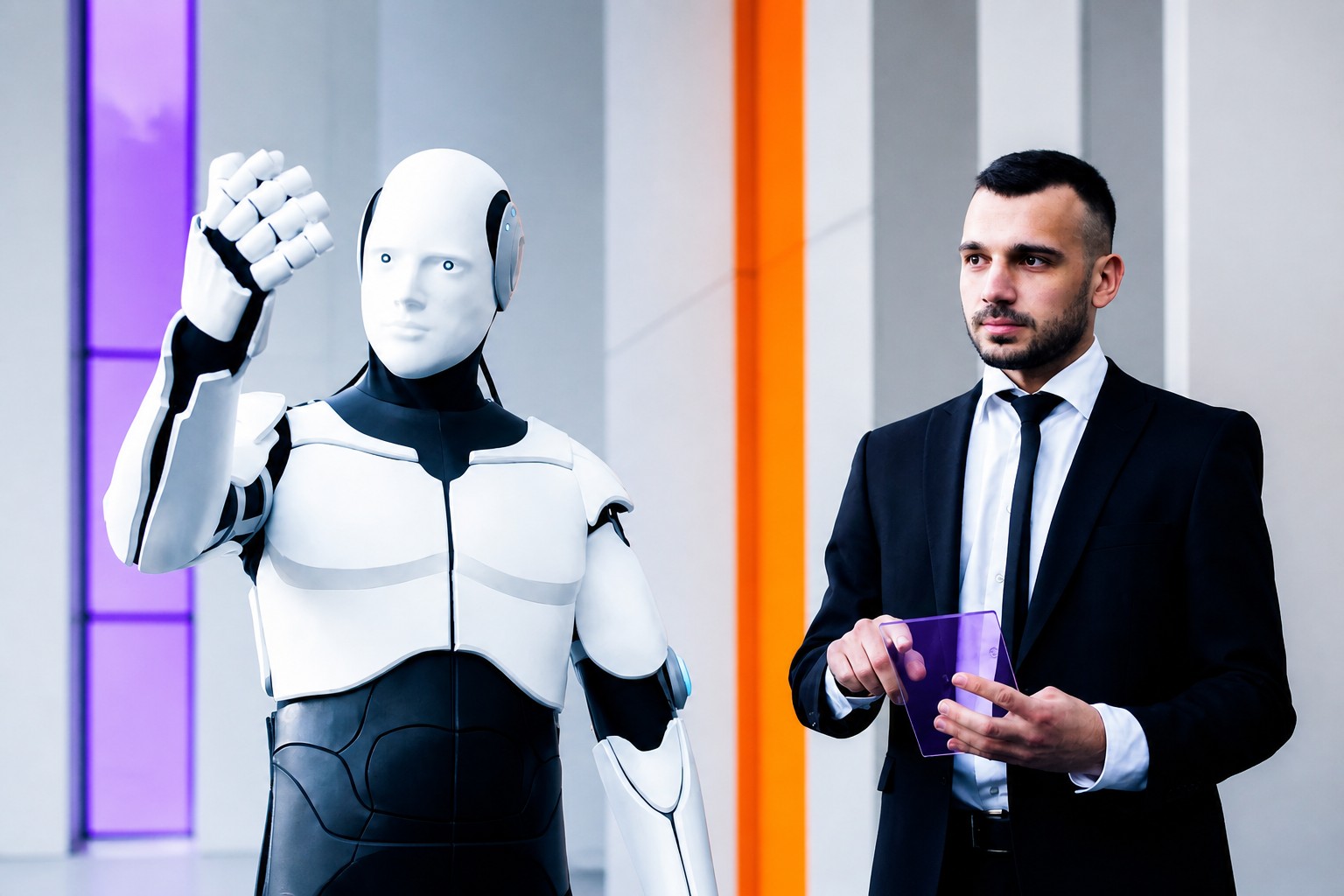
A group of engineers has released OpenExecutive, an open-source system that runs eight AI agents as a single virtual chief executive. Each agent plays a functional head — chief strategy officer, chief financial officer, head of human resources, and other senior roles — and together they resolve into one management persona. The system is built on Anthropic's models: Claude Sonnet 4.6 by default, with Claude Opus 4.7 reserved for work that requires deeper reasoning. The authors say they built it out of grudge and friendship, having lost their jobs to decisions made by their own executives, and are now offering former employers a dose of their own medicine.
The framing is deliberate and the project does not hide it. The demonstration video opens on a line about how the work continues around the clock while management cannot keep pace with its scale, over a track from a stock music library called "Corporate Music Uplifting". The creators describe the system as a "senior advisor with knowledge at the level of a Harvard Business School graduate", then note that how impressive that sounds depends on how much you trust graduates of such programs.
Underneath the joke there is a real architecture claim. OpenExecutive is said to learn from a company's documents and to retain its own recommendations and decisions — which, as the authors point out, is more than can be said for some chief executives with selective memory. The code is open source, so anyone who wants to check how it actually works can go and read it.
That memory claim is the part of this worth taking seriously, and it is the part the packaging buries. A system that keeps a durable record of every recommendation it made, and the reasoning attached to it, produces something that executive decision-making almost never produces on its own: an audit trail. Not a better decision necessarily, but a legible one. If anything here survives as a product rather than as a prank, it will be that, and it will most likely survive inside a company rather than above it.
The satire also obscures a limit. Eight agents sharing two models are not eight perspectives. They are one model's judgement, prompted eight ways, and asked to disagree with itself. Real executive teams derive whatever value they have from people whose incentives and information genuinely differ. Role-playing that difference at the prompt layer gets you the theatre of a management meeting, which may be the point, but it is not the mechanism. The authors are open enough about the project's origins that it would be unfair to pretend they claimed otherwise.
The authors accept that OpenExecutive will probably not displace chief executives outright. A chief executive does things a machine cannot reproduce, including bearing personal responsibility for decisions — though the authors themselves find that example unconvincing. The same objection applies to ordinary employees, with one difference the authors are careful to name: it is the ordinary employees who do most of the work. And by the logic chief executives themselves use, a tool that does their job more efficiently should please them. It does not strike, does not ask for a raise, and produces none of the other inconveniences that come with people.
Some executives already appear to agree. Mark Zuckerberg, chief executive of Meta, is reported to be building an AI agent to help him do his own job, and, it is claimed, a photorealistic AI clone of himself so he can be virtually present in every corner of the company. Whether that is a leader automating himself or subordinates telling him a comfortable story while they build his replacement is a distinction the reporting does not settle.
Notably absent from the release is any evidence of use. No company running on it, no measured outcome, no comparison against a human executive team or even against a single Claude prompt. What exists is a repository, a demo video and a thesis. The thesis is sharp: if the argument for replacing workers with models is that models are cheaper and more available, that argument scales upward better than the people making it would like. The demonstration that it holds is still missing.