
Perplexity has introduced Monitor API, which regularly checks websites and search queries, then sends important changes to apps and AI agents through webhooks. Developers can choose between two modes: monitoring topics across the web and news, or tracking up to 10 specified pages and recording changes against the original version. The service filters results against set criteria. In its own tests, Perplexity reported 63 fresh, relevant pages in the first eight hours, compared with 20 for Firecrawl and 15 for Exa. The API is available now: web monitoring costs $1 per 1,000 successful runs, and page monitoring costs $1 per 1,000 URLs loaded.
Perplexity launches an API for continuous web monitoring
Scheduled search and page tracking
Monitor API is designed to spare developers from having to run repeated searches themselves and write code to remove duplicates and detect changes. Perplexity says this approach becomes nearly impossible to maintain when tracking hundreds of topics and pages.
The web monitor tracks a search query using Perplexity’s web and news search. For example, it can find news about new funding rounds for companies building AI infrastructure. The page monitor tracks up to 10 pages, such as pricing pages, changelogs or policies. On its first run, the service saves the original version, then returns a text comparison showing what has changed.
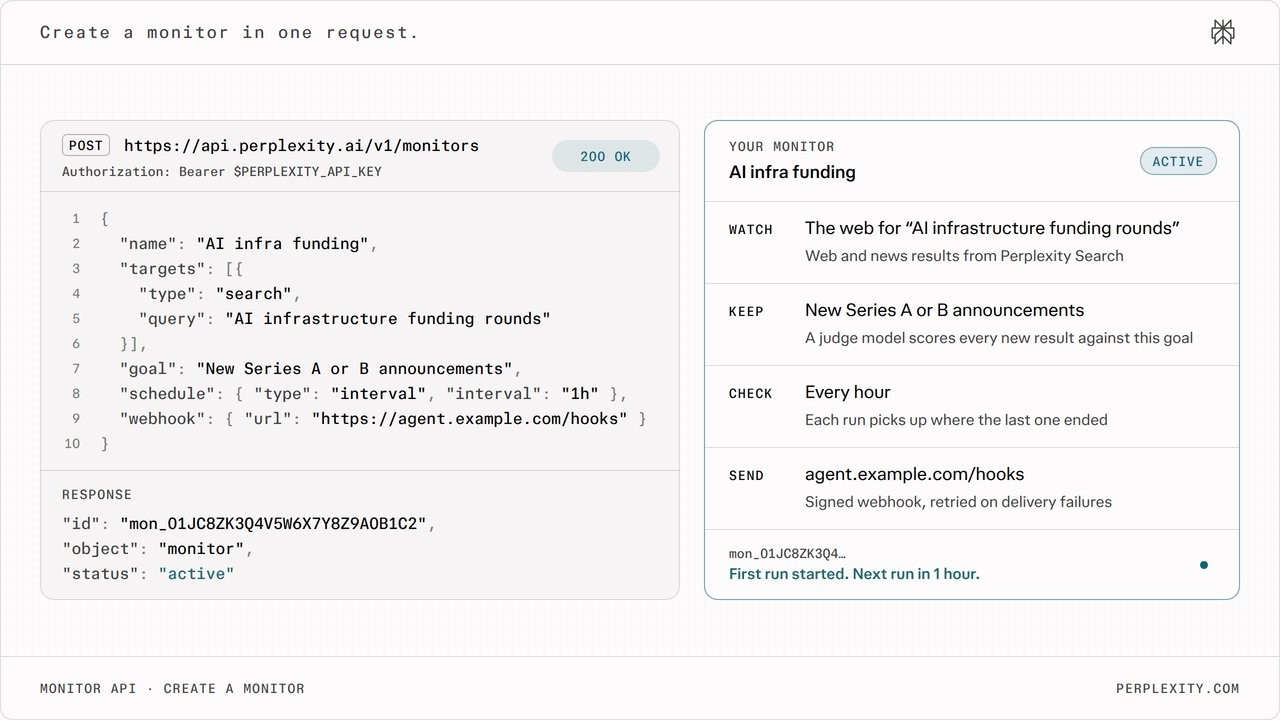
A single API request creates a monitor by setting the search query, goal, schedule, and webhook URL. | Image: Perplexity
Source: the-decoder.com
How the service selects changes
Perplexity uses its own decision-making model to match results against a goal that developers specify in natural language. Web search results are checked for relevance to the topic, source reliability, novelty and timeliness. For page changes, the service assesses how important they are to the stated goal. It sends a notification with a confidence score only if the result passes every threshold check.
Developers can adjust the threshold for each check and revise the goal without creating a new monitor. Runs can be scheduled at intervals from 15 minutes to one week, or set to a custom schedule using cron. Each new run picks up where the previous one stopped, and duplicates are filtered out. Webhook requests are signed; after temporary errors, Perplexity automatically retries delivery. A monitor can be paused, resumed or started manually through the API or API console.
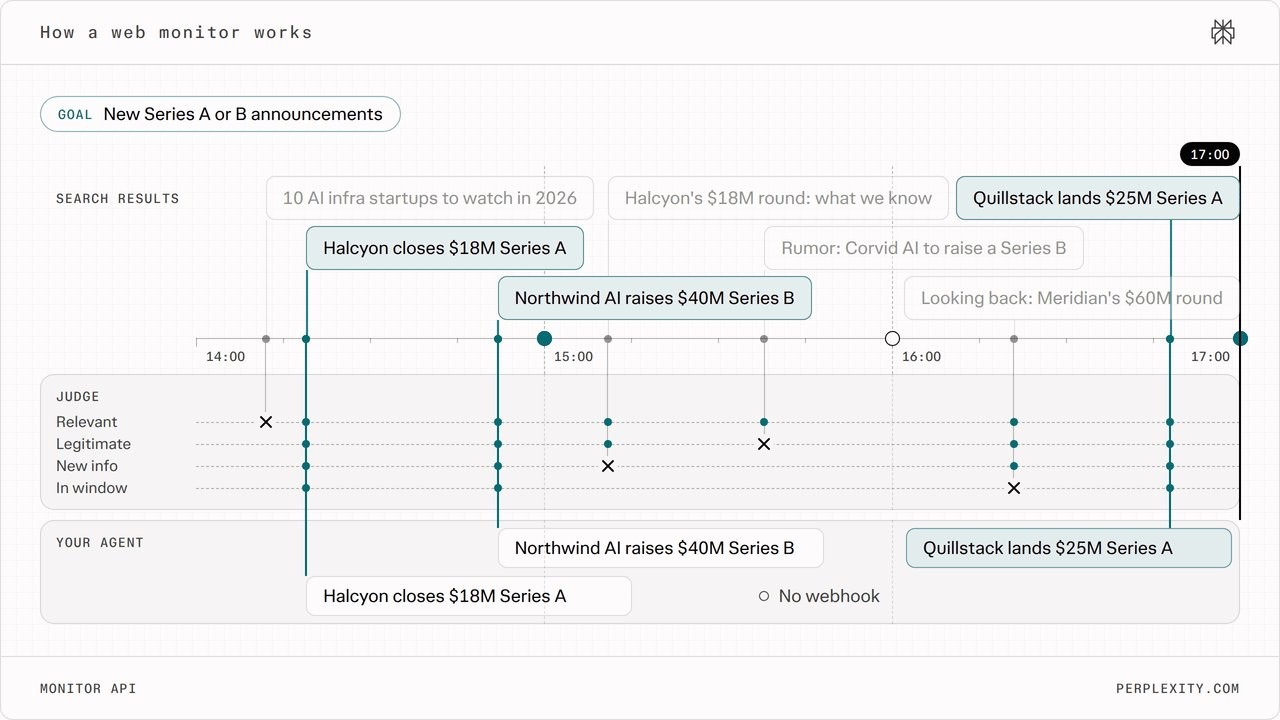
A decision model filters out previews, rumors, and recaps, forwarding only genuine new Series A and Series B announcements to the agent. | Image: Perplexity
Source: the-decoder.com
Results from internal tests
Perplexity compared Monitor API with services from Firecrawl, Exa and Parallel across 60 topics drawn from real Search API queries. These included company news, technology launches and regulation. Each provider used its own schedule and settings, while a separate model assessed the relevance and freshness of results.
In the first eight hours, Perplexity found 63 fresh, relevant pages. Firecrawl found 20, Exa 15, and Parallel Core and Parallel Lite 10 each. The company describes the results as preliminary and based on internal tests. The same three competitors led in an August Artificial Analysis benchmark comparing traditional search APIs for AI agents; Perplexity did not take part in that test.
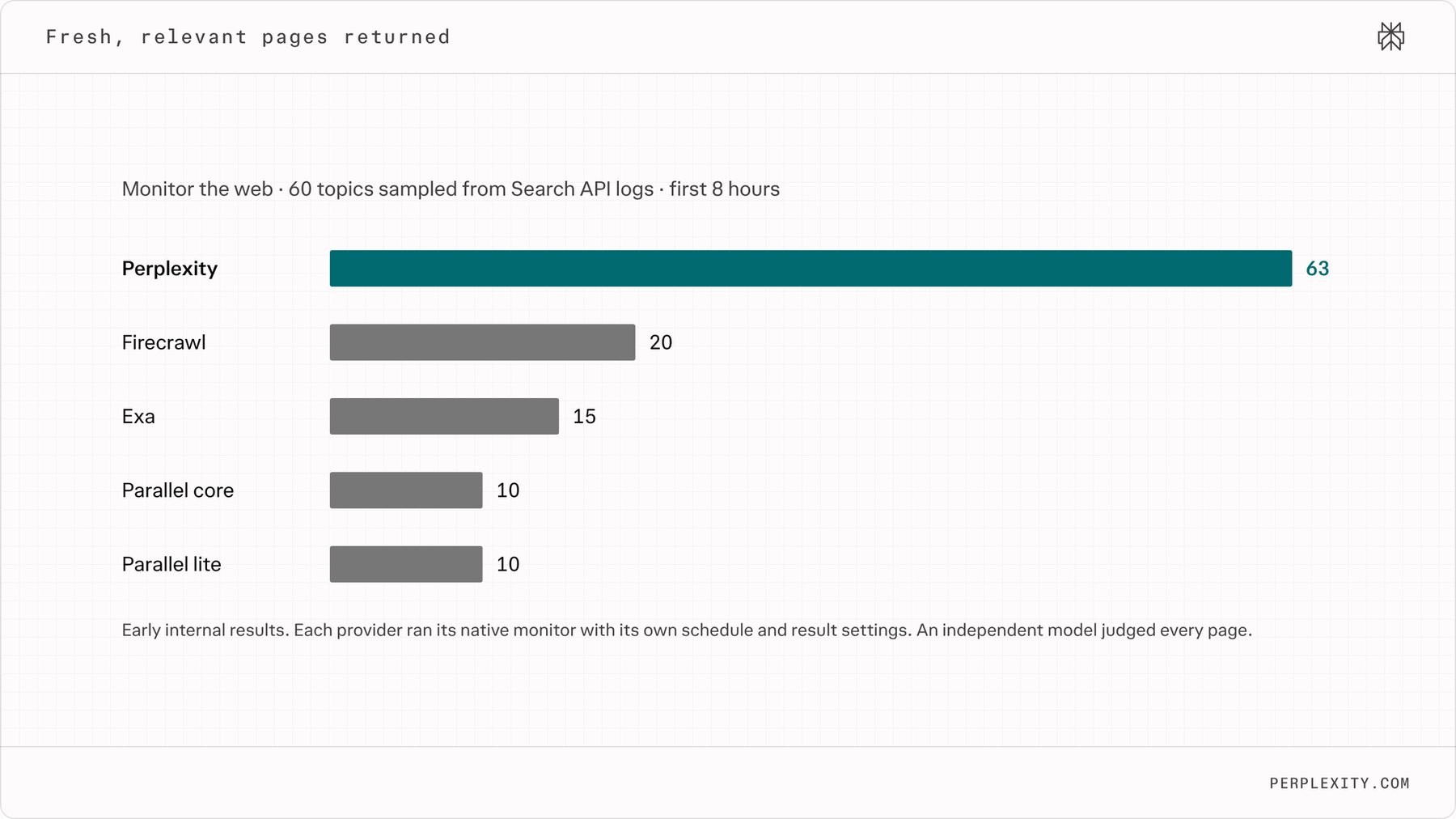
In Perplexity's early internal test, the Monitor API delivered more than three times as many fresh, relevant results as the next-best provider. | Image: Perplexity
Source: the-decoder.com
What monitoring is for
Perplexity points to sales teams tracking funding rounds and staffing changes at target companies, and analysts following quarterly reports and acquisitions. Other AI agents could report changes in competitors’ prices or summarize new regulations for compliance specialists.
Web monitors cost $1 per 1,000 successful runs, while page monitors cost $1 per 1,000 URLs loaded. Monitor API is available now through the API and API console. It uses the same key as Search API, Context API and Agent API.
A bet on developer tools
Perplexity was one of the first AI search engines, but web search has become a standard feature in chatbots, including ChatGPT, Claude and Gemini. In August, The Information reported that Nvidia was in talks to invest in Perplexity at a valuation of more than $30 billion. That makes it more important for Perplexity to find profitable business models.
The company is betting on AI agents, including Computer and always-on Teammates, as well as developer tools such as Search as Code.
Dataist's take: Monitor API moves recurring search and change filtering into a ready-made service that apps and AI agents can connect to. But the comparison figures are still based on Perplexity’s internal tests, and the company did not participate in the August Artificial Analysis benchmark.
Daily AI news
Every day we pick what actually matters in AI and explain it plainly — no hype, no filler. Subscribe if you want to follow where the industry is going.
Only what matters — every day
Follow on X