
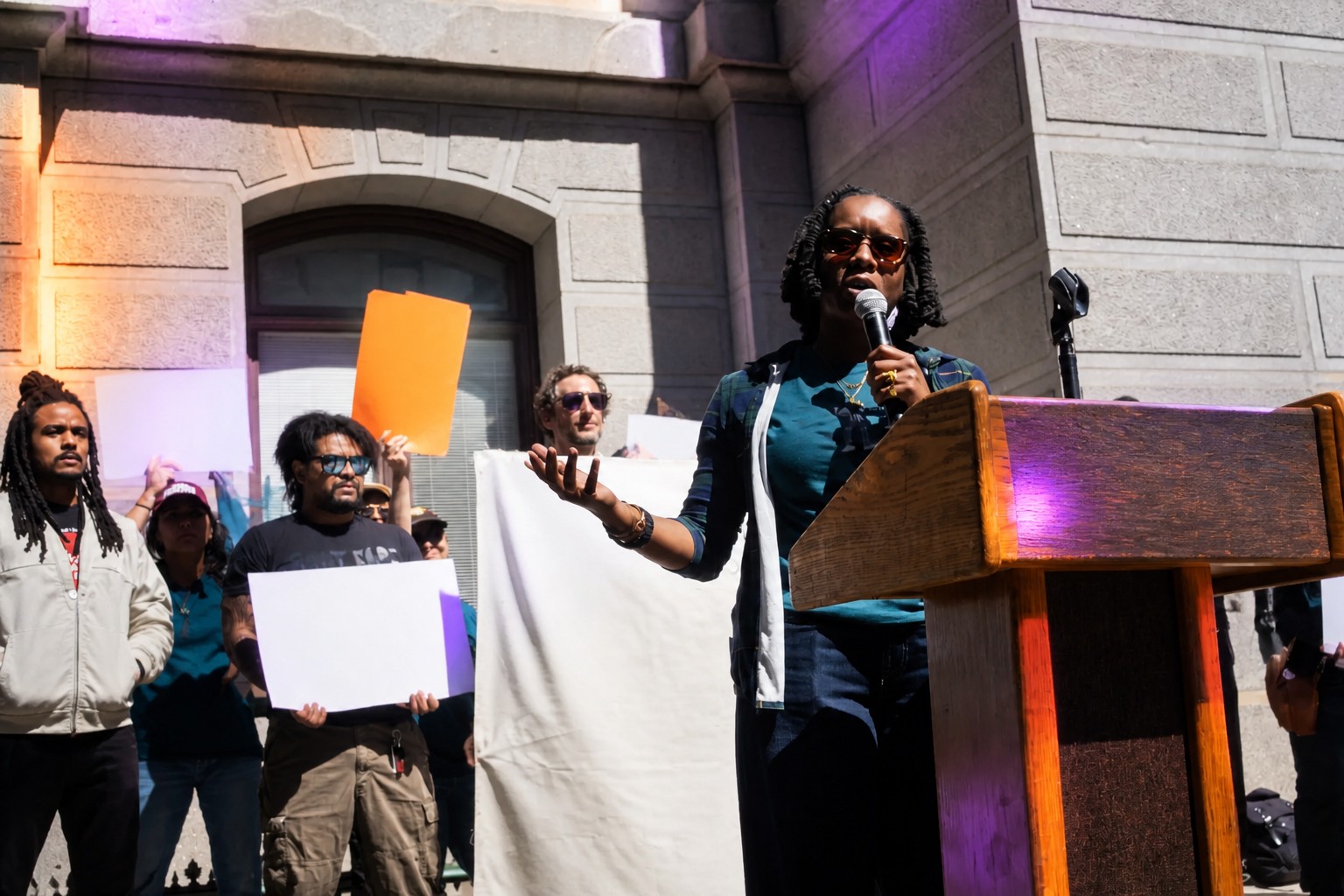
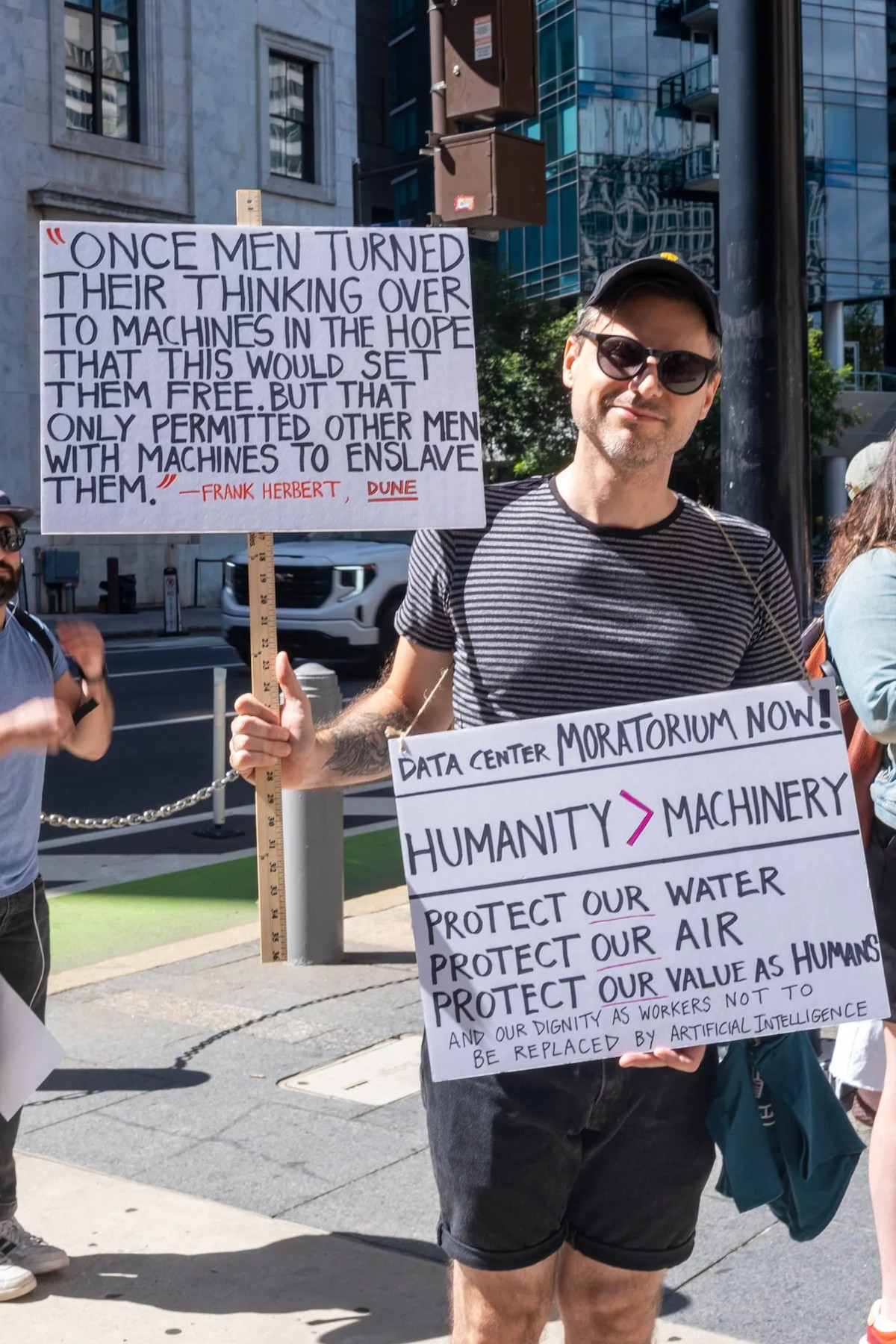
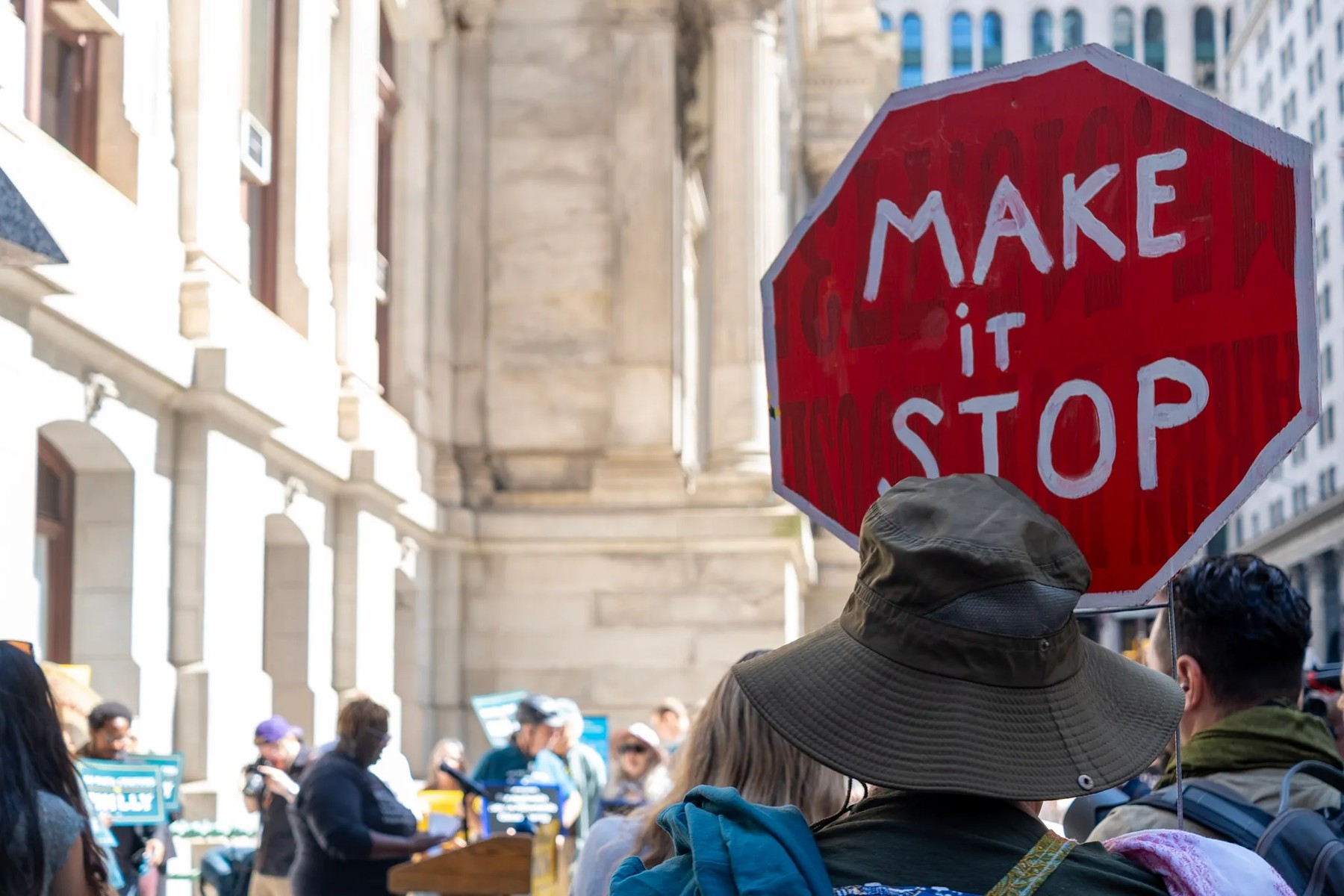
More than 100 people rallied at Philadelphia City Hall on Monday to open a campaign called No Data Centers in Philly and demand a moratorium on construction. No developer has filed an application in the city. What exists so far is a shortlist: officials have identified two possible sites, one in Northeast Philadelphia, one in Grays Ferry, the southwest neighborhood that lived beside what was then the largest refinery on the East Coast until an explosion shut it down in 2019. The opposition has arrived before the projects have.
Shawmar Pitts is now managing co-director of Philly Thrive and one of the leaders of the moratorium campaign. He has lived his whole life in Grays Ferry. Friends and relatives had chronic illnesses whose possible cause he did not understand until 2018, when Philly Thrive canvassed his neighborhood against an expansion of the refinery. In the group's material on what living next to a plant like that does to people, he found the conditions he already knew from his own family and his neighbors. He joined.
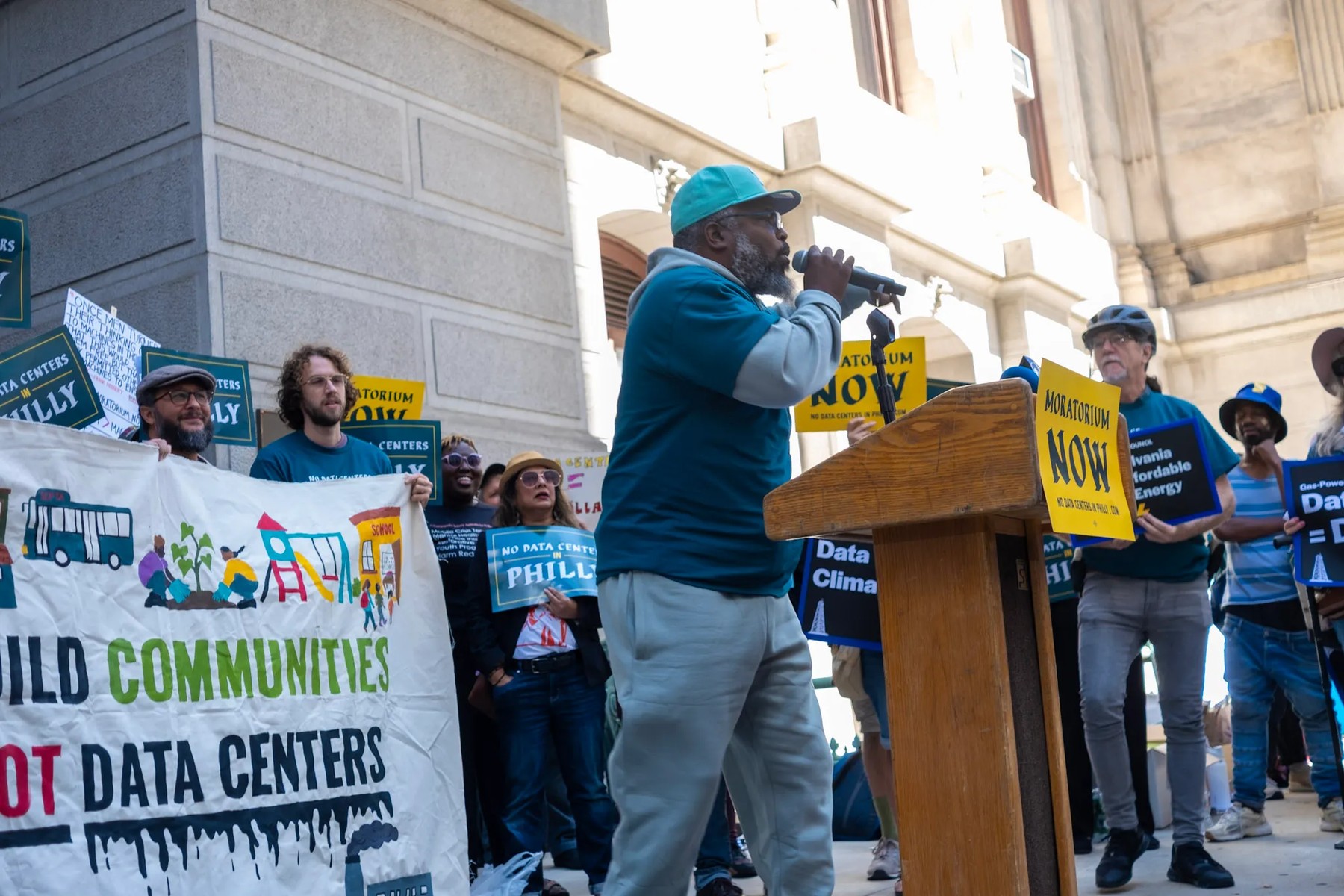
Sonya Sanders, chair of Philly Thrive's board, told the rally that residents do not want data centers because of the pollution and the noise, and do not believe the facilities will bring them jobs. Her husband, also a Grays Ferry resident, died of a rare bone cancer in 2020. He did not smoke or drink, she said, and she believes refinery emissions caused the illness — that he could still be alive had he not been killed by a pursuit of profit she called "quiet murder".
Source: techcrunch.com
Residents are organizing this way in towns and cities across the country where resources are thin, and the resistance is growing fastest in places that still carry the mark of heavy industry. Philadelphia is a clear case of that pattern rather than an exception to it.
On the raw numbers, a data center in Philadelphia would probably not be as damaging as what it would sit near. Philadelphia Energy Solutions processed up to 335,000 barrels of crude a day. But that is the comparison the industry gets handed for free in cities like this one, and it is the wrong one: the refinery is closed, so the choice in front of Grays Ferry is not a data center instead of a refinery, it is a data center instead of nothing.
The national arithmetic is moving faster than any single project. BloombergNEF projects that by 2035 US data centers will consume more natural gas than Germany and Japan combined — nearly double what the firm forecast nine months ago. Gas burns cleaner than oil and other fossil fuels, which does not make it safe: a cubic foot burned releases the equivalent of 60 grams of carbon dioxide, and the additional demand from data centers is expected to add a million metric tons of greenhouse gases a day, about 12% of current total US emissions. Harvard researchers found that in 2021 fossil fuel air pollution was linked to one in five deaths worldwide, a share expected to rise as AI spreads.
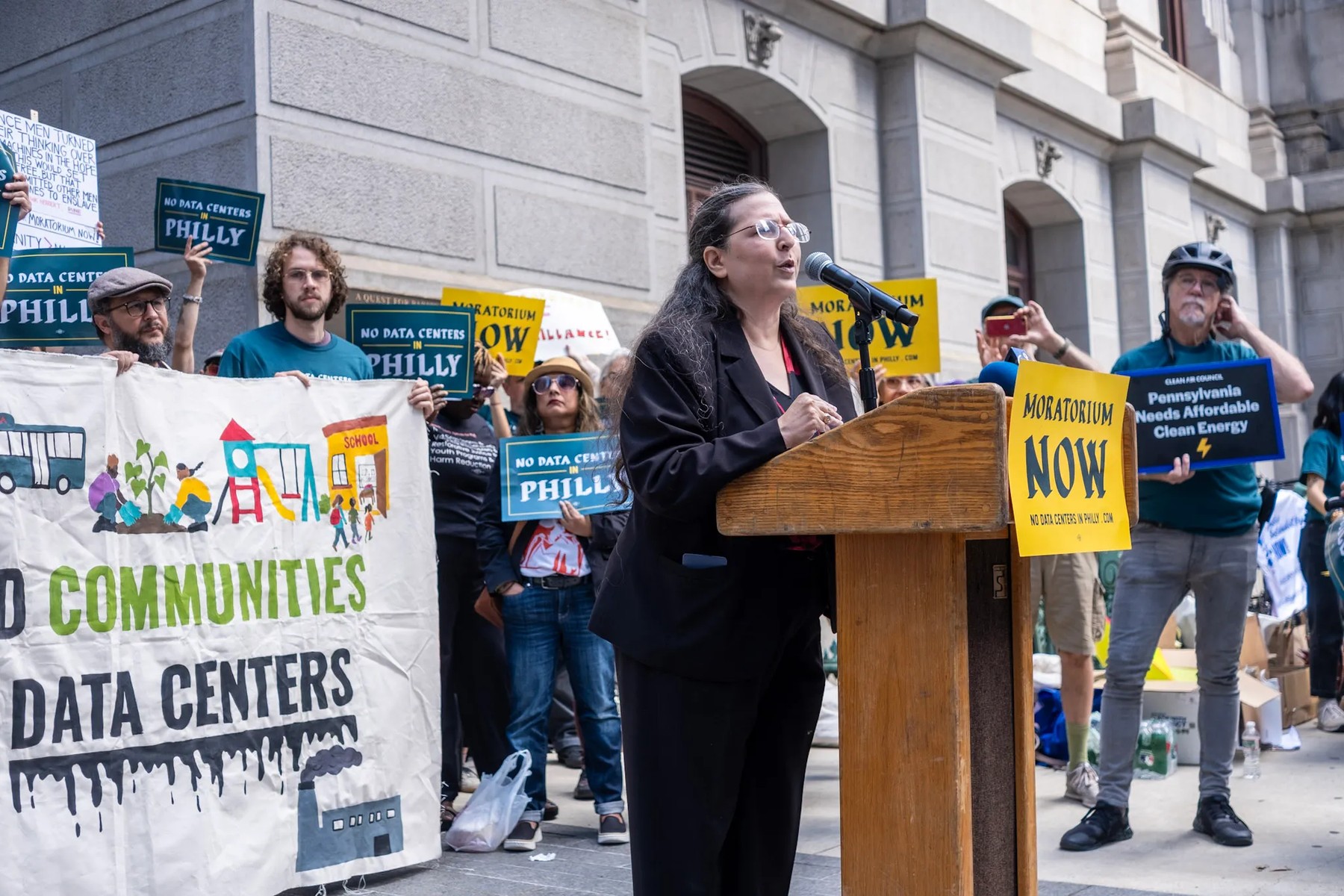
Annie Fox, an attorney with the Clean Air Council, told the rally that a typical Pennsylvania data center project includes hundreds of diesel engines emitting pollutants. Formally they are meant only for emergencies, but authorities have already allowed data centers to run those generators during some heat waves rather than draw on a strained grid. That, Fox said, is likely to happen more often: data centers with heavy fossil fuel demand intensify climate change, and heat waves become more frequent and more severe.
The "emergency only" framing is the part of this worth watching, because it has already failed once. A generator fleet is permitted on the assumption that it will almost never run, and the first exception has been granted not for a blackout but for a hot afternoon on an overloaded grid — a condition the buildout itself makes more common. That is not a hypothetical loop. It has started, and each turn of it makes the next exception easier to justify.
Local officials appear to be listening. In New York, Governor Kathy Hochul signed an executive order temporarily barring the state from approving permits for large projects, saying development should not mean higher utility bills, shrinking water supplies or noise pollution, and that data centers should only be built where people actually want them. Several US cities have already imposed moratoriums of their own: Denver, Indianapolis, Asheville, Charlotte and Reno. What a moratorium usually buys is time for a city government to gather more data on what the construction would mean.
Donna Greenberg, a Philadelphia resident at the rally, said she is worried about pollution, about surveillance, about companies getting access to information they should not have, and about the water and electricity that residents and neighborhoods need.
Source: techcrunch.com
Pitts called the turnout a result that takes serious effort and a lot of people working. The crowd chanted loudly enough, they hoped, to be heard by council members in their City Hall offices.
Nobody at the rally had to argue with a counterparty, because there isn't one yet. No application, no developer, no proposed job figure, no tax number — only two sites a city picked out. Sanders can say residents do not believe the jobs will come and no one is there to answer her. That is the asymmetry this campaign is built on, and it runs one way: once a name and a number are attached to a site, a moratorium becomes a much harder thing to pass than it is this week.