
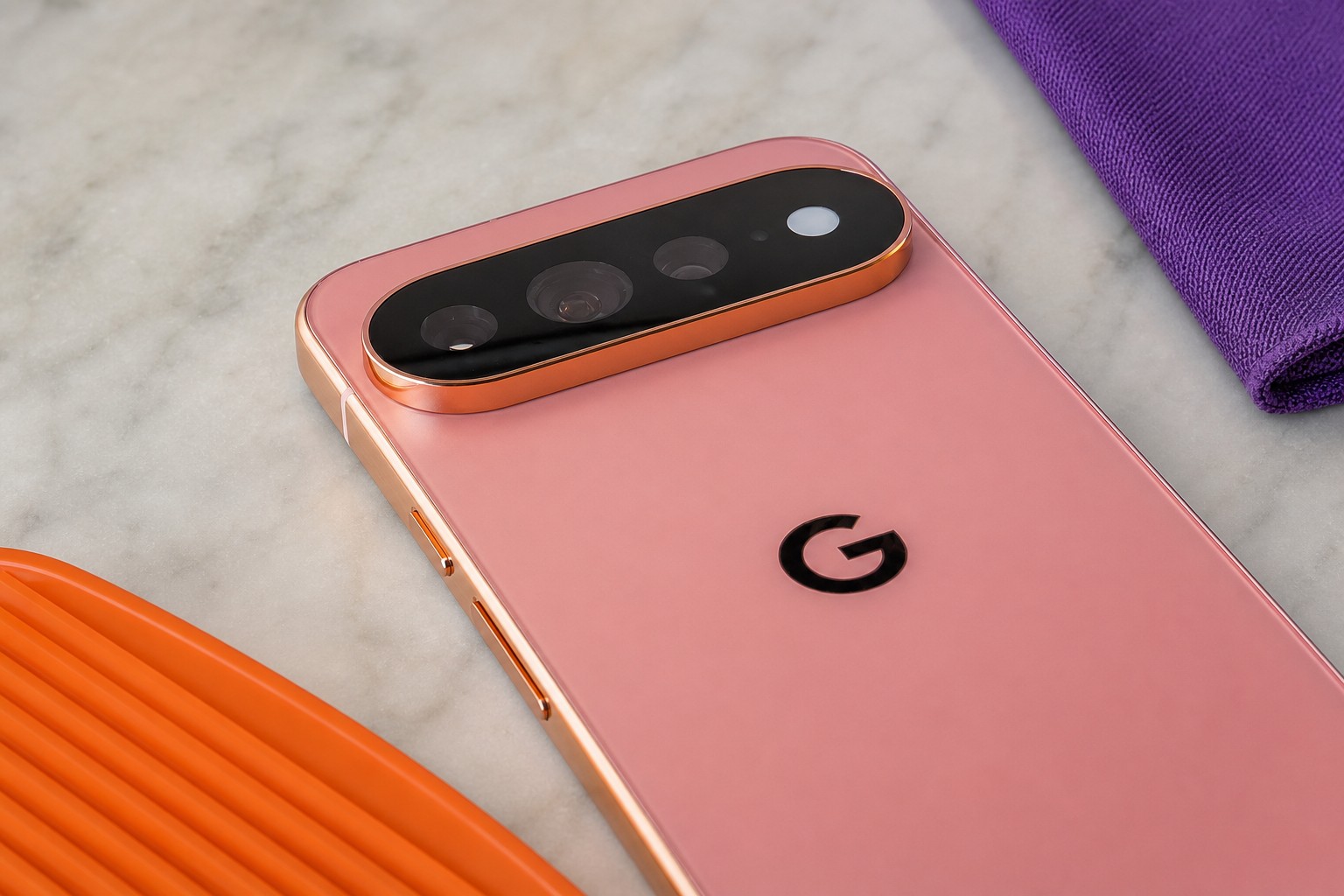
The Pixel 11 Pro series can record 4K HDR at 60 frames per second. It can also run Video Boost, the cloud processing pass that Google's Pro phones use to finish video. It cannot do both. Switching Video Boost on for a 4K60 HDR clip silently drops the capture rate to 30 fps before the file ever leaves the phone, and the returned video is padded back up to 60 fps with algorithmically generated frames. A Google representative confirmed by email that 60 fps support in Video Boost has worked this way from the start: 30 frames per second plus interpolation.
4K60 HDR is new to the Pixel 11 Pro line, and it was one of the more concrete camera upgrades on the spec sheet. Sixty frames means smoother motion and the option to play a clip back at half speed on a standard 30 fps timeline. Pixel owners had been waiting for it a long time — the iPhone has shot it since the iPhone 12 Pro.
Video Boost is the other half of the pitch. The phone records in a dedicated format, uploads it, and Google's servers return a graded, denoised, stabilized version. The approach has been working: DXOMARK placed the Pixel 11 Pro XL above the iPhone 17 Pro in some of its tests. Google's marketing page for the feature says "powerful AI algorithms" remove noise, stabilize motion, and correct exposure and color. Frame interpolation is not on that list.
The proof is a timer filmed on a 120 Hz display. In standard mode, every frame of the Pixel 11 Pro XL's 4K60 HDR capture shows a new timestamp. In the Video Boost output, each value appears twice in a row, with nothing in between — because the camera never recorded the intermediate readings. The final file is 60 fps, exactly as it is on the Pixel 10 Pro, but half those frames were invented after the fact.
Google's explanation is that the Pixel 11 Pro uses the same video processing pipeline as the Pixel 10 Pro XL, and that pipeline tops out at 30 fps for 4K HDR. The same representative confirmed the extra frames are created during cloud processing, using the identical path taken when a Pixel 10 Pro XL user selects 4K60 with Video Boost.
Nothing in the camera app says so. Picking 4K60 HDR with Video Boost enabled gives no indication of the parameters the phone is actually recording at. Google's support pages do note that Video Boost may dynamically reduce frame rate depending on the scene and camera motion — but in these tests capture never once exceeded 30 fps, which is not a dynamic reduction, it is a ceiling. Google has not explained why the cap is there on the Pixel 11 Pro XL. Only the XL variants were tested, though Google's own documentation treats both Pro models identically where Video Boost is concerned.
This reads like a spec that shipped ahead of the pipeline meant to honor it. The camera hardware and the on-device encoder can clearly do real 4K60 HDR — that is exactly what you get with Video Boost off. What cannot do it is the server side, which is a year-old pipeline carried forward unchanged. Google had two options: hold 4K60 until the cloud stack caught up, or ship it and let the two flagship video features quietly cancel each other out. It chose the second, and the support-page hedge about dynamic frame rate is doing more disclosure work than any single sentence should be asked to do.
The more interesting question is what else in a Video Boost clip is generated rather than captured. The marketing copy enumerates noise, stabilization, exposure and color — all corrections applied to something the sensor saw. Half the frames in a 4K60 output were not seen by the sensor at all, and that distinction never appears in the feature description. Once a processing pass is willing to synthesize a frame, the line between a finished video and a rendered one stops being obvious, and the phone is not telling you where you are standing relative to it.
In practice, the output still looks good. Interpolated motion is less precise than genuinely captured 60 fps, and that gap shows up most clearly in the one use case that made 4K60 worth advertising: slowing the footage down. Anyone who wants real 4K60 HDR on a Pixel 11 Pro today has to turn Video Boost off — which means choosing between the frame rate Google just added and the processing that earned the phone its camera scores.