

Pocket FM, the Indian serialized-audio platform, has doubled its annualized revenue run rate over the past year, from roughly $250 million to about $500 million. The company says AI now produces 93% of its catalog and 99% of everything new, and that the shift cut production costs by a factor of about 80. Work that once took a year — 100 hours of finished material — now takes a day. Co-founder and chief executive Rohan Nayak says people still supply the ideas and the stories; the models turn those concepts into episodes and push them out at volume.
The models are the company's own. Vasu Sharma, who runs AI at Pocket FM and was previously a scientist at Meta and Tesla, says the team trained in-house systems for creative writing and speech synthesis on several years of production data plus records of how listeners actually move through stories. That is the tell in this whole operation: the training signal is not just text, it is retention behavior.
The output numbers moved accordingly. More than 550,000 creators on the platform now generate around 2.5 million hours of AI-assisted content a year. Two years ago the entire catalog was roughly 100,000 hours. The library now holds over 770,000 audio series.
Nayak attributes listener retention to that volume. The share of users still producing revenue 12 months after they arrive rose from 44% two years ago to 76% today, which he credits to being able to match stories more precisely to different tastes.
The revenue line climbed in steps: about $250 million a year ago, $430 million in April, $500 million now. Pocket FM calculates this by multiplying monthly revenue by 12 rather than counting contracted recurring commitments. Growth came from three places — more AI in production, launches in the UK, Germany and France, and user-generated content in the US.
Ninety-six stories on the platform have each brought in more than $1 million, and 13 of those have passed $10 million. Having started in India, Pocket FM now reaches more than 250 million listeners across 20-plus countries. The US is the largest market, up about 70% in the past year and now supplying roughly 70% of the run rate. Of the $500 million, about $85 million is advertising; the remaining $415 million or so comes from listeners paying to open individual episodes.
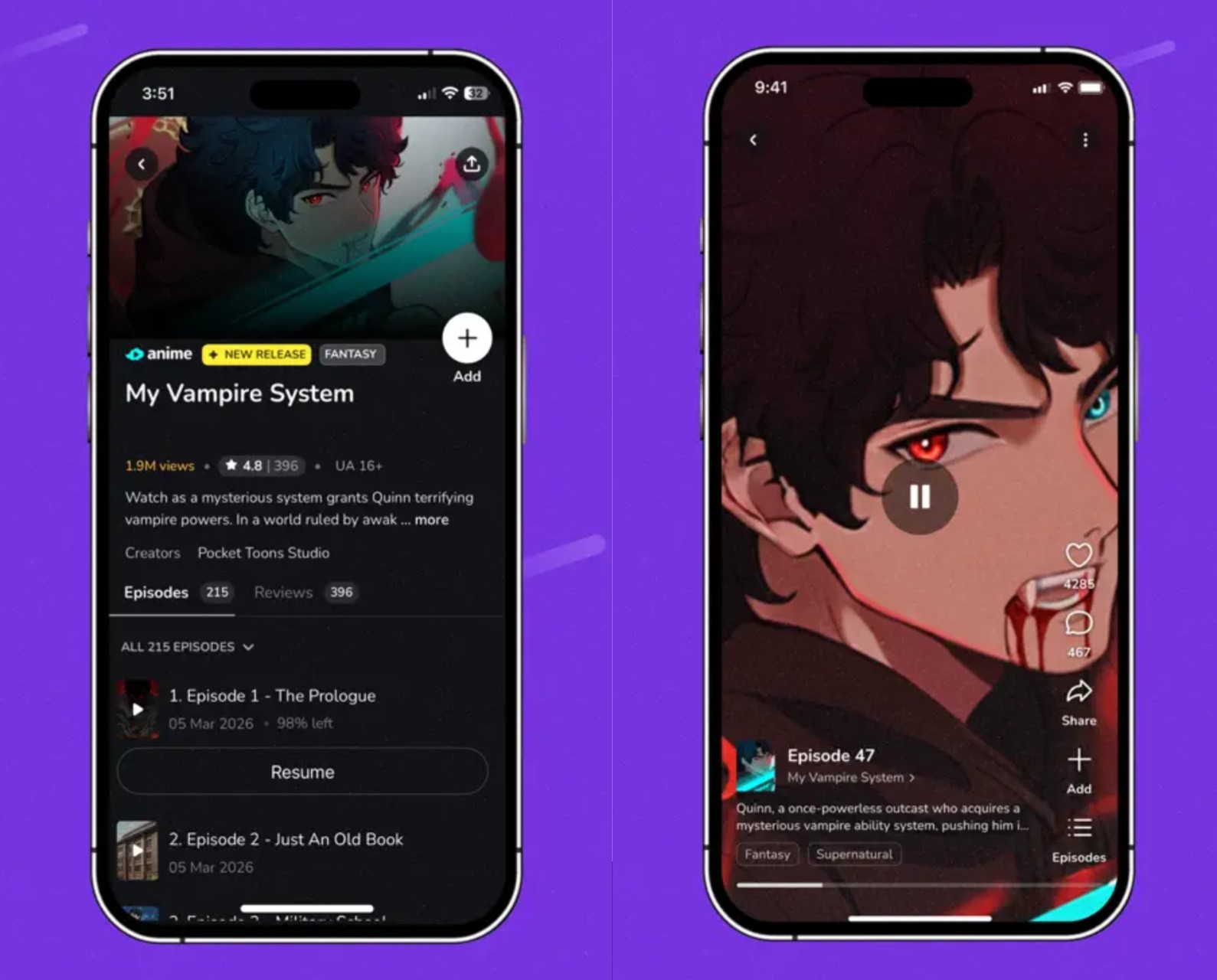
Parent company Pocket Entertainment is now moving the same production model outside audio. Pocket Saga, a short-drama app launched three months ago, is already at a run rate of about $15 million. It is US-only, and everything in it is made with AI — including video built from Pocket FM's successful audio stories, with no live-action shoot.
Over the next five years the company plans to enter at least two more entertainment formats beyond audio and short drama, and to license its better-performing stories into books, television and film. Pocket Entertainment, based in Bengaluru and Culver City, California, is in talks with investors about new capital; a recent report put the raise at $100 million to $120 million at a valuation around $2 billion. Nayak did not deny the talks but said there is no urgency, declined to confirm size or valuation, and said new money would go first into AI and new formats. The company says it is profitable and cash-flow positive on an adjusted basis, without disclosing profit, cash flow or margin. An IPO is not planned within 24 months, though a listing in India or the US remains open.
Two of these numbers deserve more skepticism than they are getting. The $500 million is monthly revenue times 12 in a business whose revenue is impulse micropayments for the next episode — a line that can fall as fast as it rose, and which the company itself distinguishes from contracted recurring revenue. And "profitable on an adjusted basis" with no figures attached, disclosed while raising at a reported $2 billion, is a claim doing promotional work rather than reporting work. The number that would actually settle the argument is the retention curve, and 44% to 76% is genuinely large — large enough that the interesting question is whether more stories caused it, as Nayak says, or whether better recommendation of the same stories did.
The other thing the announcement is quiet about is what 99% AI production means for the 550,000 creators. They are counted as evidence of scale, but a platform where models write and voice nearly everything new has changed what a creator is paid to do, and nobody has said what that job is now worth.
Pocket Saga is the experiment that matters, because it is the control group. Pocket FM keeps humans in the story-development loop on Nayak's theory that durable intellectual property requires them; Pocket Saga has no humans in that loop at all. If the fully automated app keeps compounding at the rate its first three months suggest, the human layer at Pocket FM stops being a principle and starts being a cost line awaiting review.