What Pope Leo said about AI
At UNESCO, Pope Leo said science can lose its purpose when it develops without ethics. Systems that imitate a human capacity for thought have been given the name “intelligence,” he said, while ideas and relationships can become poorer through dehumanization.
His concern was not only about what machines can do. When intelligence is assigned to computational systems, people may find it harder to recognize the inalienable dignity of human beings. Life then starts to be judged by efficiency, with those seen as no longer useful rejected and discarded.
Pope Leo’s proposed answer was ethical education: people should be able to recognize morally correct decisions as machines enter and begin to manage more parts of everyday life.
The same principle shaped his criticism of technologies and policies that, in his view, risk turning human life into a profitable project:
His comments followed France’s adoption in June of a law giving some adult patients the right to assistance in dying.
A visit framed by power and war
The visit is the first official papal visit to France in 18 years. It comes as Emmanuel Macron’s decade in power approaches its end and France prepares for presidential elections next spring, with far-right anti-immigration politician Marine Le Pen receiving strong support.
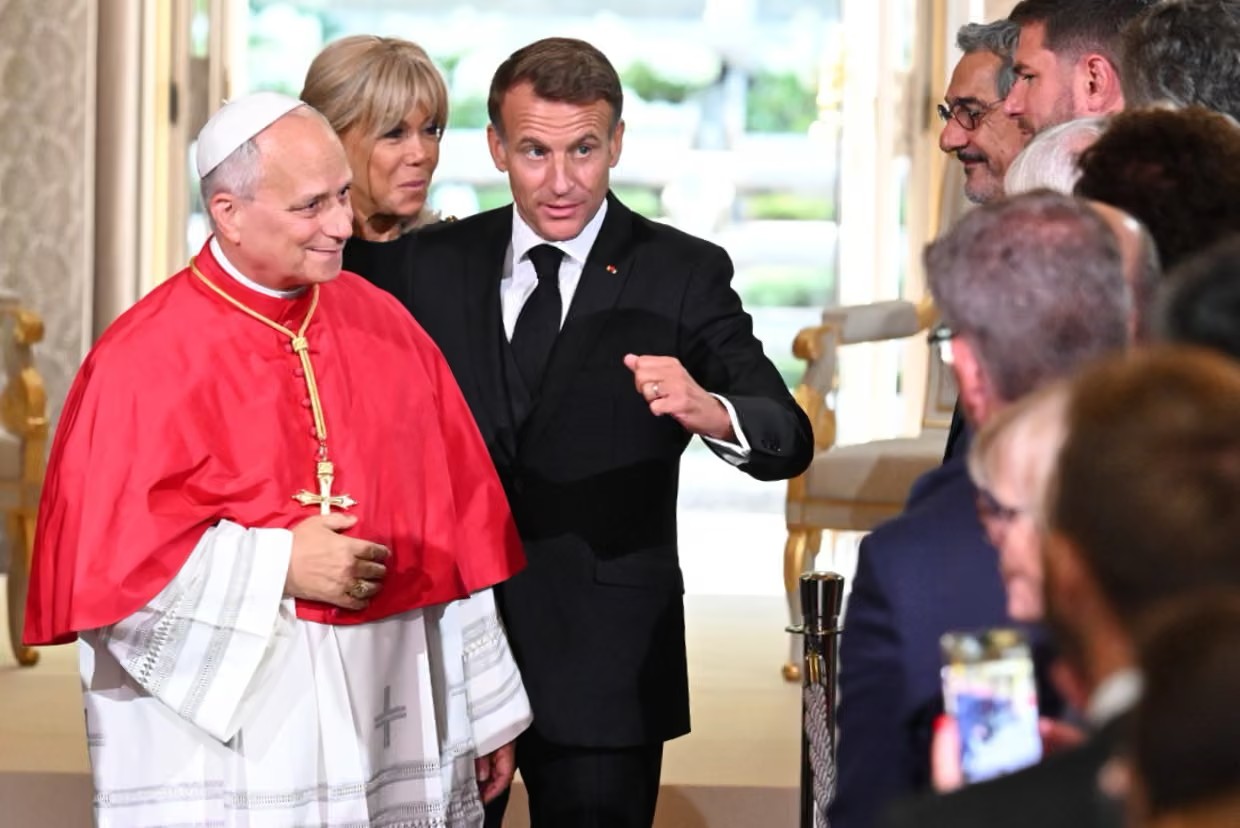
Pope Leo with the French president, Emmanuel Macron, and his wife, Brigitte Macron, at the Elysée. Photograph: Maurizio Brambatti/AP
Source: theguardian.com
Pope Leo also criticized world leaders who respect the rule of law only when it serves their interests. Without naming individuals, he said powerful people ignore laws when those laws constrain them, turning justice into a commodity that can be bought and sold.
That argument fits his recent attacks on the direction of global politics. In April, he said the world was being “torn apart by a handful of tyrants.”
On Friday, Pope Leo urged Paris to remain an “untiring advocate for peace” around the world. He will speak about peace in Europe on Monday in Metz, in eastern France, by which point Russia’s full-scale invasion of Ukraine will have continued into its fifth year. He urged French politicians, including Macron, not to become indifferent to the pain caused by the “disaster of war” or accept war as inevitable.
The trip also includes an outdoor Mass on Saturday at the Place de la Concorde and a visit to Lourdes, a Christian pilgrimage site. There, Pope Leo will hold a private meeting with seven victims of sexual abuse by members of the clergy.
The limited meeting has drawn criticism from some survivor groups, which said more people should have been invited. The Catholic Church said the format reflected the pope’s desire for a detailed conversation with individual victims.
The Conference of Bishops of France agreed to pay compensation after a 2021 report estimated that 330,000 children in France had been sexually abused over 70 years by priests and others connected to the Church. The report’s authors called the concealment of crimes by Church officials systematic. New allegations have since emerged, including against staff at the elite Betharram Catholic boarding school near Lourdes.
The question behind the speech
Pope Leo, who became pope in 2025 and has a French-born paternal grandmother, is presenting AI as part of a larger moral test: whether institutions will treat people as ends in themselves or as inputs to an efficient system.
My read is that this is less an AI policy intervention than a definition of the battlefield. Pope Leo did not offer technical safeguards, regulatory proposals or a test for deciding which systems remain “at the service of man.” Instead, he connected AI to assisted dying, biotechnology, war and the rule of law. The common thread is his fear that powerful institutions will use abstractions—efficiency, progress, legality or intelligence—to make vulnerable people easier to discard.
What I’d want to know is how his call for ethical education becomes practice. The speech identifies the danger clearly, but leaves the institutions that would teach, enforce and fund that ethics largely unnamed. That gap matters because the systems he is warning about are already being built inside organizations whose incentives are not set by moral language.
During the flight to Paris, Pope Leo also said journalists were free to cover his activities. Asked by a CNN journalist about Donald Trump’s attempt to bar CNN and other reporters from working at the White House, he said journalists were welcome aboard his plane and that he was glad to see all members of the press there.
The message gives his France visit a consistent shape: human dignity should constrain technology, political power and even the Church itself. The unresolved tension is that a principle strong enough to challenge AI and governments must also be applied to the institutions delivering it.
Daily AI news
Every day we pick what actually matters in AI and explain it plainly — no hype, no filler. Subscribe if you want to follow where the industry is going.
Only what matters — every day
Follow on X