

The share of Glassdoor reviews in which US employees speak positively about AI has fallen from 81 percent in 2019 to 43 percent by mid-2026, with negative sentiment now at 53 percent. Over the same stretch, the share of reviews that mention AI at all rose from under 0.2 percent to more than 2.3 percent, growing 240 percent in the year to May 2026 alone. Far more people are writing about AI at work than ever before, and the majority of them are complaining.
Sentiment tracks the org chart almost perfectly. People in management roles are markedly more positive about AI than anyone else. Software architects mention it more often than any other profession and mostly say good things. Software engineers whose job is mainly writing and reviewing code are far harsher: 57 percent of their comments lean negative.
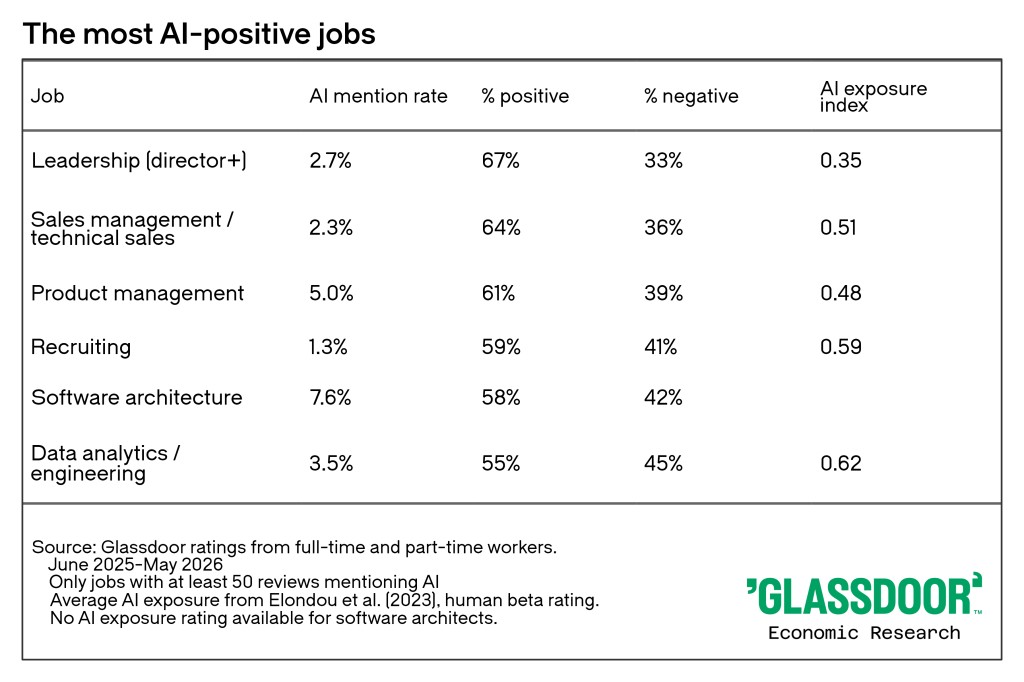
Glassdoor reviews from June 2025 to May 2026 show that employees in management positions hold the most positive attitudes toward AI
Source: the-decoder.com
At the other end sit insurance claims adjusters, whose reviews of their employers' AI efforts are almost entirely negative. Their usual complaint is that management is forcing them to use tools that do not work well. Writers, accountants and support staff also skew critical, at roughly four negative comments for every positive one.
Professions that AI barely touches — butchers, electricians — rarely bring it up at all. But once there is even moderate contact with the technology, comments show up in almost every occupation, regardless of how much automation actually threatens that particular job. The trigger is exposure, not risk. People write about AI when they are made to use it, not when they calculate that it might replace them.
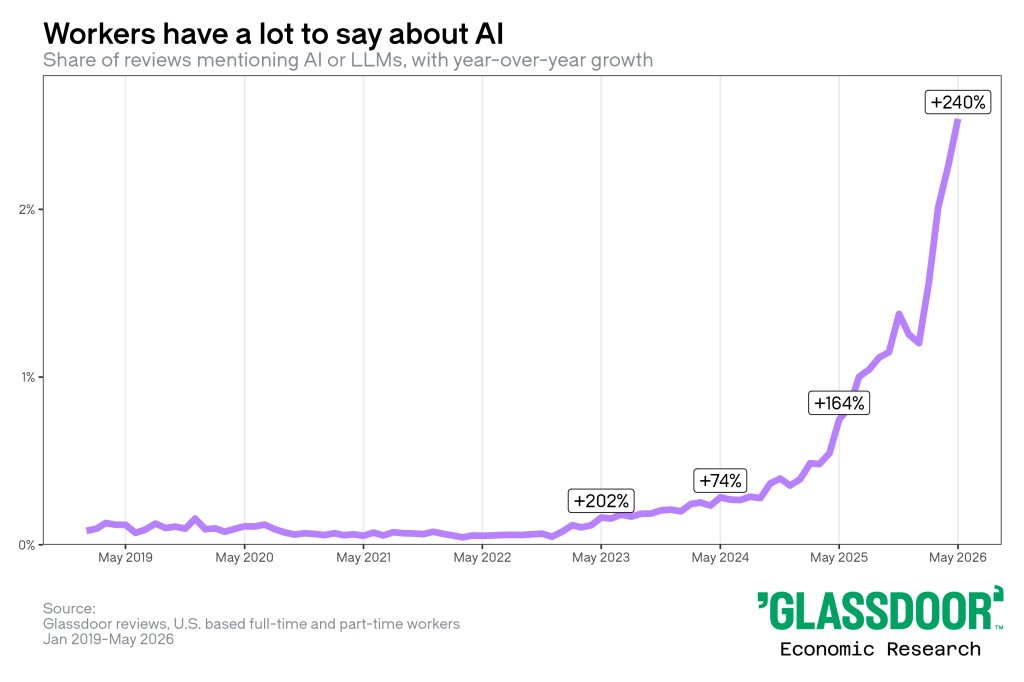
From January 2019 to May 2026, the share of reviews containing "AI", "LLM(s)", "GPT(s)", "artificial intelligence" or "OpenAI" grew from less than 0.2 percent to more than 2.3 percent, with annual growth reaching 240 percent
Source: the-decoder.com
The praise, when it comes, divides into two groups. Forty-four percent of detailed positive reviews were written by employees at companies that benefit from the AI boom — Glassdoor calls them "AI winners." Another 41 percent credit the employer specifically for tools, training and support during adoption: the "AI users." About 27 percent of positive reviews are generic enthusiasm with nothing concrete behind it.
Complaints are more varied. Fear of job loss appears in 20 percent of negative comments, the single most common grievance but nowhere near a majority. Another 14 percent say the company forces them to use AI. For 13 percent, AI distracts from the actual work or degrades the customer experience. Ten percent criticise internal deployments for a sense of alienation, citing employee monitoring and automated messages from management. Eight percent call leadership's productivity demands unrealistic.
Then there is the inverse complaint: roughly 10 percent of negative comments say the company is adopting AI too slowly or failing to provide decent tools. These employees are broadly pro-AI and unhappy with their employer, which means a tenth of the negative column is not anti-AI sentiment at all.
The demographic splits are wide. Men rate AI positively 45 percent of the time, women 32 percent. Generation X is the most receptive at 47 percent positive, followed by millennials at 40 percent and Gen Z at 33 percent.
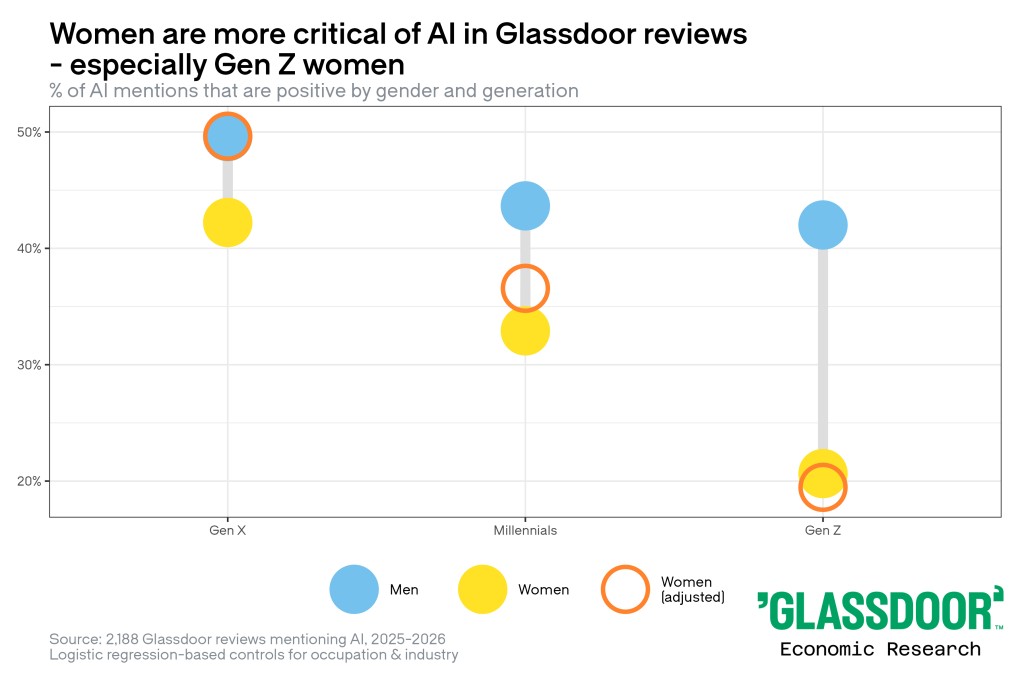
Glassdoor reviews from 2025 to 2026 show a growing gender gap in perceptions of AI, especially pronounced among younger generations
Source: the-decoder.com
The gap is sharpest among the youngest workers. Only 21 percent of Gen Z women's comments about AI are positive, against 42 percent for Gen Z men — a two-to-one split inside a single cohort. For Gen X, Glassdoor can attribute the gender difference to which industries and occupations men and women are in. For Gen Z, its analysis says that explanation does not hold.
Industry and employer size matter too. Tech workers mention AI most often and split roughly evenly between positive and negative. Media and communications staff also talk about it a lot and are more critical. The most negative sentiment comes from arts organisations and the nonprofit sector. And scale amplifies the problem: at companies with fewer than 200 employees, 51 percent of AI comments are negative; at companies with more than 10,000, that rises to 67 percent.
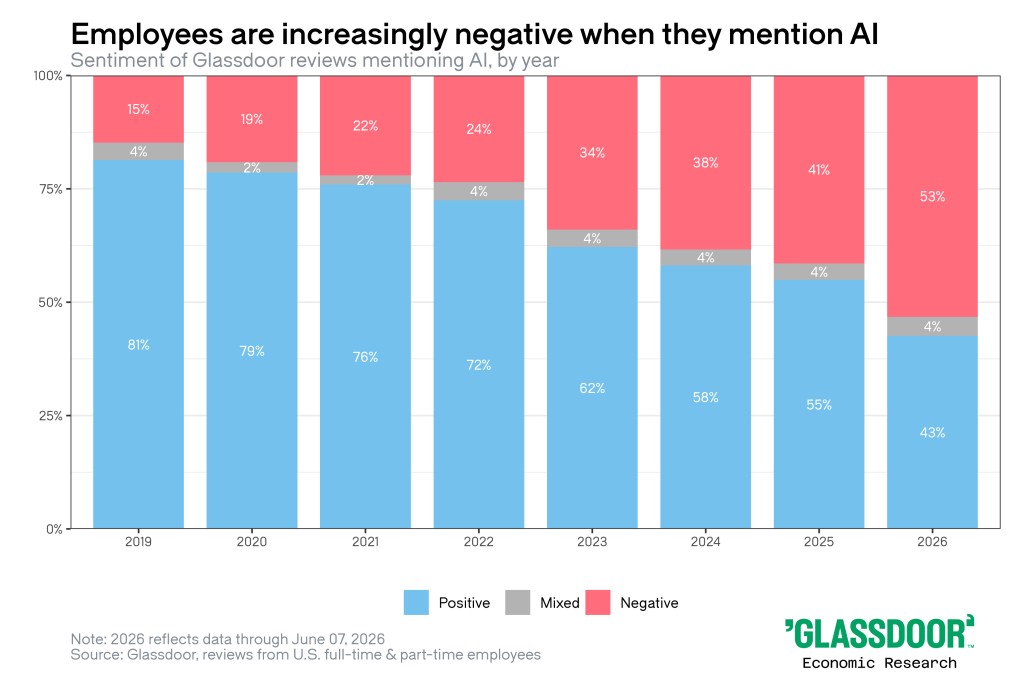
From 2019 to mid-2026, the share of positive comments about AI on Glassdoor fell from 81 percent to 43 percent, while negative sentiment rose to 53 percent
Source: the-decoder.com
Read together, these numbers describe something narrower than a backlash against AI. The heaviest negativity clusters exactly where the technology arrives as a mandate rather than a choice: claims adjusters handed broken tools, engineers reviewing code they did not write, employees at ten-thousand-person firms where rollout is a policy rather than a decision. Meanwhile the people who chose the tools — managers, architects — are the happiest, and a tenth of the complainers want more AI, not less. The 81-to-43 collapse looks less like workers deciding the technology is bad and more like workers discovering what it feels like when someone else decides for them. That distinction matters because the two problems have completely different fixes, and only one of them is about the models.
The more interesting question is what the data cannot say: whether the tools actually work. Every one of these percentages measures how employees feel about their employer's AI program. None of them measures whether the claims adjuster's tool is worse than what it replaced, or whether the engineer's 57 percent negative rate reflects bad code or wounded professional pride. A company could read this and conclude that better change management is the answer, when the reviews might simply be an accurate product review.
The usual caveat applies: Glassdoor reviews are not a representative sample of the American workforce. Unhappy employees post more than happy ones, so absolute levels probably skew negative. The movement over time is the sturdier signal, on the assumption that the platform's bias has stayed roughly constant across the years. Glassdoor's own analysts also note that some negative reviews come from office professions where burnout and layoff anxiety were common before AI arrived — though in many comments employees tie the job loss directly to AI.
The direction matches everything else in the field. A survey of US adults conducted in April found Gen Z particularly critical. Anthropic's own research found broad skepticism among American workers, driven mainly by fears of skill erosion and job loss. And Stanford's 2026 AI Index confirms the seniority gradient at national scale: 73 percent of US experts consider AI's effect on the labour market positive, against 23 percent of the general public.
Fifty points of disagreement between the people building the technology and the people living with it is not a communication problem, and it will not close by explaining AI better. It closes when the tools stop being something done to people at work — or when the reviews stop mattering because there is no one left to write them.