
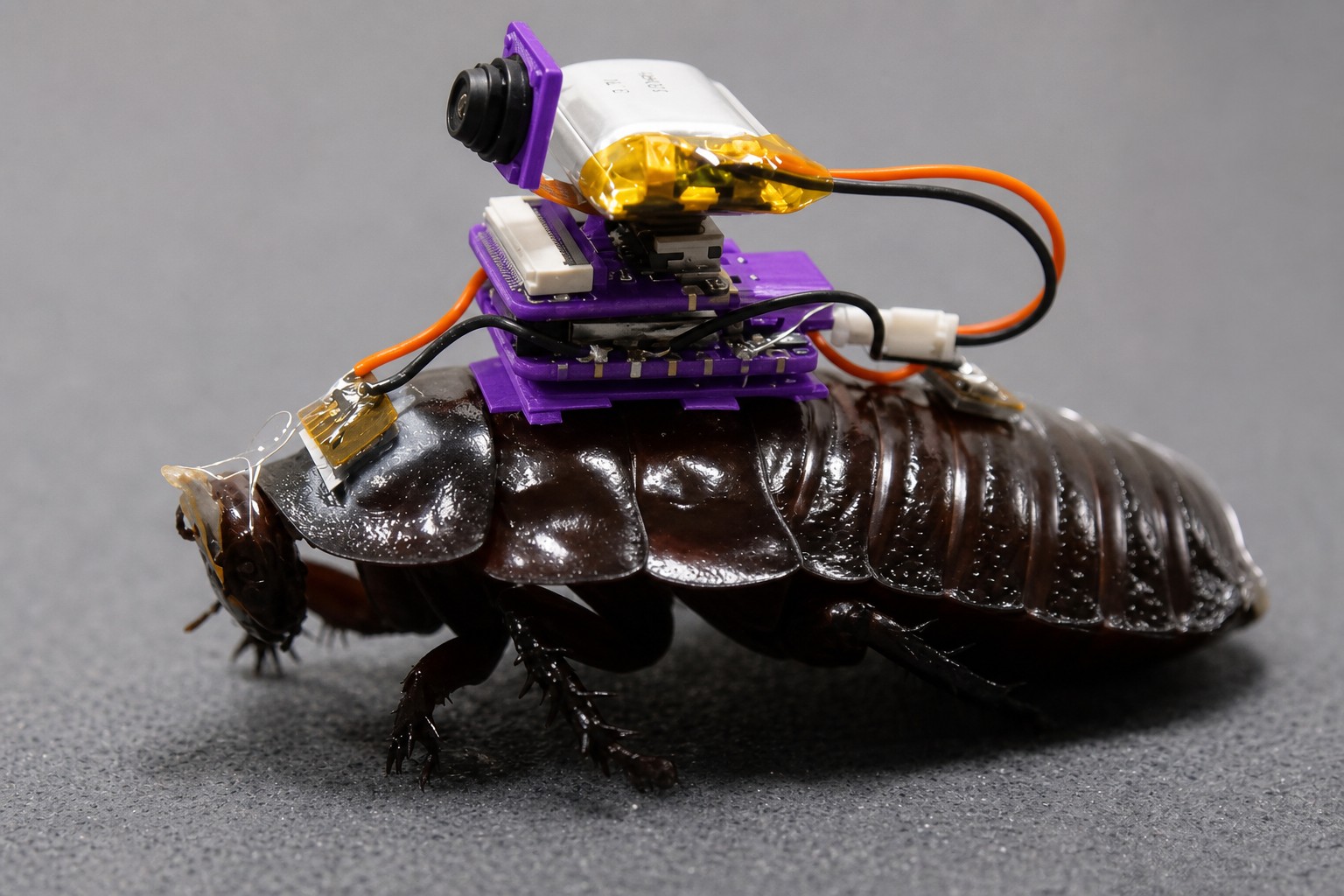
A lab at the University of Queensland has strapped a spring-loaded syringe to the back of a live cockroach, steered it across a floor by radio, and fired the needle into a silicone target. Over 25 runs the insect finished the course every time and delivered the injection in 72 percent of them. The animals are giant burrowing cockroaches, Macropanesthia rhinoceros, an Australian species that at about 40 grams is the heaviest cockroach there is. The researchers call the result a paraborg, and the job they have in mind is disaster medicine: reaching a person pinned under rubble hours before a rescue crew can, and giving them a drug in the meantime. The work was published last month in Advanced Science.
Insect cyborgs have been a research line for decades, and the reason is an admission about robotics. T. Thang Vo-Doan, who directs the biorobotics lab at the University of Queensland in Brisbane, frames the approach as a way around the hardest unsolved problems at small scale. Build an insect-sized robot that crosses broken ground reliably, climbs uneven surfaces, rights itself after a fall, carries its own power source and still has room left over for a useful sensor, and you have solved most of what the field has failed to solve. A cockroach already walks, climbs and recovers. So the lab bolts an electronic interface onto an animal that works, instead of rebuilding every body part from scratch.
Steerable beetles and moths are not new either; groups have been driving them for years. What those experiments mostly did was move the insect. The animal was a chassis for a sensor and the output was data. The paraborg carries an effector — something that acts on the world at the far end of the trip — and that, more than the steering, is what this paper adds. It also changes the failure mode. A camera that misses gives you nothing. A syringe that misses has spent its only payload.
The idea dates to 2023, when Vo-Doan and his colleague Thanh Nho Do were discussing search-and-rescue cyborgs shortly before the IEEE International Conference on Robotics and Automation. Their question was what should happen after the insect finds someone — whether it could do more than locate a survivor and actually help while the rescuers dug.
The hardware is light. Electrodes go into both antennae and into the cerci, the small tail-like appendages at the rear. Triggered wirelessly from a game controller, they make the roach turn left or right, go forward, or stop. On top rides either a wireless camera or the remote injector: a spring drives a syringe into a target at close range, and a chemical reaction inside the syringe produces a cloud of carbon dioxide whose pressure pushes the contents out.
No insect gets both. The team deliberately kept the camera and the injector on separate animals, because the extra weight and bulk would degrade the roach's footing on difficult terrain and the extra power draw would shorten its working time. The plan is to send teams — scouts carrying cameras, carriers hauling potentially life-saving drugs. Stated plainly, that is a power and payload budget that does not close, and the fix on offer is more insects rather than better ones.
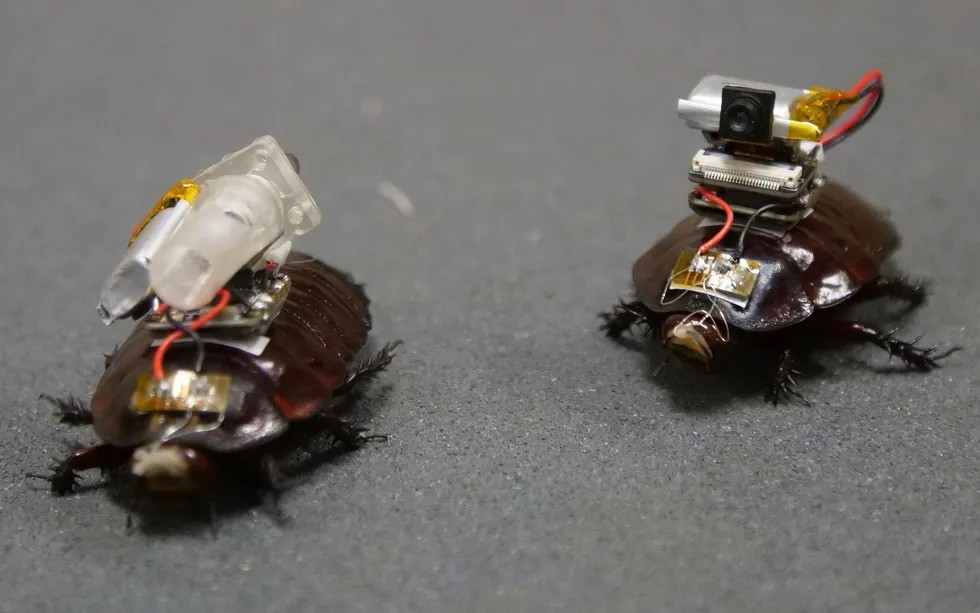
Two large cockroaches, each with a set of electronics and sensors on its shell
Source: spectrum.ieee.org
The validation runs were modest by design. Each roach covered a 2.5-meter route, passed three checkpoints, then fired its needle into a silicone target measuring 8 by 10 centimeters. Twenty-five trials, a completed route every time, 72 percent of injections landing in the target.
The insects stay alive throughout and use their own locomotion to handle the ground. The operators steer; they do not drive.
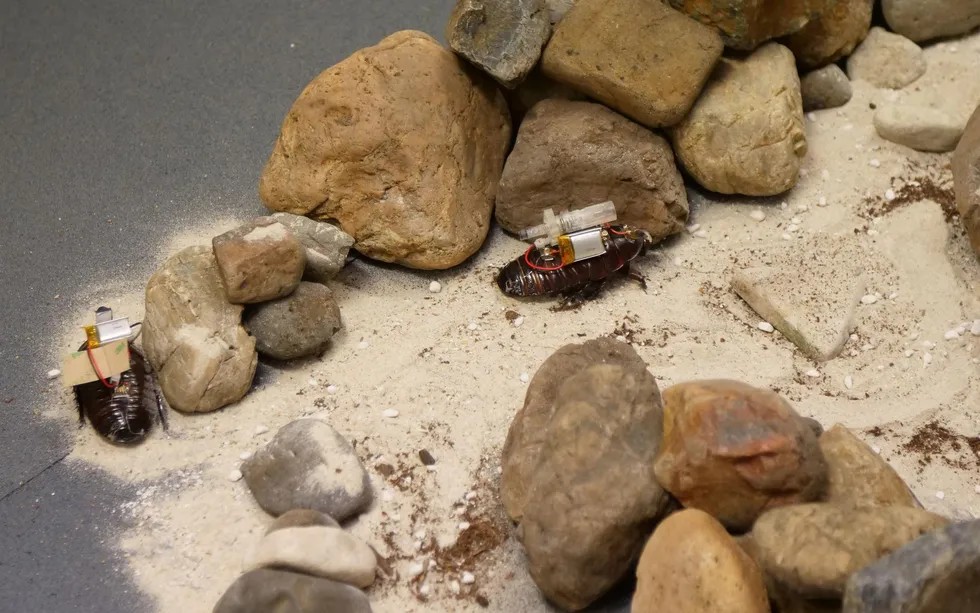
Two large cockroaches with electronics in backpacks moving around rocks and across sand
Source: spectrum.ieee.org
The team is candid that a trapped, injured person may be frightened by an approaching electronic insect. Their proposed remedies are blinking lights, visible emergency markings, or a small speaker playing a message along the lines of "help is on the way." Vo-Doan puts making the technology legible and acceptable to people on the same footing as making it work at all.
The list of unsolved problems is long, and the team publishes it: compensating for a casualty's movement, keeping a wireless link alive inside a collapsed building, getting the cyborgs through rubble, narrow gaps and dust, and raising autonomy far enough that one operator could run several insects at once.
A separate difficulty is the one that makes the whole approach attractive. The roach is an animal with its own behavior, not a wheeled robot. Electrical stimulation biases its direction; a large share of the motion remains the insect's own. That unpredictability means paraborgs will need better onboard systems simply to know where the animal is and what it is doing — enough to tell when it has wandered off the route or stopped responding to commands.
72 percent is the number that will travel, and it deserves a slow read. The target was a static silicone rectangle, 8 by 10 centimeters, at the end of a 2.5-meter course with marked checkpoints, and the team's own list of open problems opens with compensating for a casualty who moves. Twenty-five trials is a demonstration, not a reliability figure. And a missed injection is not a neutral outcome: the roach carries one shot, the drug is gone, and nobody above the rubble knows whether it went into the patient or into the dust. The remaining questions the researchers name — which drug, what dose, how to keep the needle sterile, how safe the needle is, what regulators would demand — are the right ones, and none of them has an answer yet. Vo-Doan says this is not a medical device ready for use on people, and he is right to say so.
What the work is quiet about is the animal itself. The entire argument for the method is that the cockroach supplies locomotion, footing and self-recovery for free, which is another way of saying the system's competence is borrowed from something alive. That is not a reason to stop, but it is a variable the fully robotic version does not have, and it does not appear on the list of engineering problems the team plans to solve.
Vo-Doan's closing argument is that insects can deliver some useful capability sooner while helping build the fully artificial systems that come later. That is the bridge framing, and it carries an expiry date: a bridge only matters as long as the gap stays open. Insect cyborgs have been a research program for decades precisely because insect-scale robots kept not arriving. A paraborg carrying a loaded needle into a collapsed building would be the moment the stopgap quietly became the infrastructure.