
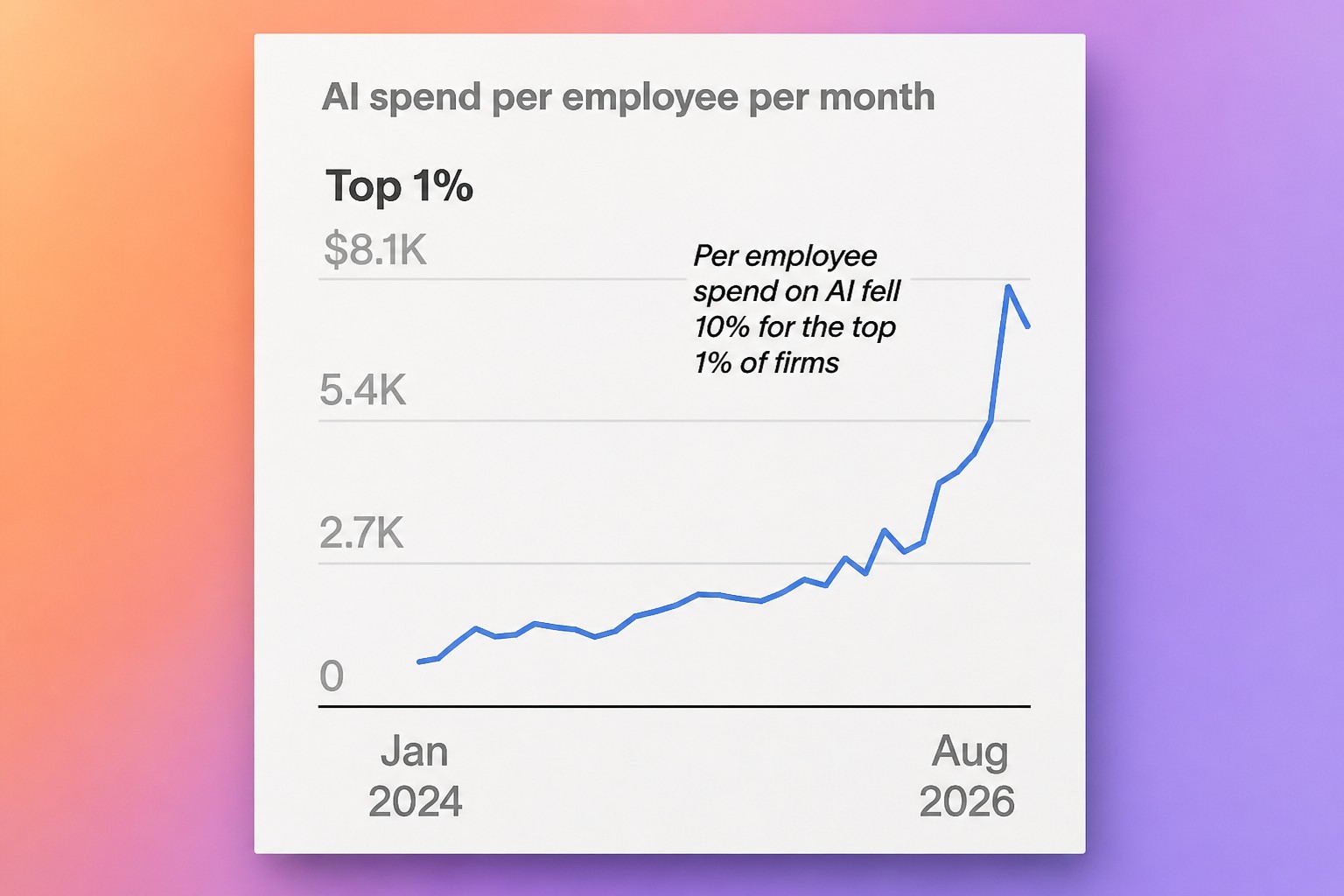
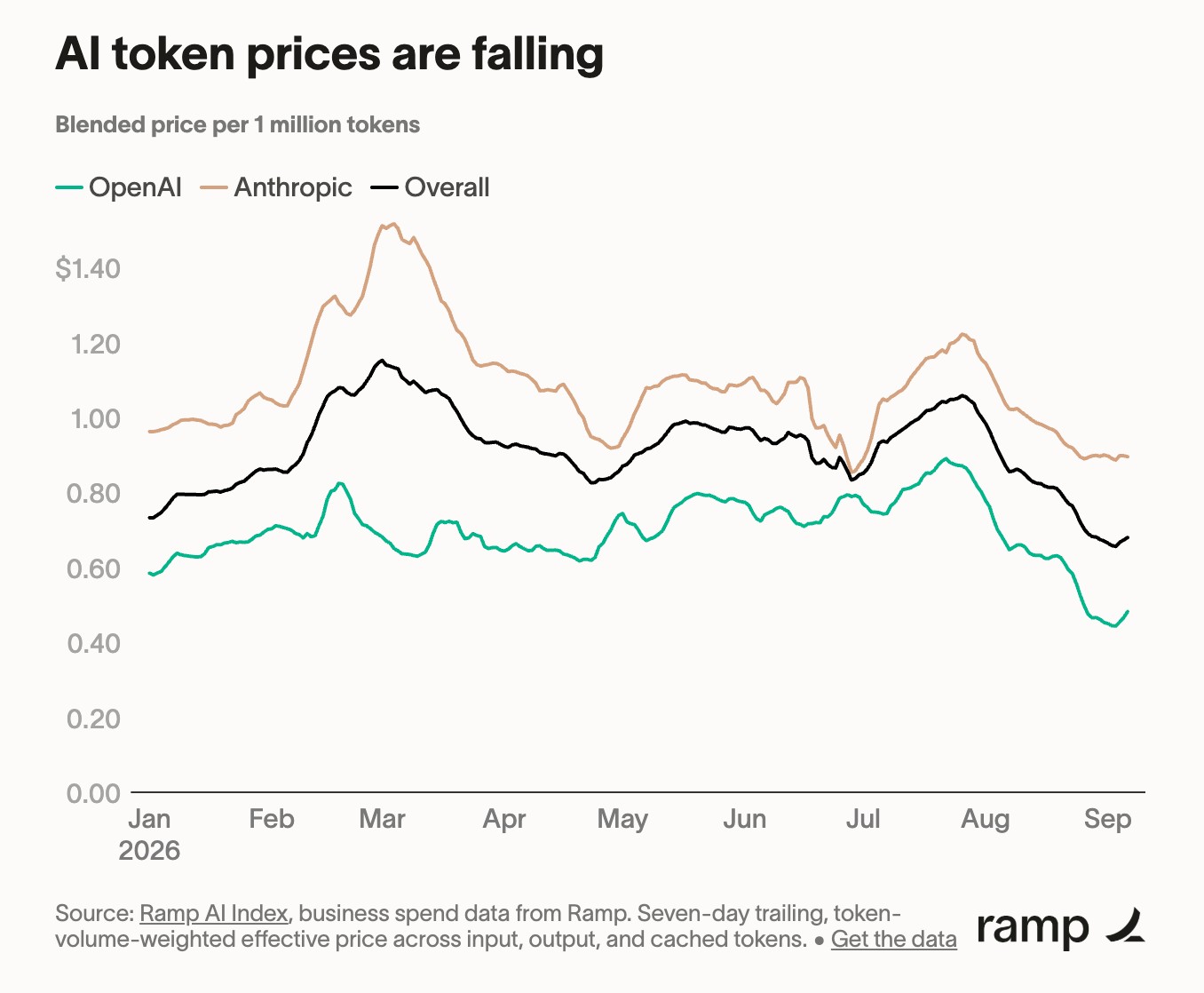
Business spending on AI went nearly flat in August. Payments company Ramp, whose data covers 70,000 companies, reports that 56% of its clients paid for an AI product last month, a gain of 0.4% over July. Among the 1% of companies that use AI most heavily, spending per employee fell almost 10%, to $7,205. The average price of a million tokens is now $0.68, down from a peak of $1.15 in March 2026, after price cuts by OpenAI and Anthropic. For labs and hyperscalers that have ordered a couple hundred billion dollars of chips against revenue they expect later, a flat month is not a rounding error.
This is not the first pause Ramp has recorded. Its AI index barely moved from August to October last year, then picked up again into the close of the year. August is also the month when a large part of the industry goes on holiday, and token usage goes with it.
The per-employee figure deserves care, because it counts dollars, not work done. Two very different things push it down: customers buying less, and the same purchase costing less.
The second is documented. Going from $1.15 to $0.68 is a decline of about 41%, though that runs over five months, while the 10% drop in heavy users' spending is a single month. The two numbers do not line up cleanly, and anyone treating one as the explanation for the other is guessing. Ramp's own reading is that the labs have not yet made up the price cuts in volume.
Source: techcrunch.com
The same incentive is pushing buyers down the model ladder. Many customers are picking older, cheaper releases, such as OpenAI's ChatGPT 5.6-Terra and Anthropic's Sonnet, over the more capable frontier versions the labs would rather sell. Staff at frontier labs have said that a large share of a model's training cost is earned back in the first weeks after release. That payback assumes a rush to the newest thing. Customers shopping the back catalogue break it.
One threat looks smaller than its share of the conversation. Despite the argument that open models undercut the frontier labs, only 6.4% of the companies spending on AI in August used model-serving and inference platforms. The share rises steadily, but not fast enough to bend the overall adoption curve.
Ramp's level also runs hot. A Census Bureau survey updated on 23 August put AI use at 22% of companies, against Ramp's 56%, a gap best explained by the technical profile of the companies that bank with Ramp. What Ramp has that the Census does not is spending, observed directly and close to real time, which makes it a usable leading indicator even when its absolute level is wrong.
My read is that the headline finding, adoption stalling, is the weaker half of this report. A 0.4% monthly gain in the same calendar window that went sideways last year is thin evidence of anything. The $7,205 is the number worth staring at. The top 1% are precisely the customers whose budgets were supposed to keep compounding, and they spent less in a month when prices were falling. That is the market running the experiment everyone has been arguing about: does a cheaper token buy proportionally more tokens? On Ramp's evidence so far, it does not.
Which points at the series nobody has published. Every figure here is denominated in dollars during a period of steep deflation, so the one measure that would settle the argument, tokens consumed rather than dollars spent, is absent. Falling spend under falling prices is consistent with demand collapsing and with demand growing briskly. Ramp cannot separate the two, and neither can anyone reading it.
Ara Kharazian, Ramp's economist, frames the price war as competition between OpenAI and Anthropic that makes AI cheaper and more available to companies, and notes that the interpretation depends on where a business sits: if you use AI, falling prices and falling bills are good news. That is the tension stated plainly. The discount that makes the buyer's year makes the seller's arithmetic harder, and the sellers placed the chip orders first.