

In August the heaviest corporate buyers of AI spent less on it per employee than they had the month before. Median spend inside the top 1% of companies fell 9.7% to $7,205, according to the September edition of Ramp's AI Index, which tracks what American businesses actually run through their corporate cards. Adoption itself kept widening over the same month: 43.8% of US companies paid for something from Anthropic, 39.8% for something from OpenAI. Breadth up, depth down — and the split arrives with Anthropic reportedly preparing an IPO filing for October.
The top 1% is the group that matters most to the model vendors, because it supplies the bulk of enterprise revenue. It is also the noisiest slice of Ramp's data: few companies sit in it, the estimate swings more than in other segments, and the report says the figure may be revised later.
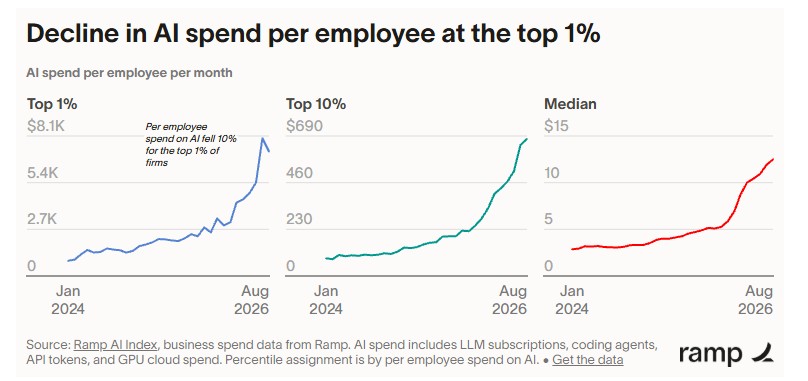
AI spend per employee at the 1 percent of companies with the highest spend fell by roughly 10 percent in August, while spend at the top 10 percent and the median continued to rise
Source: the-decoder.com
Ramp's chief economist Ara Kharazian attributes part of the drop to the calendar — August is when a lot of engineers take holiday. The rest he splits between two forces that cut in the same direction across different industries: token prices are falling, and companies are drifting toward cheaper models.
The price line is the easier one to see. Ramp puts the effective cost of a million tokens at $0.68, down 41% from its March 2026 peak. OpenAI and Anthropic have both announced fresh price cuts recently. Usage volume is rising, but Kharazian's point is that the increase may not be large enough to offset what each token now costs.
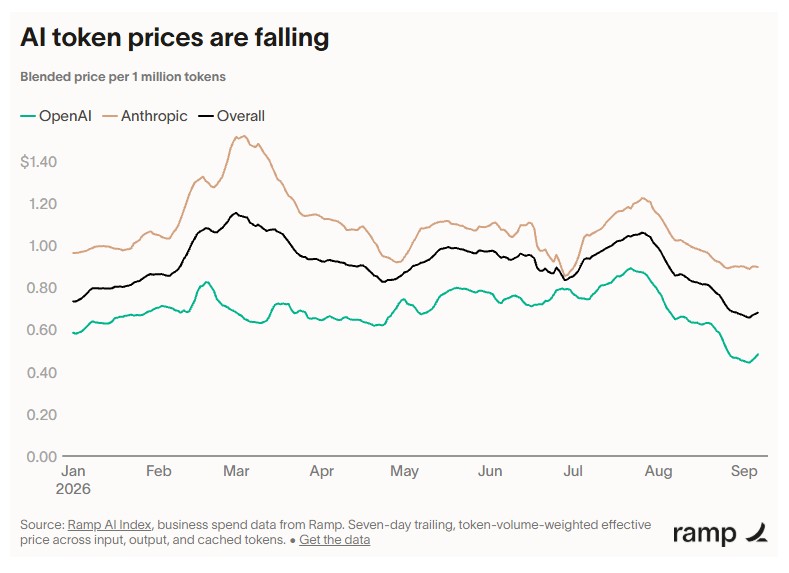
The effective price per million tokens has fallen 41 percent from its March 2026 peak, to 0.68 dollars. Throughout the period OpenAI has consistently been cheaper than Anthropic
Source: the-decoder.com
The mix shift is the more consequential half. Most of the volume growth is landing on cheaper standard models — GPT-5.6 Terra, Claude's Sonnet series — rather than on the frontier tier. Opus, Fable and Sol together accounted for 45% of all tokens consumed in early September, against 53% at the start of August. Eight points in a month is not drift; that is procurement. Kharazian says companies are writing internal rules that cap the use of expensive frontier models, and that standard models are increasingly judged good enough for production work at a visibly lower price.
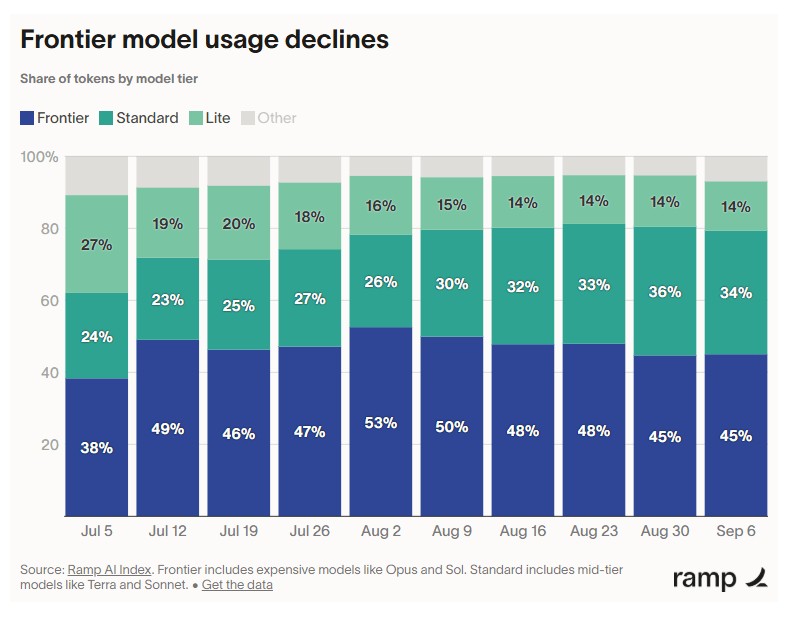
The token share of frontier models such as Opus and Sol fell from 53 percent at the start of August to 45 percent by the start of September, as standard and lite models increased their share
Source: the-decoder.com
What is not causing any of this is the open-model wave. Only 6.4% of AI-using companies on Ramp's platform run open models at all; across all companies the number is 3.6%. And Ramp measures through routing platforms that also serve closed models, so the true open-model share of usage is probably lower still. The Chinese-and-open-weights story, whatever it is doing to the discourse, is not what is pulling corporate AI budgets down.
That leaves the vendors as the authors of their own deflation. Prices fell because OpenAI and Anthropic cut them; the tier mix fell because both companies ship a cheap model good enough to cannibalise their expensive one. This is what a maturing software market looks like from the inside — customers learn which SKU they actually need — except that in this market the expensive SKU was the entire valuation argument. Last month Kharazian titled his report "Cracks in the AI thesis" and named weak uptake of Fable 5 and the slide to cheaper models as warning signs for suppliers. A second consecutive month pointing the same way is harder to file under seasonality, whatever August does to engineering headcount.
The more interesting question is one Ramp's own framing skirts. A 9.7% fall in median spend per employee tells you nothing about total dollars: if the same firms added seats faster than they cut per-seat spend, vendor revenue grew while this index fell. Ramp reports the ratio, not the aggregate, and the September release does not reconcile the two. Nor does it say whether the top 1% cut usage or simply bought the same work cheaper — which are opposite findings wearing the same number. The falling token price makes the second reading at least as plausible as the first, and Ramp does not choose.
Ramp sees only its own customers, a slice of the market. The next honest look at these numbers comes from Anthropic's IPO filing, reportedly due in October, where revenue per customer stops being an inference from card data and becomes an audited line. If enterprise revenue there is growing while spend per employee is falling, the thesis survives on seat expansion. If it is not, August was not a holiday.