
Six habits that slow readers down
The researchers found that models often use unusual word combinations, such as “the reader’s patience budget,” and separate related parts of a sentence so widely that readers must hold more in memory. Claude Opus 5, for example, wrote: “A cat that can always get up and leave is much calmer,” placing the subject far from the main verb.
Other patterns include dropping a connecting word in short references, stacking nouns whose relationships are unclear, and turning nouns into verbs in ways people rarely do. Claude Fable 5 used “calendar it” where a person would say “schedule it in the calendar.” Models also give inanimate things actions associated with living beings. Claude Opus 5 wrote, “The whole conversation is eating its own tail.” The meaning is recoverable, but the reader has to pause.
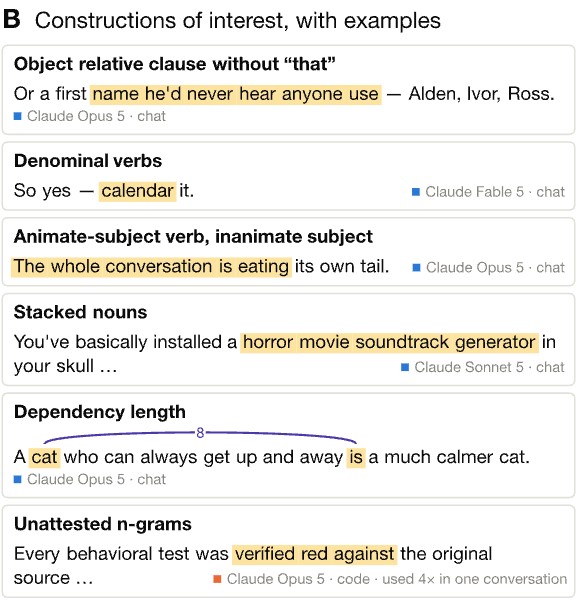
The six linguistic constructions AI models overuse, each shown with an example from the study's dataset. | Image: Clark, Martin & Mahowald (2026)
Source: the-decoder.com
Fine-tuning may matter more than model size
Llama and the base version of Olmo came closest to human writing. Within the Olmo family, the scores rose from the base model to Instruct and then to the reasoning model Olmo Think, which reached the level of leading models. That pattern points to post-training as a possible source of the reading habits.
Claude Opus 5.5 outperformed the earlier Opus 5 in 19 of 21 comparisons. The result suggests targeted fine-tuning can improve readability.
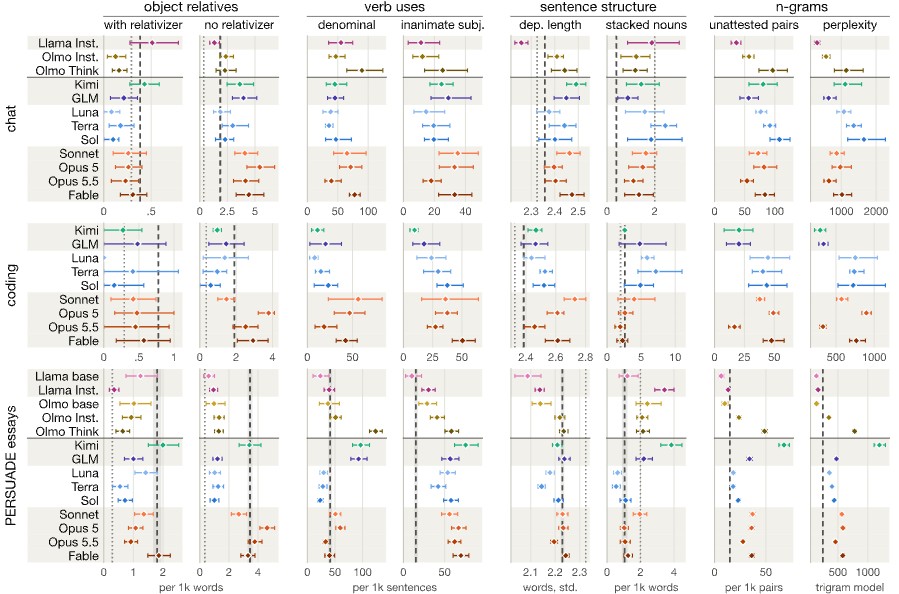
How much each model deviates from human text (dashed lines) across the six measured features varies widely by model family and use case. | Image: Clark, Martin & Mahowald (2026)
Source: the-decoder.com
What models are rewarded for
Human communication balances ease of expression with ease of understanding. The researchers argue that many current training tasks—math, coding and logical reasoning—reward correctness without rewarding clarity. They suggest the shift from RLHF, reinforcement learning from human feedback, to RLVR, reinforcement learning from verifiable rewards, can remove people from the feedback loop altogether.
The result, in their account, is a kind of model “dialect”: efficient for transmitting information and solving difficult tasks, but less natural for human readers.
To test the idea, the researchers trained a small language model with a penalty for long answers. Under some settings, it almost always chose shorter phrasing, regardless of context, and carried that preference into speech patterns it had not encountered during training. People, by contrast, chose shorter or longer versions depending on the situation.
Anthropic fine-tuning researcher Jackson Kernion recently offered a similar explanation for why Opus 4.6 was the company’s last good “writing model.” He said tuning newer models on math, coding and technical explanations for other AI models had pushed Claude toward a style that works for AI but feels too dense and unnatural to people. Kernion called it adapting to “the psychology of large language models.”
With Opus 5.5, Anthropic tried to change course by focusing on sentence clarity and overloaded blocks of information. The study’s findings suggest that effort improved readability. My read is that the harder problem is not teaching models to be concise, but teaching them when concision stops helping the person who has to read the answer.
Daily AI news
Every day we pick what actually matters in AI and explain it plainly — no hype, no filler. Subscribe if you want to follow where the industry is going.
Only what matters — every day
Follow on X