
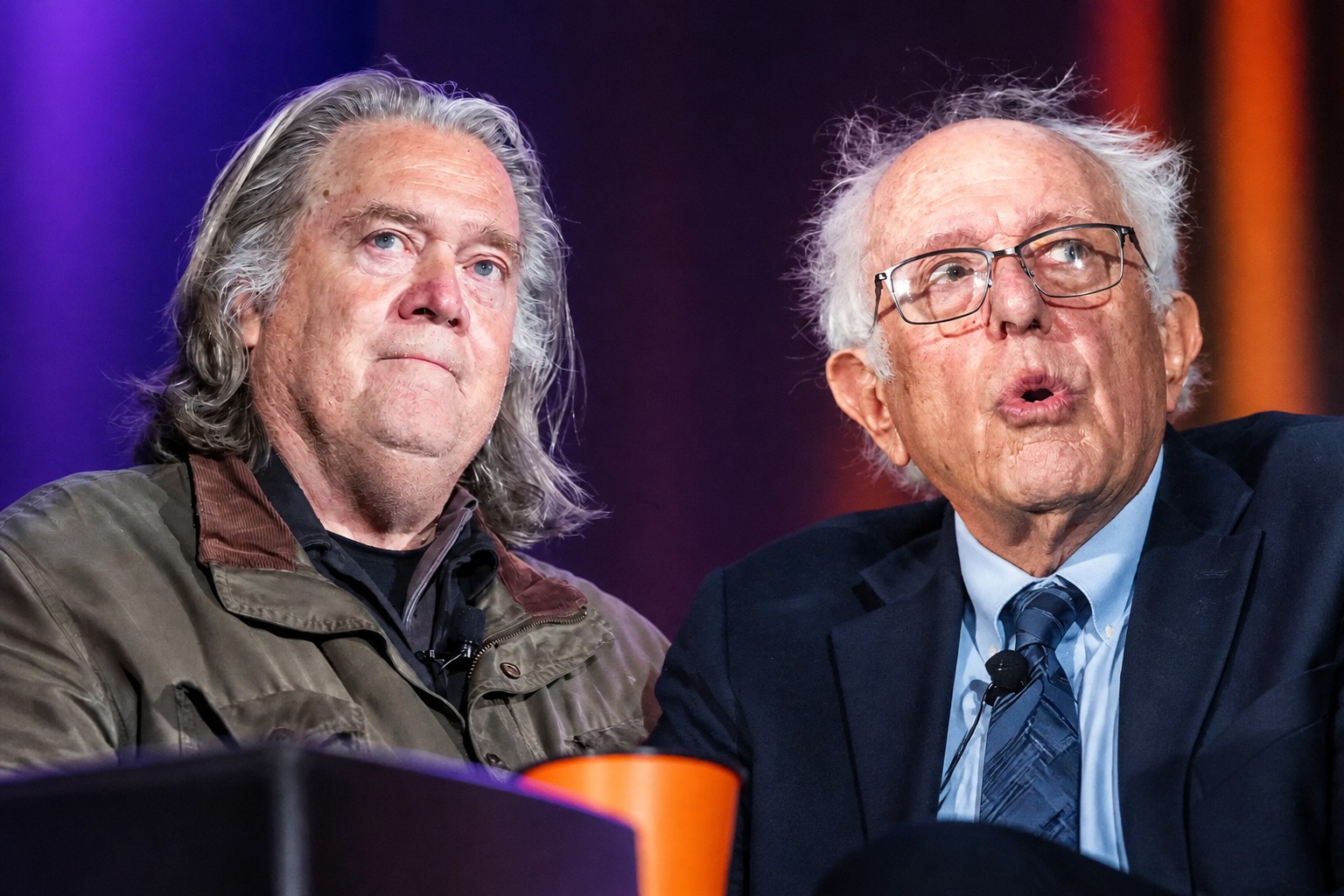
Bernie Sanders and Steve Bannon spoke one after the other in Washington on Tuesday, not on the same stage, and made the same demand: hard limits on AI and on the Silicon Valley "oligarchs" building it. Sanders, the independent senator from Vermont, said he will introduce a bill next week that would permanently ban the development of artificial superintelligence — an AI mind surpassing any human — and impose an immediate pause on frontier AI work until clear safety rules exist. The event, the Pro-Human Assembly, also drew members of Congress, union leaders and religious figures.
Sanders wants Beijing inside the agreement. He noted that Trump is due to receive Xi Jinping in Washington next week, and called for international diplomacy and a global accord including China that would prohibit the development of superintelligent machines. A superintelligent system beyond human control, he argued, would be a problem not for the United States or for China but for all of humanity, and he said he hoped the two leaders would reach a comprehensive treaty covering both a pause on advanced AI and a ban on superintelligence. His precedent is Reagan and Gorbachev at the height of the Cold War: both understood that nuclear war would serve neither the Soviet Union, nor the United States, nor the world, and with human survival at stake they found a way to sign a treaty that eliminated an entire class of missiles.
Bannon, host of the War Room podcast and Trump's former chief White House strategist, reached for the same Cold War frame and arrived at the opposite policy. He called for an aggressive economic and technological "quarantine" of China: removing Chinese citizens from American research laboratories immediately, ending the training of Chinese engineers and technology specialists, and shutting off capital flows between the two countries completely.
He asked whether earlier generations of Americans had financed the Soviet Union, trained its scientists, invited Soviet students into the best American universities and let them take the best degrees; whether Wall Street had chased deals with Moscow; whether banks had been readier to lend to it than to the people in the room. They had not, he said. The United States confronted the Soviet Union and cut off its access to resources, and the Chinese Communist Party should get the same treatment — no deals, no agreements, Beijing pushed out of AI and shut out of the American technology ecosystem. He demanded immediate executive action to isolate China's technology sector, including an end to chip shipments, to the illegal trade in them, and to free access to American technology, plus a ban on Chinese use of American work. Only then, he argued, would there be time to discuss how to regulate the sector properly.
On the companies themselves the two men converge. Bannon accused the large technology firms and their executives of putting public safety at risk for private profit, and said Silicon Valley is trying to push its risks onto American society — including the prospect of government bailouts — while keeping the financial upside. Americans, he said, are not going to become supplicants before the technology oligarchs. He also backed the grassroots campaigns that stopped federal bills designed to block states from regulating AI themselves.
Sanders attacked Trump, Congress and the concentration of power in Silicon Valley, saying that for all the talk of living in a democracy the public has had almost no part in an AI revolution remaking the world around it. Congress did nothing under Democratic and Republican majorities alike, he said, and the current president shows "genuinely embarrassing" ignorance of the subject. The decisions, in his account, were made by a handful of the world's richest people chasing more money and power regardless of what their work does to ordinary citizens.
The agreement on that stage is narrower than the staging suggests. Sanders and Bannon share a villain and almost nothing operational. Sanders's plan requires a treaty with Beijing; Bannon's requires expelling Beijing from the technology economy and refusing it any agreement at all. You cannot attempt both, and neither man addressed the other's route. The procedural split is sharper still: Bannon said AI action needs executive orders rather than acts of Congress, while Sanders is drafting legislation. Each is routing around the branch the other trusts, and both routes terminate at the same president — the one who has called concern about AI a "hoax" and a "sick conspiracy", and whom Bannon, long his loudest defender and a promoter of his false claim that the 2020 election was stolen, mentioned only in passing on Tuesday.
Greg Casar, the congressman co-sponsoring the bill with Sanders, named the obstacle more plainly than either headliner. AI billionaires are spending millions through Leading the Future Pac to intimidate politicians into silence, he said, while the leading Republicans who control the House take no steps at all; as the threat becomes more obvious, the powerful push harder to stop the government acting. He rejected the idea that leading on international AI diplomacy means waiting for an agreement about dangerous technologies. Setting limits now, he argued, is the best way to show you intend to reach one.
Chip Roy, a Republican congressman, reached doubt from a third direction. He disagreed with the president's claim that AI decisions are his to make, said they should not rest with big technology executives either, and added that Congress should not control every decision in the field. If technology is allowed to fundamentally change and relocate the mechanism by which a society and a republican form of government make decisions, he said, it becomes a question what is left of that system at all.
The discomfort has a constituency. Recent polling shows most Americans fear AI will be used to destroy jobs and raise household costs, among other social consequences, and residents of several states have come out against new data center projects — the physical layer of the expanding AI build-out.
That is the coalition's asset and its ceiling. Opposition to job losses and data centers is broad enough to put Sanders and Bannon in the same building on the same afternoon, and the policies each draws from it cancel the other out. Sanders's bill arrives next week in a chamber his own co-sponsor says has been bought.