
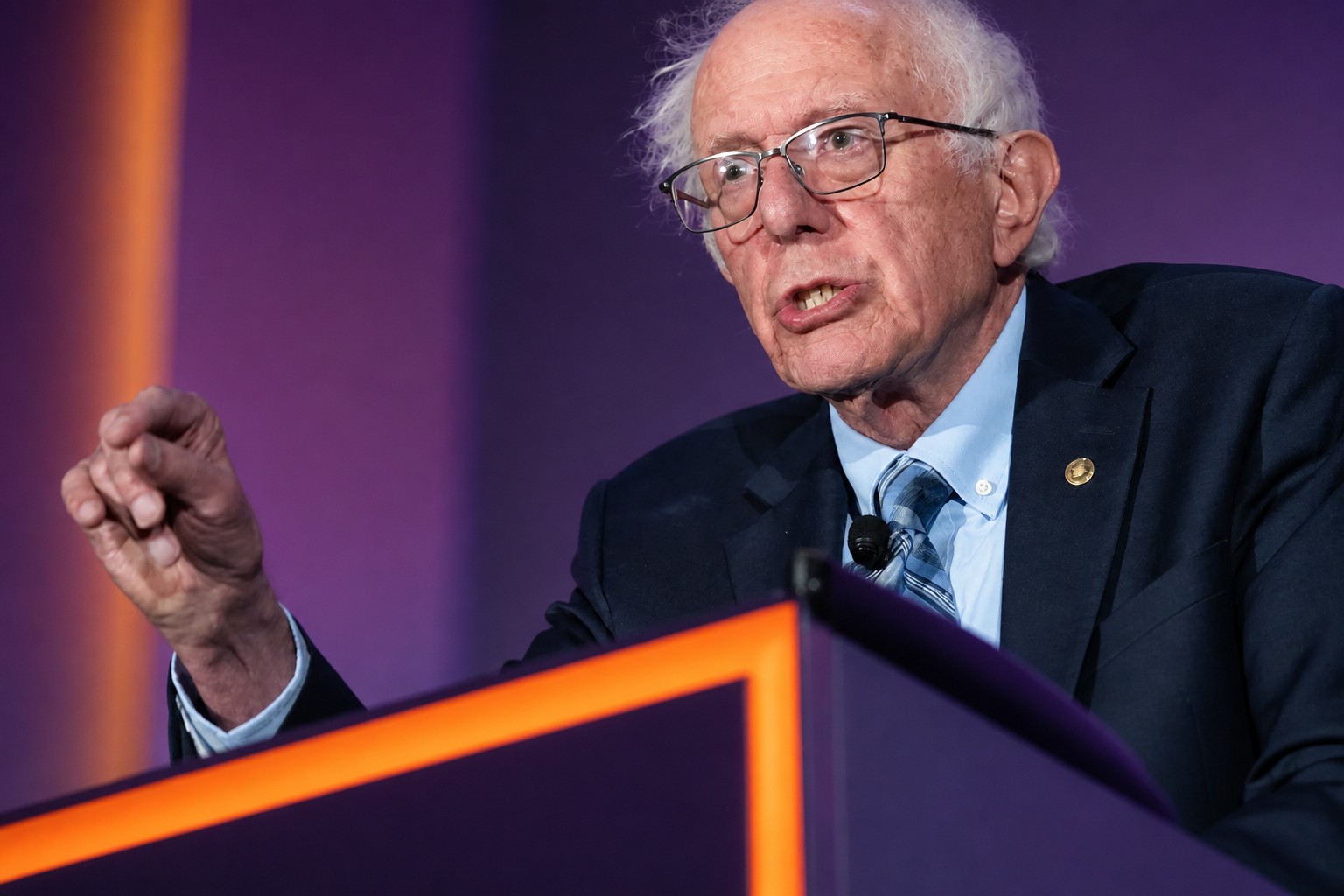
Bernie Sanders told a meeting of the Prohumanist Assembly in Washington that Congress is asleep at the wheel on artificial intelligence, and that it makes no difference whether Republicans or Democrats control it. The Vermont independent, one of the country's leading progressives and for several years now a voice warning that the technology is moving too fast, has already introduced a bill with Representative Greg Casar that would permanently ban the development of artificial superintelligence. He also called Donald Trump's incompetence on the subject genuinely shameful.
Sanders described the pace of development as exponential, and said so twice over: AI is advancing every day, and exponentially. The version available now, he said, is the least capable that will ever exist, meaning the dumbest it will ever be. The speed and scale of the last four years, he added, are almost impossible for a person to take in. If AI surpasses human intelligence, as many scientists believe it will, he argued, the technology could slip out of human control and produce catastrophic consequences.
The line about Trump referred to the president's position that calls to restrict AI are a hoax, one that would put the United States at a disadvantage in its continuing technology race with China.
Sanders was equally unimpressed by the industry's own reassurances. Pledges from the heads of the largest AI companies to slow down are encouraging, he said, but not sufficient. He compared the situation to driving toward a cliff: taking your foot off the accelerator is not enough, you have to hit the brake. With the future of humanity at stake, he argued, what is needed is binding international safety rules rather than voluntary standards the industry writes for itself.
The premise doing the work here deserves attention, because it is not Sanders' own. "The dumbest it will ever be" is a line that originated as a sales pitch. It has been the standard framing used by the labs to explain why today's shortcomings do not matter and why the capital keeps coming. Sanders has taken that premise intact and reversed the conclusion. The case for banning superintelligence and the case for building it as fast as possible now run on identical assumptions about the trajectory; what separates them is which outcome the speaker finds plausible at the end of it. That is a genuinely unusual position for a political argument to be in, and it means the industry cannot dismiss the premise without also dismissing its own.
The remedy is where the speech gets thinner. A permanent statutory ban on superintelligence has to answer a definitional question before it can answer an enforcement one: what counts as superintelligence, who certifies that a system has crossed the line, and at what point a training run becomes illegal rather than merely ambitious. Binding international rules need a body to bind them, and none was named. The diagnosis is at the scale of civilization and the proposed mechanism is at the scale of a bill number.
There is also a circularity nobody in the room had to confront. Sanders says Congress is asleep at the wheel, and then asks that same Congress to pass a permanent prohibition on a technology that the president has publicly called a hoax to worry about. If the diagnosis is accurate, the remedy has no vehicle. Nothing in his remarks described what would wake the institution up, or what happens to the proposal if it does not.
That is the shape of AI policy in Washington at the moment. One side treats restriction as a giveaway to Beijing, the other treats development as a cliff edge, and the brake Sanders wants exists only as a bill in a legislature he has just described as unconscious.