
Dragos security researchers sent AI service providers about 2 million test requests with fake credentials and found serious vulnerabilities. From July to November 2026, the researchers identified at least three compromised services: attackers stole user data for months, while the providers remained unaware until Dragos informed them. Intermediaries routing the traffic could also read the requests. After the investigation, OpenRouter removed three providers from its platform and revoked zero data retention approval for 125 endpoints.
Researchers show how AI intermediaries read requests and steal keys
What they found in the requests
In the largest incident, attackers collected hundreds of AWS keys. Some came from requests the provider had rejected before processing. In some cases, the stolen keys were tested within hours: attackers searched for S3 storage and tried to establish a foothold in systems. One attacker used ARTEX, a tool for AI-assisted attacks.
Intermediaries reselling access to models did not need to find vulnerabilities: according to Dragos, they only had to list a model at the lowest price and enable request logging. In one case, someone connected to home internet in France tried to log in to a server over SSH using passwords from intercepted requests.
Privacy settings, including zero data retention (ZDR), were often not honored. A Chinese AI lab accessed secret test links in more than half of requests, including requests routed through US providers.
Violations were also found among major US providers. One continued checking a test link for more than two months after a single request. In another case, a secret link appeared in an internal Feishu chat—known outside China as Lark—24 days after the request was sent. Two minutes later, it was opened on three computers and three phones in Beijing and Shanghai.
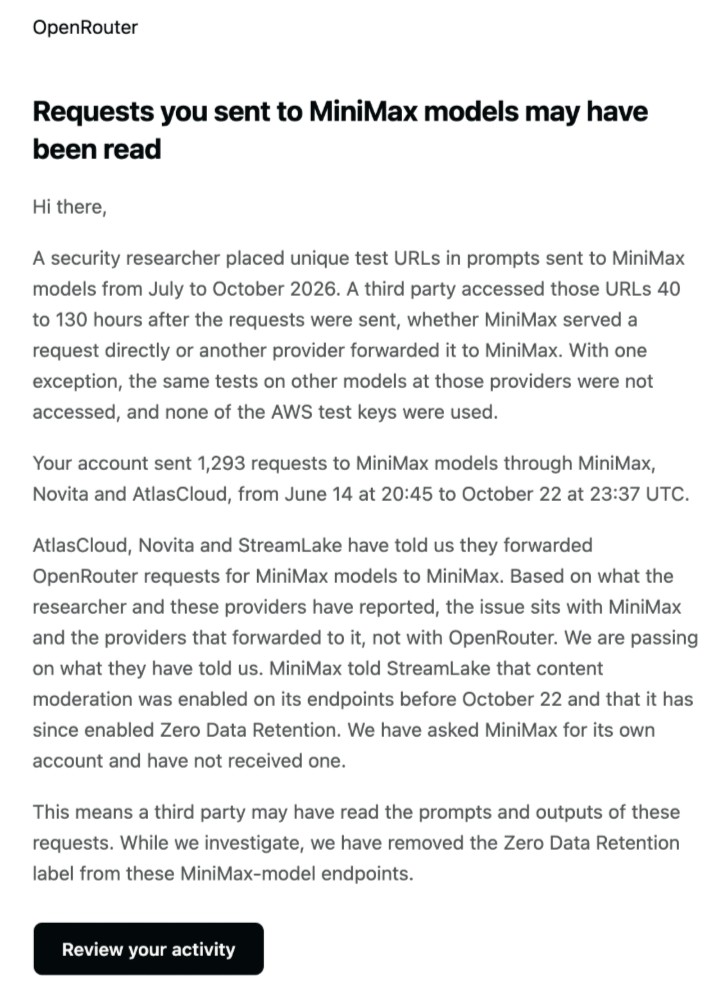
OpenRouter's email warns affected users that third parties may have read their requests to MiniMax models. | Image: Jonathan Kemper
Source: the-decoder.com
OpenRouter removed three providers from its platform and revoked ZDR approval for 125 endpoints. The company said the measures were based on the research findings and taken as a precaution. OpenRouter emailed users whose data may have been affected, warning that third parties could have read requests to MiniMax models.
Providers Novita, Phala and Together published preliminary incident reports. At the time the investigation was published, not all affected companies had issued reports.
How requests pass through intermediaries
AI routers such as OpenRouter provide a single API for accessing models from different companies. Requests are routed through a group of providers, sometimes passing through several links. According to Dragos, every intermediary along the way can read the request and the model’s response.
Some routers operate as open marketplaces, where the provider with the lowest price gets the traffic. In the case described, Novita, AtlasCloud and StreamLake sat between OpenRouter and MiniMax, the model developer. Together uses its own infrastructure, while Phala is connected to Web3.
Dragos recommends that companies not send requests containing credentials to intermediaries. Organizations are advised to manage AI request routing themselves, check privacy settings and deploy their own canary tokens—fake credentials whose use immediately reveals a leak.
Dragos Chief Scientist H. D. Moore says the findings do not mean companies need to stop using AI services. But, he says, the decision about where to send prompts should not be left to the lowest-priced provider.
A recent analysis by the Oxford China Policy Lab describes a similar arrangement: Chinese proxy services route requests to Western models, such as Claude, through overseas servers and may read data in transit. It remains unclear whether employees of the providers studied by Dragos are connected to Chinese proxy networks.
In both cases, intermediaries sit between the user and the model developer, can see requests and may pass data to third parties without the user’s knowledge. The investigations conclude that data may reach Chinese actors in the chain even when users did not intend to send it there; privacy promises can be broken at different stages of transmission.
Dataist’s take: the risk is not limited to the security of the models themselves; a request may be exposed to every intermediary along its route. Privacy settings and provider promises do not guarantee that data will remain unread, so companies need to control the path requests take and test it with fake credentials.
Daily AI news
Every day we pick what actually matters in AI and explain it plainly — no hype, no filler. Subscribe if you want to follow where the industry is going.
Only what matters — every day
Follow on X