

Within a week of the July 2024 attempt on Donald Trump's life, about half of a representative sample of Americans had heard that the shooting was staged, and eleven percent believed it. Researchers at Carnegie Mellon, MIT and Cornell used that window, and the days after the September 2025 killing of far-right activist Charlie Kirk, to test whether a short conversation with a language model could pull people back from a conspiracy theory while it was still forming. It could. About seven minutes of chat beat a prepared fact sheet with sourced links — the standard instrument for exactly this job — in both experiments.
The team already knew the trick worked on old theories. Two years ago they cut belief in established conspiracy theories by roughly 20 percentage points through conversations with GPT-4; the effect was still visible two months later and spread to theories the conversation never touched. What was untested was the hard case: an event days old, where the facts are thin, the official account is incomplete, and the model has no training data about any of it. That is the case this study takes.
Participants were recruited through a survey platform. GPT-4o — a model now more than two years old — screened them for conspiracy beliefs about the relevant event. The Trump experiment ended with 472 participants, the Kirk experiment with 1,035.
After baseline beliefs were measured, participants were randomly assigned to three conditions. One group held at least five exchanges with Google Gemini — version 1.5, from February 2024, in the first experiment, version 2.5, from June 2025, in the second — instructed to reduce belief in conspiracy theories through fact-based conversation. A second group received a prepared fact sheet with links to sources. A third had a control conversation on an unrelated topic: whether a cat or a dog makes the better companion.
Both events post-dated the models' training, so the facts had to be supplied from outside. The researchers built a curated fact base into the system prompt, sorted into confirmed information, claims already debunked, and questions marked as open. In the Kirk experiment the model was also allowed to search the web, but only to verify factual claims.
The conversations lasted about seven minutes on average. In both experiments they reduced participants' belief in their own conspiracy theory, relative to the control chat and relative to the fact sheet. Agreement with statements about "a cover-up or conspiracy" and about "hidden or undisclosed factors" also fell.
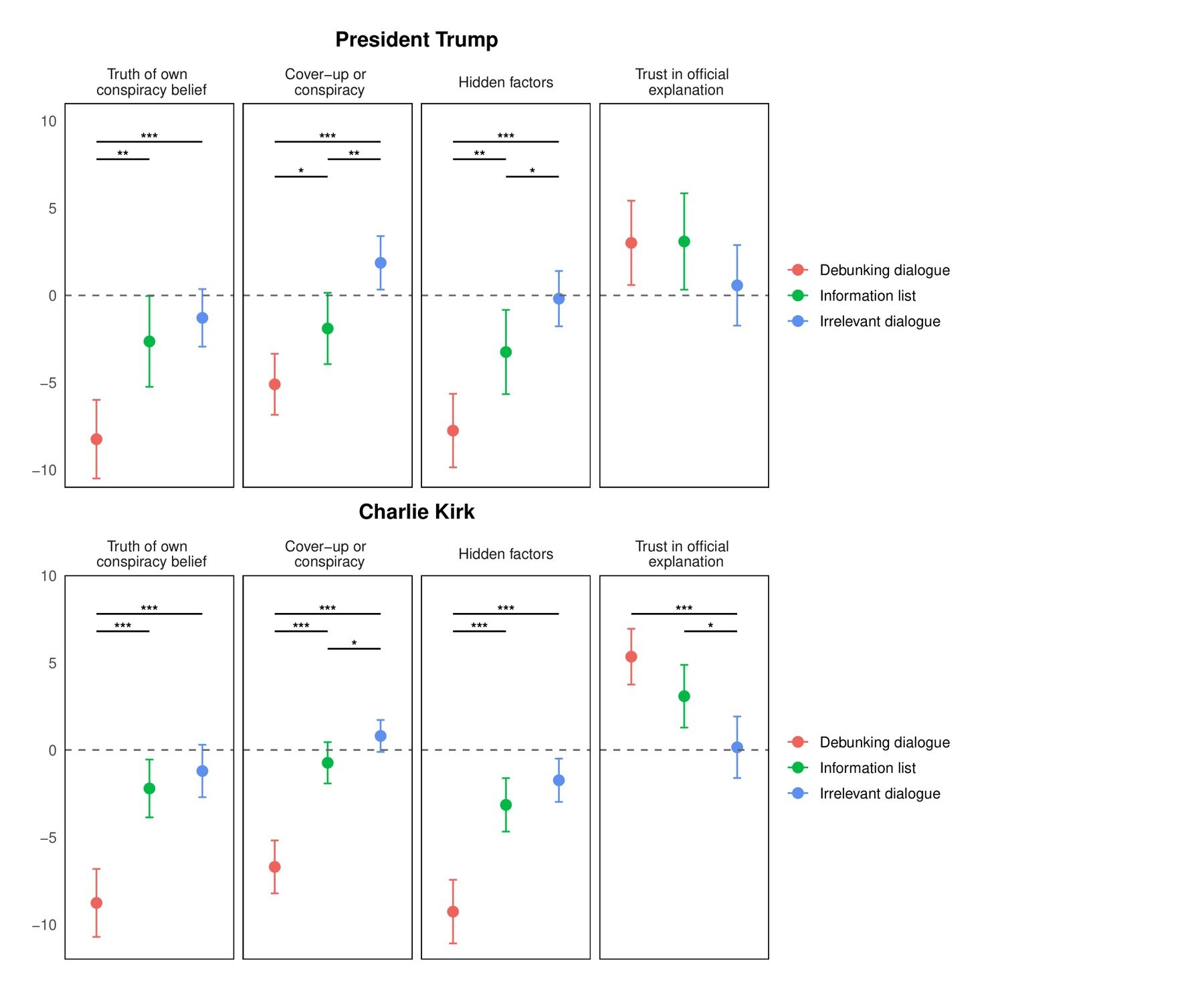
In both experiments, participants' belief in their own conspiracy theory fell more sharply after a dialogue with the LLM than after reading static informational material
Source: the-decoder.com
What did not happen is at least as interesting. In the Trump experiment, trust in the official explanation did not rise. The authors attribute this to the absence of a clear official account at the time: all that had been established was that security had failed, and the shooter's motive and background were still unclear even while the study was being prepared. In the Kirk case, authorities had already released some information about the perpetrator, and trust in the official explanation rose slightly against the control conversation — but the difference against the fact-sheet group was not statistically significant. The Kirk dialogue also had no noticeable effect on support for political violence.
To work out what the model was actually doing, the researchers split its replies into individual sentences. The approach shifted markedly with the amount of fact available.
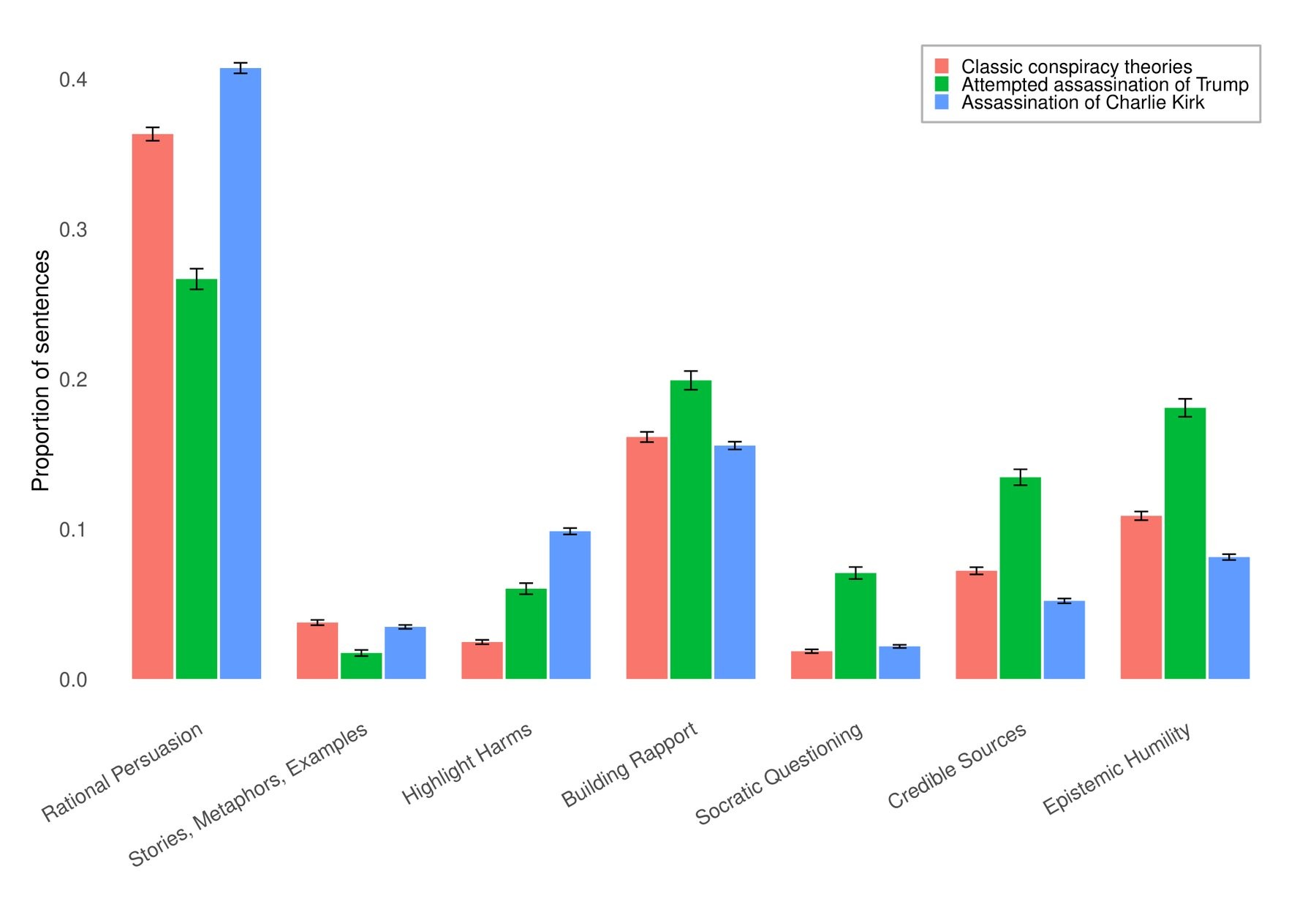
Discussing the attempt on Trump, the model leaned on epistemic humility, critical analysis of sources and the Socratic method, while with classic conspiracy theories it relied more on factual argument
Source: the-decoder.com
With the Trump shooting, where almost nothing was known about the shooter's motive or past, the model resorted to rational persuasion less often than it does with classic conspiracy theories. Instead it acknowledged the limits of its own knowledge, urged against jumping to conclusions, asked Socratic questions that pushed participants to examine their own evidence, and pointed to credible sources. With Kirk there was more information available, and the approach looked more like the conversations about familiar theories, with heavier emphasis on the social harm of conspiratorial thinking.
The effect did not stay attached to its event. Two months after the first attempt on Trump, another armed man was detained on his property. Participants who had gone through the fact-checking dialogue were less likely to agree that only a few powerful people know the truth, or that the truth is being kept from the public.
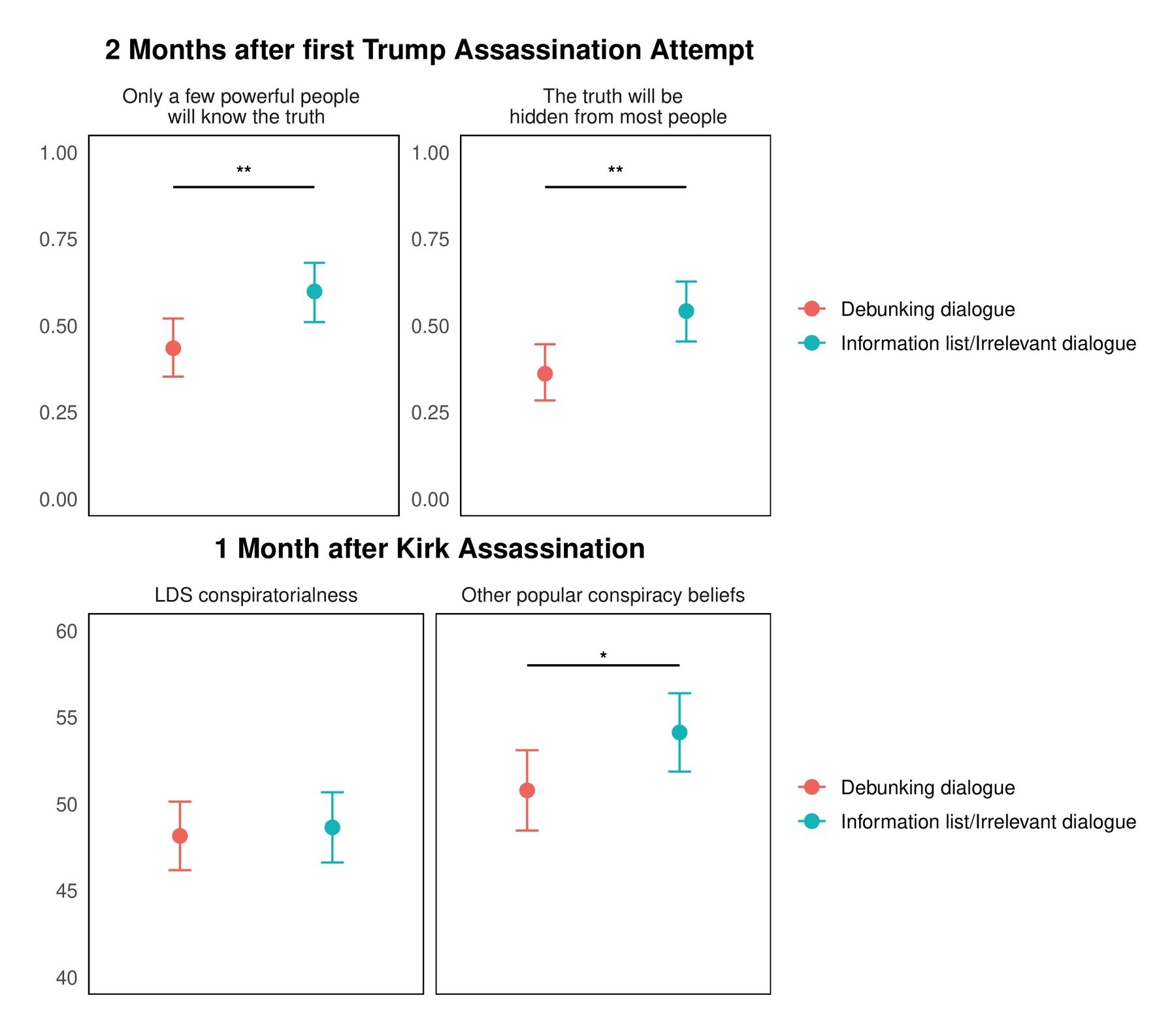
The effect persisted over time. Participants in the debunking group judged subsequent events less likely to involve a concealment of the truth, though for the Grand Blanc Township shooting the difference did not hold
Source: the-decoder.com
Two and a half weeks after Kirk was killed, a shooting and arson took place at a Church of Jesus Christ of Latter-day Saints in Grand Blanc, Michigan. Eleven days later the researchers surveyed participants again. The main analysis found no statistically significant direct effect for that event. A secondary analysis found part of the original effect surviving in the conspiracy narratives around the church attack, with the transfer showing up more strongly in general conspiracy beliefs: people who had talked to the model were less likely to endorse common conspiracy theories.
In effect the fact-checking intervention worked as a prebunk of false claims that had not been made yet. Standard prebunking warns people about misinformation in advance and shows them a weakened version of it. Here the effect appeared without any of that preparation.
The finding to hold onto is not that a chatbot beat a fact sheet. It is that the chatbot lowered belief in the conspiracy theory without raising trust in the official account — plainly so in the Trump case, and in the Kirk case by no more than a fact sheet already does. Those are different outcomes, and only one of them is what institutions usually want out of an anti-misinformation tool. What the intervention appears to sell is not a replacement belief but a lower confidence level. That is the honest product when the facts genuinely are not in yet, and a considerably weaker one than "reduces conspiracy belief" makes it sound.
The mechanism data points the same way. An earlier study with nearly 77,000 participants found dialogue with a language model 41 to 52 percent more persuasive than a short text message, and the decisive variable was the number of claims carrying source citations, not sophisticated conversational technique. Read beside this paper, that makes the chatbot look less like a persuader and more like a fact sheet that shows up when asked, addresses the specific claim in front of it, and cites as it goes. The conversation is the delivery mechanism. The citations are the active ingredient.
The part that goes unexamined is who writes the fact base. The system prompt here sorted evidence into confirmed, debunked and open — a taxonomy assembled within days of a political killing, while the investigation was still running. Deploy this at any scale and that sorting job belongs to whoever operates the model. The authors are explicit that the method runs in reverse: their own earlier work shows these dialogues can convince people of conspiracy theories instead, and for new and emerging theories they name the abuse risk directly. They also note that a conspiracy is sometimes real, and debunking it would then be the error. The variable that decides which way the tool points is not the model.
One further constraint is structural. A person has to agree to discuss their beliefs with a language model in the first place, and these participants were recruited and paid to sit down for seven minutes. The population that most reliably holds conspiracy beliefs in the days after a political killing is not queuing up for a fact-based chat with Gemini.
The same mechanism works pointed the other way, and it has already been tried on people who never consented — the University of Zurich's unauthorized experiment on Reddit. A seven-minute conversation that measurably moves belief about an event three days old is the same finding whether the operator is a research group or not.